
A question often prohibited, but always asked
Otto Dov Kulka’s writing considers how religious belief can exist in a world with no future. His answer comes in the form of a dream

‘Implicit in Otto Dov Kulka’s writing is the very disturbing question of whether he could have felt the safety he did in this sky without the yearning to escape from the horror that surrounded him below.’
One part of the immense distance that separates Gentiles from the Jewish experience of Auschwitz is the role of God there. Of course many atheists and many Christians died there, along with people who had believed in humanity and in the future. But there is a peculiar quality of claustrophobic horror in Jewish reflections on the matter, for they are the chosen people whose whole history is of wrangling with God; yet an omnipotent God singled them out for this dreadful fate. If we disregard the frankly disgusting suggestion that they deserved it, there is no explanation possible and certainly not one that does not sound glib. Yet that does not stop the conversation.
Otto Dov Kulka approaches this in two ways. The first is so indirect as to leave almost no traces. He talks about beauty: the most beautiful and innocent experience of his childhood, he says, was watching the skies of southern Poland where “silver-coloured toy aeroplanes carrying greetings from distant worlds pass slowly across the azure skies while around them explode what look like white bubbles. The aeroplanes pass by and the skies remain blue and lovely, and far off, far off on that clear summer day, distant blue hills as though not of this world make their presence felt.”
Yet these were seen from inside the camp. “I took in nothing but that beauty and those colours, and so they have remained imprinted in my memory. This contrast is an integral element of the black columns that are swallowed up in the crematoria, the barbed-wire fences that are stretched tight all around by the concrete pillars. But in that experience all this seemingly did not exist, only in the background and not consciously.”
Implicit in this is the very disturbing question of whether he could have felt the safety he did in this sky without the yearning to escape from the horror that surrounded him below.
This sense of almost entering something just out of reach seems a central religious experience. It is connected with George Santayana‘s claim that “another world to live in – whether we expect ever to pass wholly over into it or no – is what we mean by having a religion.”
Against that, Kulka stresses over and over again the inescapable, totalitarian quality of Auschwitz. It was a world in which the future was completely absent, where any other world became impossible. That is one of the things that he means by “the immutable law of the Great Death”.
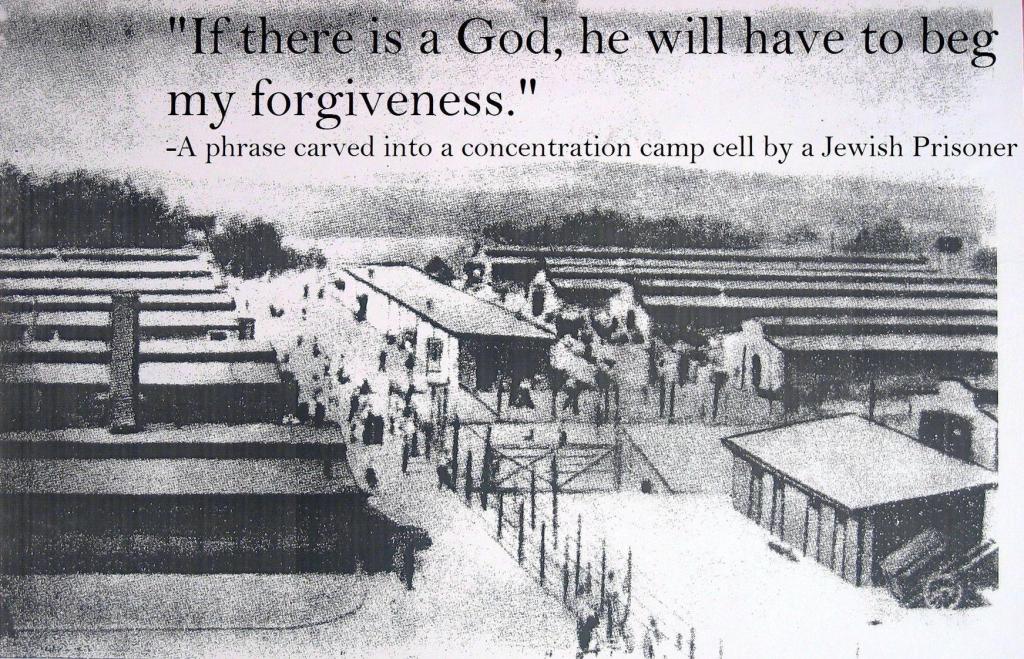
So religious belief, or even religious experience, becomes impossible in a way that is more profound than even the obvious and overwhelming fact of the suffering of innocents in the extermination camps. Where was God there? Because the question is unanswerable, some religious authorities pronounce it is forbidden to ask it: Kulka quotes two people saying that, one of them who was actually in the camp as a Sonderkommando, whose reply was: “It is forbidden to ask that question, those questions, there, and unto eternity.” It will be seen that this isn’t an answer.
The answer Kulka offers is a dream he had more than 50 years after the event, when Israel was braced for a chemical attack in the Gulf war. He dreamed then he was inside crematorium number 2, and there was God, also: “At first I felt Him (only) as a kind of mysterious radiation of pain, flowing at me from the dark void in the unlit part of the cremation ovens. A radiation of insupportably intense pain, sharp and dull alike. Afterwards He began to take the shape of a kind of huge embryo, shrunk with pain … He was alive, shrunken, hunched forward with searing pain … a figure on the scale of His creatures, in the form of a human being who came and was there … as a response to ‘the question they were forbidden to ask there’, but was asked and floated in that dark air.”
Even more than most dreams, this cannot have its meaning pinned down. It works like the Gate of the Law in the Kafka story: it is open for everyone but individual to each of us. The atheist might see in it that God is no more than the quintessence of humanity. It is not one answer but many, none of them sufficient. All it unarguably shows is that the question of God keeps being asked, no matter how often it is prohibited.

 Milo
Milo 