
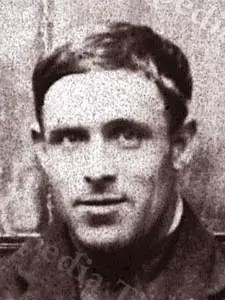
Mr George Henry Cavell was born in Southampton, Hampshire, England on 4 December 1889.
His parents were George Henry Cavell (1863-1927), a marine fireman, and Alice Florence Purkiss (1865-1945), both Hampshire natives who had married in Southampton in 1888.
One of a reported thirteen children, his only known siblings were: Ellen Jane (1884-1959, later Mrs Alfred Mainer), Rose Mathilda (1886-1907), Alice Florence (b. 1887), Lily Elizabeth (b. 1895), Alice Maud (b. 1898) and Frederick Ernest (b. 1901).
Cavell first appears on the 1891 census living with his family at 28 Chapel Street, St Mary, Southampton and by the time of the 1901 census the family were living at 25 Chantry Road, Southampton and his father was by then described as a general labourer.
The family had moved to 46 Russell Street in the same city by the time of the 1911 census although George is absent from the household and was listed elsewhere at Bermuda House.
George, who was unmarried, signed on to the Titanic on 6 April 1912, giving his address as Lower East Road, Sholing. He had previously served on Adriatic, Oceanic, and Olympic, before joining the Titanic and had worked with the White Star Line for eighteen months by that point.
On the evening of 14 April Cavell was on the 8 to 12 watch, and was alone in the starboard coal bunker in boiler room 4 at the time of the collision. He felt a shock and the piles of coal around him collapsed, covering him and from which he had a job freeing himself. Hearing warning bells that the watertight doors were closing, Cavell then managed to get into the stokehold but upon arriving he was surprised by the lights suddenly extinguishing. He then left the stokehold via an escape ladder to fetch lamps and went to Scotland Road where he saw steerage passengers heading aft, many wet through and clinging to lifebelts, being told to remain calm by stewards; it was here he ascertained from a colleague that the ship had struck an iceberg.
He fetched the lamps and returned to the stokehold but by the time he had returned the lights had come back on and he received orders to start drawing the fires. Whilst doing this water started to flood through the floor plates which rose about a foot before Cavell left his station and returned to Scotland Road but found it deserted. Believing that there was no danger Cavell briefly returned to boiler room 4 but found it deserted. He again made his way up top where he went to the aft boat deck.
Upon reaching the aft starboard boat deck Cavell noted that there were still a few lifeboats remaining; one was still hanging in the davits (#15) whilst the other was being lowered (#13) and the only people on deck where a handful of firemen and the crew lowering the boat, including an unidentified officer. The officer ordered Cavell and the other firemen into lifeboat 15 and it was lowered flush with A-deck to receive passengers but only five came forward. Boat 15 was then lowered again to become flush with B-deck and calls for more passengers was met with a large crowd of third-class passengers appearing and gathering around, which Cavell estimated to be around sixty in total and what he believed to be all women and children and with a few men standing back. He also noted that the majority of the crowd seemed to be Irish women.
With lifeboat 15 heavily laden with an estimated 70 survivors aboard, fireman Frank Dymond took charge.
Cavell was called to testify at the British Inquiry on 9 May 1912 and received expenses of £11, 6s.
George returned to the sea, serving on ships including the Olympic, Braemar Castle, Carnarvon Castle, Armadale Castle, Warwick Castle and Rothesay Castle and continued to serve in the merchant service throughout the duration of WWI.
He was married in Southampton in 1919 to Kate Elizabeth Barber (b. 7 January 1885); the couple would have no children.
Cavell later left the sea and worked as a fitter’s mate; by the time of the 1939 register he and his wife were residents of 2, The Popes Buildings in Southampton.
George Henry Cavell died in Winchester, Hampshire on 21 July 1966, his wife Kate Elizabeth died 11 November 1967 and they are both buried together in Hollybrook Cemetery Southampton (section L16, plot 46, possibly an unmarked grave).
George Henry Cavell signed up to serve on the new ocean liner Titanic on her maiden voyage. On the evening of April 14, 1912, George was assigned to the coal bunker, and was alone when that great ship hit the iceberg. He worked with the crew to secure the ship as best they could, but then was ordered by an officer into a lifeboat.
One of the passengers aboard the Titanic was a man named John Harper, a Baptist pastor from Scotland who was on his way to Chicago to preach a series of revival meetings—his second trip to do so. He did not make it into a lifeboat, and he was one of the hundreds of people who drowned that night. Before he died, however, he spent his final moments urging people to come to Christ. Anytime someone drifted close to where he was, he would ask them, “Are you saved?”
George Henry Cavell replied from a lifeboat, “No,” to which Harper shouted above the noise the words of Acts 16:31, “Believe on the Lord Jesus Christ and thou shalt be saved.” Harper drifted away. Later, Harper drifted back within sight of the lifeboat. From the frigid water, once more the dying Harper shouted the question, “Are you saved?” Once again he received the answer, “No.” Harper repeated the words of Acts 16:31, “Believe on the Lord Jesus Christ and thou shalt be saved,” before he drifted away again.
The frigid water of the North Atlantic took John Harper’s life, and his body was never recovered. But George put his faith in Jesus Christ.
Later he was rescued by the lifeboats of the S.S. Carpathia. In Hamilton, Ontario, George Henry Cavell testified that he was John Harper’s last convert. With his dying breaths John Harper was urging people to come to Christ, because he knew there wasn’t much time; that was the last opportunity for many of them.
Without being too dramatic, the truth is that none of us knows when our last opportunity has arrived. So allow me to ask: “Are you saved?”
If the answer is “No,” or you do not know how to answer that question, please pay attention to the words of Acts 16:31 as if your life depended on it–because it does. “Believe on the Lord Jesus Christ and thou shalt be saved.”
 Milo
Milo 