“Thou couldst have no power at all against me, except it were given thee from above.” (John 19:11.)
NOTHING that is not God’s will can come into the life of one who trusts and obeys God. This fact is enough to make our life one of ceaseless thanksgiving and joy. For “God’s will is the one hopeful, glad, and glorious thing in the world”; and it is working in the omnipotence for us all the time, with nothing to prevent it if we are surrendered and believing. One who was passing through deep waters of affliction wrote to a friend: “Is it not a glorious thing to know that, no difference how unjust a thing may be, or how absolutely it may seem to be from Satan, by the time it reaches us it is God’s will for us, and will work for good to us? For all things work together for good to us who love God. And even of the betrayal, Christ said, “The cup which my Father gave me, shall I not drink it?” We live charmed lives if we are living in the center of God’s will. All the attacks that Satan, through others’ sin, can hurl against us are not only powerless to harm us, but are turned into blessings on the way.—H. W. S.
In the center of the circle
  Of the Will of God I stand:
There can come no second causes,
  All must come from His dear hand.
All is well! for ’tis my Father
  Who my life hath planned.

Shall I pass through waves of sorrow?
  Then I know it will be best;
Though I cannot tell the reason,
  I can trust, and so am blest.
God is Love, and God is faithful,
  So in perfect Peace I rest.

With the shade and with the sunshine,
  With the joy and with the pain,
Lord, I trust Thee! both are needed,
  Each Thy wayward child to train,
Earthly loss, did we but know it,
  Often means our heavenly gain.
‘O send out thy light and thy truth: let them lead me; let them bring me unto thy holy hill, and to thy tabernacles.’ Psalm 43:3 SUGGESTED FURTHER READING: John 7:37–44
What is expressed: every word is emphatical and full of meaning. Send forth. From whence? From Jesus. He is the Fountain, the Sun, the Treasury of all grace. This sending forth is the fruit of his intercession. He has received gifts, even the Holy Spirit, to teach, comfort and seal every seeking soul. Thy light. All light and knowledge is from God, but natural and common light, the light of reason, books, or education, will not do—therefore the soul prays thy light, that which is peculiarly thine, and which none partake of but by special favour. Light signifies knowledge, as in Psalm 119:130, and comfort, as in Micah 7:9. Both these, the heart which God has touched seeks from him alone. And thy truth. This is already revealed or sent forth in the Word, but the meaning of the prayer is that the promises, which are true in themselves, may be sent forth in their power and sweetness and applied to the heart. Two things the soul wants to know of God’s truths: their extensive meaning and fullness and its own interest in them.
FOR MEDITATION: I labour under a thousand difficulties in my ways to goodness, my heart is wicked and deceitful, my affections corrupted, my hopes and fears misplaced, and all my faculties unhappily bent toward evil; the world, the flesh and the devil in many different forms and circumstances strive to draw me from my duty. These things are to me insuperable but they are not so to thee. If thou but speak the word, all obstacles shall vanish. That powerful word which cleansed the lepers and raised the dead can in one moment purge my soul from all the defilements it has contracted and raise me up to newness of life. Lord I believe, help thou mine unbelief, for thy name’s sake, for thy promise’ sake, for the sake of that precious sacrifice thou didst once offer up for all. Diary, 1 July 1752
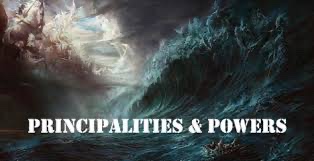
The phrase principalities and powers occurs six times in the Bible, always in the King James Version and its derivatives (NKJV, MKJV). Other versions translate it variously as “rulers and authorities,” “forces and authorities,” and “rulers and powers.” In most places where the phrase appears, the contexts make it clear that it refers to the vast array of evil and malicious spirits who make war against the people of God. The principalities and powers of Satan are usually in view here, beings that wield power in the unseen realms to oppose everything and everyone that is of God.
The first mention of principalities and powers is in Romans 8:37–39: “No, in all these things we are more than conquerors through him who loved us. For I am convinced that neither death nor life, neither angels nor demons, neither the present nor the future, nor any powers, neither height nor depth, nor anything else in all creation, will be able to separate us from the love of God that is in Christ Jesus our Lord.” These verses are about the victory Christ has won over all the forces ranged against us. We are “more than conquerors” because no force—not life, not death, not angels, not demons, indeed nothing—can separate us from the love of God. The “powers” referred to here are those with miraculous powers, whether false teachers and prophets or the very demonic entities that empower them. What is clear is that, whoever they are, they cannot separate us from the love of God. Victory is assured. It would be unfortunate to dwell on identifying the powers and miss the main thrust of the verse, which is assurance about what God has done to save us.
Another mention of principalities and powers is in Colossians 1:16, “For by him all things were created: things in heaven and on earth, visible and invisible, whether thrones or powers or rulers or authorities; all things were created by him and for him.” Here is the clear statement that God is the Creator and Ruler over all authorities, whether they submit to Him or rebel against Him. Whatever power the evil forces possess, they are not out of the ultimate control of our sovereign God, who uses even the wicked for bringing about His perfect plan and purpose (Daniel 4:35; Isaiah 46:10–11).
In the next chapter of Colossians, we read about Jesus’ ultimate power over all other powers: “And having disarmed the powers and authorities, he made a public spectacle of them, triumphing over them by the cross” (Colossians 2:15). In keeping with all things, the powers are created by Christ and therefore under His control. They are not to be feared, for they have been disarmed by the cross. The Savior, by His death, took dominion from them, and took back what they had captured. Satan and his legions had invaded the earth and drawn mankind into captivity, subjecting them to their evil reign. But Christ, by His death, subdued the invaders and recaptured those who had been vanquished. Colossians 2:14 speaks of Jesus being nailed to the cross along with the written charges against us. The record of our wrongdoing, with which Satan accuses us before God, is nailed with Christ to the cross. It is thereby destroyed, and the powers can no longer accuse us; we are innocent in the eyes of God. Hence, they are disarmed.
Ephesians 3:10–11 presents different principalities and powers—those of the heavenly realms: “His intent was that now, through the church, the manifold wisdom of God should be made known to the rulers and authorities in the heavenly realms, according to his eternal purpose which he accomplished in Christ Jesus our Lord.” Here we see the angelic hosts being shown the wisdom and purpose of God in the plan of salvation through Christ. Angels, both holy and unholy, witness the glory of God and the preeminence of Christ above all creatures in the church, those who are saved and preserved by His power (Ephesians 1:20–21).
Ephesians 6:12 declares the warfare in which we are engaged as we battle throughout our lives “against the rulers, against the authorities, against the powers of this dark world and against the spiritual forces of evil in the heavenly realms.” So, having been saved, we must continue to struggle to do good things in light of the sure victory promised in Romans 8. It is as though we are facing an army of dark powers who have been disarmed from real power and against whom we have been promised victory. It is our job to demonstrate and depend upon the wisdom and power of God in defeating them in our lives. We can do this by trusting in God’s victory.
The final reference to principalities and powers is Titus 3:1. Here they refer to those governmental authorities whom God has placed over us for our protection and welfare. They are God’s representatives on earth, and submission to Him involves submission to His duly constituted authorities. Those who rebel against earthly authorities are “rebelling against what God has instituted, and those who do so will bring judgment on themselves” (Romans 13:2).
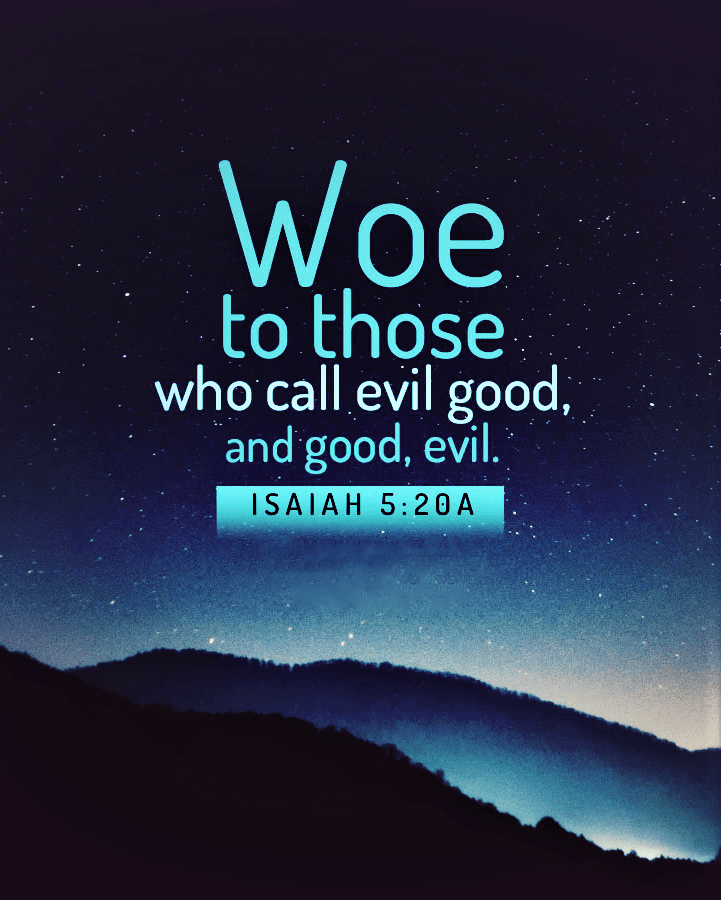
In Isaiah 5:8–30, the prophet pronounces “woes” or judgments on Judah for their wicked behavior. Judah had produced the “bad fruit” of unrighteousness, as illustrated in the song of the vineyard (verses 4–7). Their wickedness even led them to proclaim sinful things as good, which is why Isaiah exclaims, “Woe to those who call evil good and good evil, who put darkness for light and light for darkness, who put bitter for sweet and sweet for bitter” (verse 20). Light and darkness are opposites, which adds to the gravity of the men of Judah calling evil “good.”
A major problem in Judah during Isaiah’s time was widespread drunkenness. People would wake up early in the morning to drink alcohol and continue long into the night (Isaiah 5:11). Instead of respecting “the deeds of the Lord,” they reveled in their sin and drunkenness (verses 11–12). They did not see their sin as wickedness; rather, they called their evil “good.”
A world in rebellion against God will have a skewed perspective and embrace a topsy-turvy morality. There are many people today who still call evil “good” and good “evil,” as they promote behaviors that the Bible specifically calls sinful. The celebration of homosexuality and the defense of abortion on demand are usually accompanied by a mockery of those who value life and promote traditional marriage. Evil is being called “good,” and good is slandered as “evil.”
Apart from God, our value system will always become jumbled. We will begin to confuse sweetness and bitterness, light and darkness, and good and evil. We will label biblical morality as “intolerant” and “oppressive.” We will take offense at the truth that Jesus is the only way to salvation (John 14:6). “Light has come into the world, but people loved darkness instead of light because their deeds were evil” (John 3:20).
Calling good “evil” and evil “good” is a sure sign of spiritual wickedness at work: “The god of this age has blinded the minds of unbelievers, so that they cannot see the light of the gospel that displays the glory of Christ, who is the image of God” (2 Corinthians 4:4). Paul warns that the intensity of the spiritual battle will increase: “There will be terrible times in the last days. People will be lovers of themselves, lovers of money, boastful, proud, abusive, disobedient to their parents, ungrateful, unholy, without love, unforgiving, slanderous, without self-control, brutal, not lovers of the good, treacherous, rash, conceited, lovers of pleasure rather than lovers of God—having a form of godliness but denying its power. Have nothing to do with such people” (2 Timothy 3:1–5).
Cutting through the confusion over right and wrong and enlightening spiritually darkened minds is the Bible: “I gain understanding from your precepts. . . . Your word is a lamp for my feet, a light on my path” (Psalm 119:104–105). In their fallen condition, humans cannot accurately determine what is right and wrong. Only God can give definitive answers on good and evil. The Bible is “God-breathed,” the only certain source in providing guidance to mankind (2 Timothy 3:16).
The biblical account of Noah begins in Genesis 6. Approximately 1,600 years had passed since the creation of Adam and Eve (Genesis 1:26–27). As the earth’s population exploded in number, it also exploded with evil. Long forgotten was the righteous sacrifice of Abel (Genesis 4:4) as “the Lord saw that the wickedness of man was great in the earth, and that every intention of the thoughts of his heart was only evil continually” (Genesis 6:5). Verses 11 and 12 say, “Now the earth was corrupt in God’s sight, and the earth was filled with violence. And God saw the earth, and behold, it was corrupt, for all flesh had corrupted their way on the earth.” However, “Noah found favor in the eyes of the Lord” (verse 8).
When Jesus described the events that will surround His second coming, He said, “Just as it was in the days of Noah, so will it be in the days of the Son of Man. They were eating and drinking and marrying and being given in marriage, until the day when Noah entered the ark, and the flood came and destroyed them all” (Luke 17:26–27). Jesus was pointing out that, although the people of Noah’s day were totally depraved, they were not the least bit concerned about it. They were carrying on the events of their lives without a single thought of the judgment of God. Noah is described as a “preacher of righteousness” (2 Peter 2:5), meaning he had spent years warning his friends and neighbors what the Holy God was about to do. No one listened.
The depravity and ungodly lifestyles of the entire world at that time were enough to cause the Lord to “regret that He had made man” (Genesis 6:6). Many scholars believe that part of the need to destroy every human being except Noah and his family was the sin mentioned in Genesis 6:1–4, when “the Nephilim were on the earth in those days, and also afterward, when the sons of God came in to the daughters of men, and they bore children to them.” As evil reproduced and overtook the world, the most merciful act God could perform was to start over.
It is interesting that God allowed Noah nearly one hundred years to complete the building of the ark. Through all that time, God patiently waited (1 Peter 3:20). Scripture seems to imply that Noah preached to the people of that time about what was coming (Hebrews 11:7). They did not believe Noah and were content with their wickedness and idolatry. Their hearts were hard and their ears dull. No one repented, and no one cared to seek God.
Jesus said that the world will be much the same before He returns to set up His earthly kingdom (Matthew 25:31–33). He warned us to “be ready, because the Son of Man will come at an hour when you do not expect him.” Second Timothy 3:1–4 gives us a clear picture of the state of the world before Jesus comes and most likely also describes the world in the days of Noah. That verse says, “But mark this: There will be terrible times in the last days. People will be lovers of themselves, lovers of money, boastful, proud, abusive, disobedient to their parents, ungrateful, unholy, without love, unforgiving, slanderous, without self-control, brutal, not lovers of the good, treacherous, rash, conceited, lovers of pleasure rather than lovers of God.” It is becoming increasingly obvious that, to understand what the world was like in the days of Noah, we only need to watch the evening news.
This is my personal collection of thoughts and writings, mainly from much smarter people than I, which challenge me in my discipleship walk. Don't rush by these thoughts, but ponder them.



 Milo
Milo 