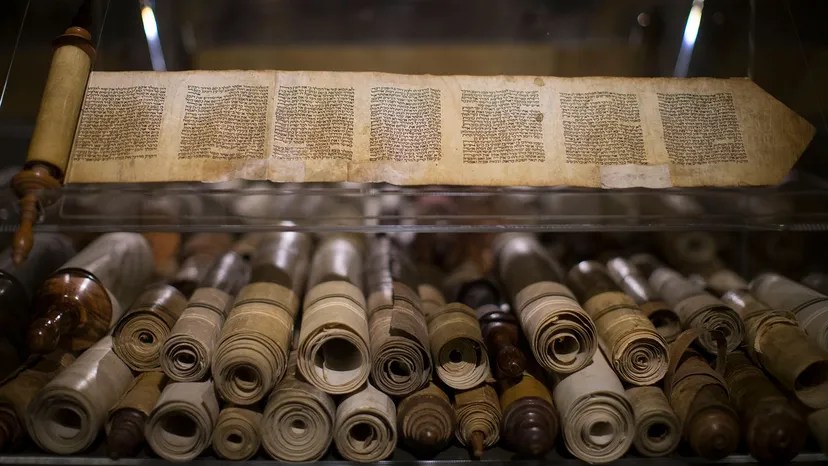
Revelation 22:18-19 I testify to everyone who hears the words of the prophecy of this book: if anyone adds to them, God will add to him the plagues which are written in this book; and if anyone takes away from the words of the book of this prophecy, God will take away his part from the tree of life and from the holy city, which are written in this book.
Deuteronomy 4:2 Verse Concepts You shall not add to the word which I am commanding you, nor take away from it, that you may keep the commandments of the Lord your God which I command you.
Proverbs 30:6 Verse Concepts Do not add to His words Or He will reprove you, and you will be proved a liar.
Proverbs 30:5-6 Every word of God is tested; He is a shield to those who take refuge in Him. Do not add to His words Or He will reprove you, and you will be proved a liar.
Deuteronomy 12:32 Verse Concepts “Whatever I command you, you shall be careful to do; you shall not add to nor take away from it.
Matthew 22:29 Verse Concepts But Jesus answered and said to them, “You are mistaken, not understanding the Scriptures nor the power of God.
Mark 7:13 Verse Concepts thus invalidating the word of God by your tradition which you have handed down; and you do many things such as that.”
Genesis 3:1-4 Now the serpent was more crafty than any beast of the field which the Lord God had made. And he said to the woman, “Indeed, has God said, ‘You shall not eat from any tree of the garden’?” The woman said to the serpent, From the fruit of the trees of the garden we may eat; but from the fruit of the tree which is in the middle of the garden, God has said, You shall not eat from it or touch it, or you will die.read more.
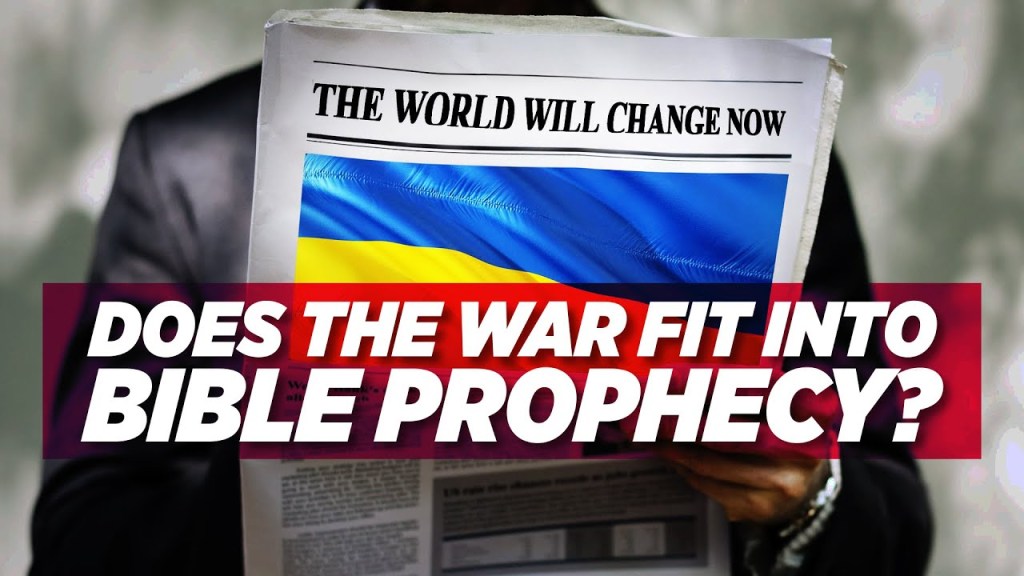
The war in Ukraine has reignited beliefs among some conservative evangelicals that Russia could help fulfill biblical prophecies about the end of the world.
These evangelicals, particularly charismatic Christians who focus on end-times theories, have long believed that Russia has a special role to play in the end times and are sharing new theories about why the invasion of Ukraine might be part of God’s plan.
Earlier this month, California megachurch pastor Greg Laurie, who was part of President Donald Trump’s inner circle of pastor-advisors, told his followers he saw a “prophetic significance” to what is happening in Ukraine. And Christian Broadcasting Network founder Pat Robertson suggested Russian President Vladimir Putin was “compelled by God” to attack Ukraine. Since then, people who engage in prophecy have been giving their own biblical interpretations of global events, particularly around Russia’s role in triggering the end of the world.
A Rapture Index that tracks what it sees as end-times activity recently increased its index to 187 out of 200. The index hit 182 after Sept. 11, 2001. In its most recent update, it notes climate change, the coronavirus and the rise of oil prices as factors for recent changes.
Conservative Christians have long looked at world events and pointed to biblical references as signs that what is happening in the world could fulfill biblical prophecy, and this time is no different, said Michael Brown, host of the Charlotte-based Christian radio show “The Line of Fire.”
“When you have Christians who already think about how we’re living in the last days and they see the continual moral decline of America, they see the church being marginalized, it doesn’t take much to tip the scales,” he said. “Whenever Russia gets involved, it’s like, ‘Ah here it is, it’s the final conflict.’”
Some evangelicals once believed that Mikhail Gorbachev, the former leader of the Soviet Union, was the Antichrist, in part because he had a birthmark on his forehead that conjured up concerns that it could be “the mark of the beast,” a biblical sign for Satan in the end times.
A Ukranian bishop in late February likened Putin to the Antichrist. However, Brown said he thinks Putin is unlike the Antichrist because most of the world appears hostile to Putin while the Antichrist as described in the Bible will bring the whole world under his sway.
Could Vladimir Putin battle the Antichrist? How some evangelicals debate the end times.
A Feb. 20-24 Washington Post-ABC News poll found that White evangelical Christians were just as negative toward Russia and supportive of sanctions as Americans overall. Among White evangelicals, 47 percent said Russia is an enemy of the United States and another 33 percent said it is unfriendly. Similarly, 68 percent supported sanctions and 51 percent said they would still support them if energy prices went up.
White evangelicals were also much more likely to say they disapprove of the way President Biden has handled the situation with Ukraine (75 percent) than Americans overall (47 percent).
Brown said he understands why recent global events, including the pandemic, seem to disturb some conservative evangelicals. Many, he said, are concerned about vaccine mandates and the World Health Organization as possible preparation for a one-world government, or one international leader who will make decisions for the globe.
This is not the end of the world, according to Christians who study the end of the world
“We got a sneak preview on a small level for how people can be moved by fear,” Brown said. “It provided an insight into how we could quickly get to a situation where everyone agreed worldwide to certain standards. If you don’t do this, you can’t participate in real life.”
Based on some Christians’ interpretation of Revelation, the New Testament’s final book, Jesus will return to Earth, believers will be raptured to heaven and will leave unbelievers behind.
For many White evangelicals, Russia is part of that narrative, said Matthew Avery Sutton, a Washington State University history professor and author of “American Apocalypse: A History of Modern Evangelicalism.”
Literature from people such as John Nelson Darby after the Civil War, and the Scofield Bible in 1909, have tied Russia to biblical narratives. The Scofield Bible identifies a “kingdom of the north,” described in the Book of Daniel, as Russia. Hal Lindsey’s 1970 bestseller “The Late Great Planet Earth” also popularized the idea that Russia was the land of Magog, the prophesied invader of Israel in the Book of Ezekiel.
In their best-selling 1995 book “Left Behind: A Novel of the Earth’s Last Days,” Jerry B. Jenkins and the late evangelical pastor Tim LaHaye cast Russia as Magog in a modern-day version of the Book of Ezekiel. “Left Behind” opens focusing on Israel but then Russia attacks Israel for a new technology, setting the stage for the end times.
“The apocalyptic obsession ebbs and flows in moments of crisis,” Sutton said. “We’re at another moment where prophecy is invoked to make sense of current events.”
Daniel Hummel, a historian of religion who is working on a book about a system that emphasizes a literal reading of the Bible called dispensationalism, said Christians would write in the 1840s and 1850s about Russia using literal connections between the Bible and what would happen in the future. Other Christians tended to see biblical descriptions as more symbolic or allegorical.
Christians using a more literal interpretation draw connections between Russia and biblical prophecy and look to a reference in the Book of Ezekiel where it speaks of the Prince of Rosh, which sounds like Russia. During the Cold War, Christian leaders would apply American understandings of good and evil, viewing Communism as an evil force.
In recent decades, Christians, especially those in Pentecostal or charismatic traditions, have seen global events, such as the modern state of Israel, as a fulfillment of God’s prophecies. Since 9/11, some of these leaders have focused on “Islamic terrorism,” particularly on the role of Iran because of how Persia is described in the Old Testament. And anything involving Israel especially provokes commentary about God’s active role in the world.
“There are a lot of people who are cheaply saying [Russia’s war in Ukraine] is prophetically significant,” Hummel said. “You get some credibility for saying prophetic things are happening, but they lose credibility if they try to specify anything. A lot of these people don’t have a clear sense of what the U.S. should be doing, but they want the credibility of saying they’re on the right side of interpreting these things.”
Recent events have given rise to older narratives about Russia, but they’ve also scrambled them, said Amy Frykholm, a senior editor for the Christian Century magazine and author of “Rapture Culture: Left Behind in Evangelical America.” Frykholm said recent events have complicated how people see Russia’s role in the end times, including how some right-wing commentators have been more complimentary of Putin’s actions.
Within the past decade, Trump’s rise to power also had some altering prophetic predictions, she said, because he didn’t fit with past narratives about how the world was going to end and Christians would be raptured, and he didn’t also quite represent a theology where conservative Christians seek power themselves.
“For so much of the 20th century, it felt like for a lot of evangelicals everything that happened felt like it fit the prophetic pattern: Israel becoming a nation, the Cold War and the way it was divided in good vs. evil, and the atomic bomb,” Frykholm said. “It was built on reading the news as if it was the Bible and reading the Bible as if it was the news. I’m not sure you can do that with this current situation.”
Many students of Bible prophecy consider Revelation 16:12–16 to possibly refer to China in the end times:
“The sixth angel poured out his bowl on the great river Euphrates, and its water was dried up to prepare the way for the kings from the East. Then . . . demonic spirits that perform signs . . . go out to the kings of the whole world, to gather them for the battle on the great day of God Almighty. . . . Then they gathered the kings together to the place that in Hebrew is called Armageddon” (Revelation 16:12–16).
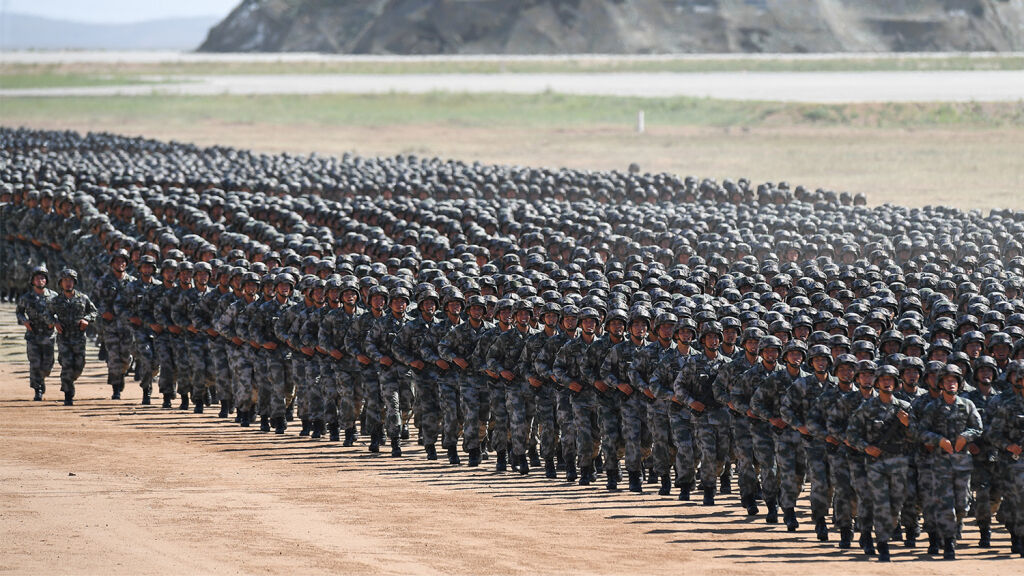
This passage predicts a massive, climactic conflict known as the Battle of Armageddon. It occurs at the end of the tribulation, after the sixth bowl judgment. At that time, the Euphrates River will be dried up, allowing the “kings from the East” to invade the Near East and march toward Israel. It is the “kings from the East” identification that many associate with China. The Chinese army, or a Chinese-led coalition, will take advantage of the removal of a natural barrier and sweep westward to meet up with the forces of the Antichrist.
When the end-times’ force from China joins with the armies of the Antichrist, the seventh and final bowl judgment will be poured out. The Lord Jesus will return, the most violent earthquake ever will shake the world, and the forces of the Antichrist and the armies of the East will be destroyed (Revelation 16:17–20; 19:11–21).
It is impossible to know for sure if the Eastern confederacy of the end times will include China; however, it seems likely that China will be involved. Recent years have seen a dramatic rise in China’s power and influence. The development of enormous military strength; intimidation of Hong Kong, Tibet, Taiwan, and other regions; pursuit of global economic dominance; aggressive rhetoric on the world stage; and, of course, the persecution of Chinese Christians—all this has been characteristic of China. It is not hard to imagine that the “kings from the East” who one day march into Israel will include China.
Some people identify another battle, mentioned earlier in Revelation, as a prophecy of China in the end times. The association hinges on the mention of an army of 200 million (Revelation 9:16) and occasional reports of China’s capability of equipping such a vast army. There are a couple problems with this view. One is that Revelation 9 says nothing of an army from the East; rather, it speaks of a demonic horde that destroys a third of mankind. The “horses” these beings ride are definitely not normal horses (verse 17). Also, the battle of Revelation 9 occurs after the sixth trumpet judgment; the battle of Revelation 16 involving the kings of the East occurs after the sixth bowl judgment, probably about three and a half years later.
In the end times, many nations, likely including China, will try their hand at conquest. Ultimately, their fight will be against God. The tribulation will be a tumultuous time of warfare, disasters, and divine judgment. But God has it all under control, as Psalm 2:2–6 assures:
“The kings of the earth rise up and the rulers band together against the Lord and against his anointed, saying, ‘Let us break their chains and throw off their shackles.’ The One enthroned in heaven laughs; the Lord scoffs at them. He rebukes them in his anger and terrifies them in his wrath, saying, ‘I have installed my king on Zion, my holy mountain.’”
The scriptural, prophetic identity of the most populous nation on the planet
“China: The Next Superpower.” “China: America’s Number-One Enemy.”
Such headlines have become common. It is logical that the nation with nearly 20 percent of the world’s population, the second-biggest economy and the biggest military (in terms of manpower) would inspire such discussion.
But will China become the world’s next superpower? The truth is, you cannot know China’s future unless you understand that nation’s identity in the Bible, the only source that can reveal the answer!
Yes, if you believe the Bible, you can actually know for certain—without a doubt—who will dominate the world very shortly!
Hundreds of think tanks spend countless hours and vast sums of money in search of an answer to this question. Yet, the Bible reveals the answer—if they would only believe!
The Bible is a book primarily about Israel, physical and spiritual. When other nations are mentioned, it is typically in relation to Israel. In biblical times, the interaction between the Chinese and the Israelites was of no major consequence, and so China was rarely mentioned.
However, the Bible does speak prophetically of China’s role in end-time events. Technological advances in communication and trade have shrunken the distance between China and the modern descendants of Israel considerably (for an explanation of who these nations are, request our free book The United States and Britain in Prophecy). Today China has considerable global influence: Witness, for example, the amount of U.S. debt China holds and the huge trade imbalance between the two nations, and the fact that China is the world’s most dominant trading nation.
An understanding of these prophecies hinges on knowing the biblical identity of the Chinese people. Before delving into this, however, we must gain a basic overview of Chinese history.
A Brief History of a Great People The Chinese people comprise one dominant ethnic group and many small minorities. The ethnic Han comprise more than 90 percent of the 1.3 billion people living in China. Though minority ethnic groups—such as the Uygurs, Tibetans, Mongols and Manchu—make up a small percentage of the Chinese population, in absolute numbers they are still large populations. For example, there are actually more Mongols living in China than in Mongolia.
These other ethnic groups have been absorbed into China through conquest by the Han Chinese. The Han have long dominated the heartland of China, usually defined by the Yellow River in the north, the Yangtze in the middle and the Pearl River on the south. This rich agricultural region is surrounded by border regions occupied by non-Han peoples, such as Tibet, Xinjiang (home of the Muslim Uighurs), Inner Mongolia and Manchuria, the historical name given to the territory north of North Korea.
Historically, fierce nomadic cavalry armies from the northern border regions have posed a difficult challenge to the agriculture-based Chinese. The incursions motivated the building of the Great Wall.
When the Han were strong, just like today, the border regions were under their rule. When they were weak, they lost control of those buffer regions and in some cases were even invaded by their Turkic and Mongol neighbors.
The foreign invaders all achieved measures of success, controlling portions of Chinese territory for various periods, mainly in northern China. The most complete conquest was the Mongol invasion started by Genghis Khan in the a.d. 1200s: The resulting dynasty fully controlled China for a century.
All these invasions had one thing in common, however: They all met their end by the Han Chinese.
No matter which foreign invader occupied the throne, China always remained Chinese.
One remarkable demonstration of the resilience of their society and culture was the survival, amid all the invasions, of the Chinese language—a feat few other languages have managed.
This was partly due to the size of the Han population. In a.d. 2, the first available census shows a Chinese population of about 60 million, one fourth of the world’s population at the time!
To better rule this immense population, nomadic invaders typically adopted Chinese administration techniques and the Chinese language, a language quite unrelated to their own. Eventually their descendents adopted Chinese culture and the agricultural lifestyle as well. When the Han reasserted themselves, they easily absorbed the invaders that remained.
All the mixing and migrating of different peoples has made it impossible to characterize what a pure ethnic Han is. Nevertheless, prophetically speaking, China refers to all the people of China, not just the Han ethnic group. And at any rate, the Chinese and all the minority groups living in China are of the Mongoloid race, which stems from Noah’s son Japheth.
The Mongoloid Race As Herbert W. Armstrong taught throughout his ministry, Noah’s son Japheth married a woman of the yellow race, and went on to father the Mongoloid people. The Hebrew word Japheth means enlargement, according to The Zondervan Pictorial Bible Dictionary, and a glance at the modern world shows that the Oriental populations have been enlarged and multiplied to an unparalleled degree. Japheth’s descendants have long been the most populous people on Earth, with the bulk living in China, Southeast Asia and Japan.
Genesis 10:2-5 show that the enlargement of Japheth began with the patriarch himself siring seven sons and an untold number of daughters. Obviously, these sons and daughters were a mix between the Caucasoid and Mongoloid races, the latter of which grew more definitive in subsequent generations. Soon after the dispersion at the Tower of Babel (Genesis 11:8), Japheth’s descendants migrated through Central Asia to the lands they occupy now.
One of the seven sons of Japheth bears special importance to the prophetic identity of the Chinese and even their nomadic neighbors. That is Magog, the second son of Japheth mentioned in Genesis 10:2.
Where Did Magog Go? Again, the Bible deals primarily with Israel. Since Magog’s descendants migrated to an area largely independent of the civilizations developing in the Middle East, no sons of Magog are listed in Scripture.
However, Jewish historian Josephus indicated where Magog’s descendants settled. He wrote in the first century, “Magog founded those that from him were named Magogites, but who are by the Greeks called Scythians” (The Complete Works of Josephus).
In a prophecy in Ezekiel 38, the Bible labels this vast territory of northern Eurasia where the Scyths lived—a region that stretched from the Russian steppes east into modern-day China and Mongolia—as Magog.
This territory contained many different tribes of people of the white and yellow races, all of whom were called Scyths or Scythians by the Greeks (see last month’s installment in this series). The Ezekiel 38 prophecy demonstrates this as well, listing numerous nations and peoples associated with or dwelling “in the land of Magog.” The people who most prominently settled this land are typically identified as Mongolic and Turkic. The name Mongol is even derived from the name Magog.
The ancient history of this land is a story about different Turkic and Mongolic tribes vying for control of the area. Whenever a tribe grew strong enough, it would rule the area; in rare cases—such as with the Huns, Seljuk Turks and Mongols—if these nomadic tribes consolidated enough power, they conquered lands beyond their own.
The resulting conquests led to much cultural and genetic intermixing with the people of Central Asia—and makes their national borders largely irrelevant to defining their ethnic backgrounds.
Today the land the Bible calls Magog is dominated in the west by Russia—which is reasserting control over the region it once possessed through the ussr—and China in the east.
Details of the ancient history of Magog and its people remain obscure since the Turks and Mongols didn’t develop a written language until after their contact with the Chinese or Persian civilizations. Though these nomadic peoples have a sketchy history, they still play an important role in understanding China’s prophetic role.
While the Mongols’ connection to Magog is most obvious, they were just one tribe of a related people that carry the biblical name Magog. Ezekiel 38 is a prophecy about the land of Magog and all the distant “cousins” that live there and are associated with each other, such as the Russians and Chinese. One of the Mongolic nomadic tribes in this area bears a special relationship with China. They are the Khitan, a people responsible for China’s modern name and one of China’s biblical names, Chittim.
China Is Chittim Isaiah 23:1 has a prophecy about “the land of Chittim.” To which modern nation does this end-time prophecy apply? This biblical name refers to both the island of Cyprus and to the nation of China, whose progenitors first populated Cyprus and gave it its name.
Jewish historian Josephus records that some descendants of Japheth—such as the families of Gomer, Tubal and Togarmah—first settled in southern Europe before migrating east into Asia. Kittim was one such family, originally settling lands to the west of Mesopotamia before moving to the Far East.
Genesis 10:4 lists the sons of Japheth’s fourth-born son: “The sons of Javan were Elishah, Tarshish, Kittim, and Dodanim” (New King James Version). Kittim is synonymous with the Chittim of Isaiah’s prophecy. Verse 5 mentions that these sons of Javan settled the isles, or the coasts. This occurred shortly after the dispersion of the Tower of Babel, when the sons of Javan migrated to the northern Mediterranean. These tribes gave their names to various cities and islands, such as Cyprus and Rhodes.
The Mongoloid types of these families, including the Kittim, did not stay in the Mediterranean, however. Over hundreds of years and many generations, some of these families migrated east into Asia from Cyprus, where they are found today, according to research by Dr. Ernest Martin, formerly of Ambassador College.
The descendants of Javan’s son Kittim came to Asia some time after many of their cousins had already settled there. After their migration through Central Asia, the Kittim made their appearance in modern-day northern China and Mongolia under the name Khitan in the fourth century a.d. In the 10th century, the Khitan people managed to create a dynasty that subjugated the peoples, including the Chinese, in modern-day northern China. Their territory stretched from what is now Korea to eastern Kazakhstan, including Beijing, the seat of government in China today.
Because the Khitans controlled the overland trade and communication route from China through Central Asia to Europe, China was called Cathay, after the Khitans. The designation first applied to north China, but later designated all of China. It is a name the Russians still use for China today.
Isaiah 23:1-3 reveal that Chittim, modern-day China, will form a part of a global economic market along with Europe, one that is prophesied to shut out the nations of Israel. It should be no surprise that China will be an integral part of this economic partnership with Europe, as it is now the world’s greatest exporter. These two trading blocs will soon dominate the global economy!
The history of the Khitan demonstrates what has happened to many of the Mongolic tribes that once roamed the western portions of what the Bible calls Magog. These nomadic tribes were not considered Chinese when they were conquering the Han civilization, but after centuries of living inside China’s borders, much of their populations have been ethnically absorbed by the Han Chinese. Whatever remnants of these Mongolic nomads that have managed to remain distinct, such as the Mongols, are now classified as ethnic minorities in China.
In the Khitan’s case, their absorption was so complete that an ethnic minority group from their descendants doesn’t even exist!
The history of these nomads shows just how strong a connection China has with biblical Magog. To a certain degree, they even share the same borders and the same people. But if this explains the Mongolic nomads whose descendants now live in northern China, what about the original Han people who settled and continue to live in China’s heartland?
Handling the Han The history of the Han Chinese is much less obscure. In fact, the Han people record their history all the way back to the time of the Tower of Babel!
Ancient Chinese records speak of China’s first emperors, Yaou, Shun and Yu.
One such record, The Shoo King, explains that one of Yaou’s tasks was to deal with the effects of a great flood that ravaged the land: “Destructive in their overflow are the waters of the inundation. In their vast extent they embrace the mountains and overtop the hills.”
While scholars explain the inundation as a local flood in China, it is clear from the biblical account, God’s sacred Word, that these annals are talking about Noah’s Flood. Consider:
During Yaou’s lifetime a new leader, Shun, came to power. According to another ancient Chinese manuscript, The Bamboo Annals, Shun is described as having a “black body.” He was obviously not Chinese, and his mother was called “the queen mother of the west,” indicating him as a foreigner. The Shoo King gives the name of Shun’s father as Koo-sow.
According to Dr. Herman Hoeh’s Compendium of World History, this Shun was none other than the Nimrod of the Bible. Therefore Koo-sow, which can also be spelled Kusou, is Nimrod’s father Cush! And the “queen mother of the west” can only be Semiramis. She was the mother-wife of Nimrod who called herself “queen of heaven,” as documented in Alexander Hislop’s Two Babylons. These are the three principal figures of man’s rebellion at the Tower of Babel.
Nimrod was a son of Cush and therefore of the black race. The Bible describes him as a mighty rebellious leader who caused the people to revolt against God shortly after the Flood (Genesis 10:8-9). He gathered the different races and peoples together to build the Tower of Babel, but was stopped when God intervened and confused the languages (Genesis 11:1-7). The different races and peoples were then scattered to different areas of the world (verse 8).
At that point, Yu became the next ruler. Yu, China’s first great hero, founded the Xia dynasty; from that point forward, leadership was given on a hereditary basis. The return of government to a Chinese ruler indicates that the Chinese immediately left the area of Babel and broke free from Nimrod and his successors’ rule. Under Chinese rulers, they migrated to their modern-day location.
The chronology as presented by The Shoo King places the rules of these three kings toward the end of the third millennia b.c. (The Chinese Classics). This time frame also agrees with the Bible.
The Chinese have preserved the most complete secular history of their civilization, dating back more than 4,000 years. There is a lot of myth and legend included as well, but the general chronology of emperors is verified by archeological finds, as well as what is recorded in Scripture.
Archeological Proof Western scholars and the Chinese themselves, heavily influenced by Western thought after the 1920s, believed the Xia dynasty and the history immediately following were mere inventions, mythical heroes and kingdoms.
However, an archeological find in 1959 at Erlitou in the western part of the Henan province revealed an early Chinese society dating back to the same time and place that The Shoo King records the Xia dynasty existed! The city found at Erlitou is the largest of all cities found dating to this time period and is believed to be the capital city of the Xia government.
Since that find in the North China Plain off the Yellow River, archeologists have found some 200 sites revealing the same culture throughout a broad area, demonstrating a rapid settlement and urbanization during 1900 to 1500 b.c. This was the formation of the first Chinese state! (The Chinese Neolithic:Trajectories to Early States).
TheBamboo Annals records the existence of other Chinese states and how the Xia rulers expanded their control over them. Archeologists have found evidence of other Chinese states, but none contained as many settlements as those closely identified with the city found in Erlitou where the Xia ruled—clearly the center of power of the first post-Flood Chinese civilization.
Interestingly, the archeological record shows a period of extremely low-population settlement in the period immediately before the Erlitou culture arrived. The archeologists, steeped in evolutionary thought, call the time before the Flood the Neolithic period. They have found evidence of a thriving civilization in China in this time period, followed by a contraction in settlement, with evidence pointing to drastic flooding in the region (ibid.).
Though the archeologists won’t admit it, this is evidence of a great flood followed by a resettlement of the area led by the Xia dynasty!
Back to Gog and Magog So if history is clear that Shun is Nimrod, who are Yaou and Yu? How do these names fit in our biblical identity?
A basic understanding of Ezekiel 38 gives us that information. That chapter speaks of the land of Magog and specific people or peoples living in that land: “Son of man, set thy face against Gog, the land of Magog” (verse 2). Gog and Magog are also mentioned together in Revelation 20:8, showing a close connection between the land and peoples. When Arab historians talked of the Mongols, they used the terms Yagog and Magog.
According to Dr. Hoeh, Yaou in Chinese history is likely the same person the Arabs call Yagog in their tradition. Every prophetic indication is that China has a strong connection with Gog and Magog. Ezekiel 38:2 refers to China. Along with Russia, China dominates the entire area of Magog and is associated with the nations listed in subsequent verses.
Therefore, the Chinese Han people were ruled first by a Japhetic descendant associated with Magog—possibly his son, though the Bible doesn’t say specifically. During Nimrod’s rebellion at the Tower of Babel, the Chinese were ruled by Nimrod. After his reign, when God intervened and changed the languages, government over the Chinese returned to the Japhetic line, under Yu’s rule. These people then migrated north and east to modern-day China, setting up their capital in the North China Plain at the end of the third millennium b.c.
The location of China helps reveal other biblical identities as well.
Kings of the East In a prophecy recorded in Daniel 11, a clash is foretold between “the king of the north,” a German-led European power, and “the king of the south,” a radical Islamic power led by Iran (these prophetic identities are explained in our booklets Germany and the Holy Roman Empire and The King of the South, both free upon request). Emerging victorious, the European army is then prophesied to conquer the tiny Jewish nation now called Israel. At that point, verse 44 foretells, “tidings out of the east and out of the north shall trouble” this European king.
Any map will show that north and east of Jerusalem are Russia and China, the two dominant powers of the land biblically referred to as Magog!
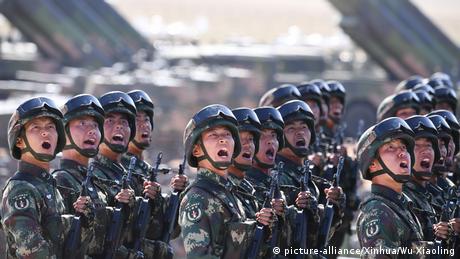
This event is further expounded in Revelation 16:12, where it is prophesied that the “kings of the east” will gather an army that numbers 200 million soldiers! (Revelation 9:14-16). Such a vast army could only be assembled with the massive population of China. Clearly China is one of those kings of the east!
So back to our original question: Will China become the world’s next dominating superpower after the decline of the U.S.? The answer is no!
Though it will grow to tremendous world power, even superpower status—especially through economic means, as indicated in Isaiah 23—it will not rise to the top spot. That position will be filled by the European power led by Germany! After a short economic partnership, China will violently contend with the king of the north for global dominance.
But this war will end when Jesus Christ returns and destroys both powers!
After that, according to biblical prophecy, Christ will restore His government on Earth, a government that will bring peace and prosperity for 1,000 years. Yet Ezekiel 38 prophesies that not every nation will submit to Christ’s rule voluntarily. Soon after the Second Coming, the people of Asia will form an army in order to attack the people living in Jerusalem!
This will be the last great rebellion in the 1,000-year period. Christ will utterly destroy it and deliver His people. It is a grand statement from God: “Thus will I magnify myself, and sanctify myself; and I will be known in the eyes of many nations, and they shall know that I am the Lord” (Ezekiel 38:23).
Believing the Bible gives us an understanding of ancient Chinese history that scholars reject, and reveals the future status of China and major events this world power will participate in. But even more, it gives us the final and inspiring end result: Christ establishing His Kingdom on Earth!
God is offering the wonderful opportunity to know, now, who is the Lord! Horrible wars are prophesied to occur shortly, but God will deliver His people, those who know He is the Lord and rely on Him. That should lead to the next big question: Are you one of those?
Bible prophecy forecasts a rising power bloc in Asia that is about to change world events. JULY 12, 2017
Russia and China are spearheading the emergence of an Asian power bloc.
This loose alliance of Asian nations has enormous global influence and is redefining the world order.
Russia is expanding its presence in Eastern Europe, Central Asia, the Middle East and North Africa.
China, too, is making rapid advancements—chiefly, island building in disputed territory in the South China Sea, putting a stranglehold on critical trade routes in the region.
The emergence of this Asian alliance is actually mentioned in Bible prophecy.
A prophecy in Revelation 16 refers to this end-time Asian bloc as the “kings of the east” (Revelation 16:12).
Ezekiel 38 prophesies specifically that this alliance is led by a strongman in Russia.
A prophecy in Isaiah 23 says that the “kings of the east” will form a trade alliance with an end-time, German-led European superpower. But this cooperation will be short-lived.
A prophecy in Daniel 11, verses 40 through 45, is specifically for the “time of the end.”
This prophecy says that once the “king of the north” destroys the “king of the south,” it will be “troubled” by “tidings out of the east.”
Revelation 9 shows that, all together, the “kings of the east” will amass an army of 200 million (Revelation 9:16).
This massive army will battle with the German-led European power, and also with Jesus Christ at His Second Coming.
Following this battle, Jesus Christ will usher in a new era of peace and prosperity for the whole Earth.
This is my personal collection of thoughts and writings, mainly from much smarter people than I, which challenge me in my discipleship walk. Don't rush by these thoughts, but ponder them.


 Milo
Milo 