By what right do we become “a royal priesthood”? By the right of the Atonement. Are we prepared to leave ourselves resolutely alone and to launch out into the priestly work of prayer? The continual grubbing on the inside to see whether we are what we ought to be, generates a self-centred, morbid type of Christianity, not the robust, simple life of the child of God. Until we get into a right relationship to God, it is a case of hanging on by the skin of our teeth, and we say—‘What a wonderful victory I have got!’ There is nothing indicative of the miracle of Redemption in that. Launch out in reckless belief that the Redemption is complete, and then bother no more about yourself, but begin to do as Jesus Christ said—pray for the friend who comes to you at midnight, pray for the saints, pray for all men. Pray on the realization that you are only perfect in Christ Jesus, not on this plea—‘O Lord, I have done my best, please hear me.’ How long is it going to take God to free us from the morbid habit of thinking about ourselves? We must get sick unto death of ourselves, until there is no longer any surprise at anything God can tell us about ourselves. We cannot touch the depths of meanness in ourselves. There is only one place where we are right, and that is in Christ Jesus. When we are there, we have to pour out for all we are worth in the ministry of the interior.
“It was noised that he was in the house.” (Mark 2:1.)
THE polyps which construct the coral reefs, work away under water, never dreaming that they are building the foundation of a new island on which, by-and-by, plants and animals will live and children of God be born and fitted for eternal glory as joint-heirs of Christ. If your place in God’s ranks is a hidden and secluded one, beloved, do not murmur, do not complain, do not seek to get out of God’s will, if He has placed you there; for without the polyps, the coral reefs would never be built, and God needs some who are willing to be spiritual polyps, and work away out of sight of men, but sustained by the Holy Ghost and in full view of Heaven.
The day will come when Jesus will give the rewards, and He makes no mistakes, although some people may wonder how you came to merit such a reward, as they had never heard of you before.—Selected.
Just where you stand in the conflict,
  There is your place.
Just where you think you are useless,
  Hide not your face.
God placed you there for a purpose,
  Whate’er it be;
Think He has chosen you for it;
  Work loyally.
Gird on your armor! Be faithful
  At toil or rest!
Whate’er it be, never doubting
  God’s way is best.
Out in the fight or on picket,
  Stand firm and true;
This is the work which your Master
  Gives you to do.
—Selected.
Safely we may leave the crowded meeting, the inspiring mountain top, the helpful fellowship of “just men,” and betake ourselves to our dim homely Emmaus, or to our dread public Colossae, or even to our far Macedonia in the mission field, quietly confident that just where He has placed us, in the usual round of life, He ordains that the borderland may be possessed, the victory won.—Northcote Deck.
‘Blessed are the poor in spirit: for theirs is the kingdom of heaven.’ Matthew 5:3 SUGGESTED FURTHER READING: Esther 5:9–7:10
Would you know if this is your state or how far you have advanced? Attend to the effects. So far as you are poor in spirit, you will find: (i) a resignation to the will of God, for you will not only believe that his appointment is best, but you will see everything is better than you deserve. (ii) you will not be easily angry. A knowledge of your own heart will teach you to make allowance for others. And from a sense of your debt of 10,000 talents to God, you will be ready to forgive a few pence to man. (iii) you will not be over-confident. To be poor in spirit is to be sensible that you are weak, fallible and know but little, and this will keep you diffident of your own judgement. (iv) you will not aim to stand high in the opinion of others, any more than a beggar will try to pass for a rich man. (v) especially, you will most gladly renounce your own righteousness and count all things but dung for the excellency of the knowledge of Christ Jesus the Lord. But what do I say? Shall I unchristian all my hearers and myself too? Many, I am afraid, can in no degree stand this trial, but these gracious tempers must be formed in you, if you would be saved. These are the mind that was in Christ, and if any man have not the Spirit of Christ he is none of his. What can those who live in pride, anger, peevishness—impatient of the least contradiction—say to this? O may the Lord convince you and stir you to seek for pardon and grace for Jesus’ sake while it is to be found. And those of us who believe have need to be ashamed and humbled into the dust. How much do we feel contrary to these tempers!
FOR MEDITATION: Bless God for an Advocate—admire rich grace and trust to it. If he has begun the work, he will finish. And even now you are blessed, for yours is the kingdom. The kingdom of grace is yours. Grace is glory begun. Glory is grace perfected. Watch, pray and strive for an increase of this poverty of spirit, that your light may shine to the glory of your Father which is in heaven.
Therefore I tell you, every sin and blasphemy will be forgiven people, but the blasphemy against the Spirit will not be forgiven. Matthew 12:31
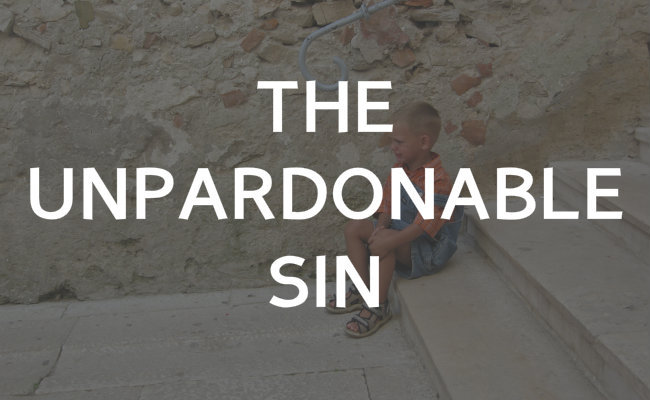
Context The Unpardonable Sin He who is not with Me is against Me, and he who does not gather with Me scatters. Therefore I tell you, every sin and blasphemy will be forgiven men, but the blasphemy against the Spirit will not be forgiven. Whoever speaks a word against the Son of Man will be forgiven, but whoever speaks against the Holy Spirit will not be forgiven, either in this age or in the one to come.…
The blasphemy against the Holy Ghost.—Better, against the Spirit, the word “Holy” not being found in any MSS. of authority. The question, What is the nature of the terrible sin thus excluded from forgiveness? has, naturally enough, largely occupied the thoughts of men. What, we ask, is this blasphemy against the Holy Ghost? (1.) The context at least helps us to understand something of its nature. The Pharisees were warned against a sin to which they were drawing perilously near. To condemn the Christ as a gluttonous man and a wine-bibber, as breaking the Sabbath, or blaspheming when He said, “Thy sins be forgiven thee,” was to speak a word against the Son of Man. These offences might be sins of ignorance, not implying more than narrowness and prejudice. But to see a man delivered from the power of Satan unto God, to watch the work of the Spirit of God, and then to ascribe that work to the power of evil, this was to be out of sympathy with goodness and mercy altogether. In such a character there was no opening for repentance, and therefore none for forgiveness. The capacity for goodness in any form was destroyed by this kind of antagonism. (2.) We dare not say, and our Lord does not say it, that the Pharisees had actually committed this sin, but it was towards this that they were drifting. And in reference to later times, we may say that this is the ultimate stage of antagonism to God and to His truth, when the clearest proofs of divine power and goodness are distorted into evidence that the power is evil. The human nature in that extremest debasement has identified itself with the devil nature, and must share its doom.
By the blasphemy here spoken of, we are evidently to understand injurious or impious speaking against the Spirit of God, such as the Pharisees were now guilty of; that is, attributing to the devil those miracles which Christ gave full proof that he wrought by the Holy Spirit. That this, and nothing but this, is the sin here intended, is manifest from the connection in which the words stand in this place; and more especially still from the parallel passage, Mark 3:28-30, in which the evangelist, assigning the reason of our Lord’s making this declaration, adds, Because they said, He hath an unclean spirit; that is, “hath Beelzebub, and by the prince of devils casteth out devils.” This, then, and this only, is the sin, or blasphemy, as it should rather be called, (and as the Scriptures always call it,) against the Holy Ghost. It is an offence of the tongue; it is committed not by thinking, but by speaking, by evil-speaking, by belying, slandering, or reviling the Divine Spirit, by which our Lord wrought his miracles, ascribing them to the devil: which in fact was calling the Holy Ghost, or the Spirit of the one living and true God, the devil: a more heinous crime than which is not to be conceived.
The issue of the death penalty has long been a constant debate among Christians. One side justifies capital punishment from its biblical origins as retribution of wrongdoing, while others argue against the practice, maintaining a holistic pro-life stance.
The death penalty is advocated for in the bible, but Christians should not support the existing death penalty model. Current inconsistencies in the system and discrepancies with offenders’ cases should cause Christians to stop blindly encouraging the policy Christians must first retain our pro-life and human rights stance before we can promote the poorly implemented capital punishment model we currently have in place.
The concept of capital punishment was established in Genesis 9:6: “Whoever sheds the blood of man, by man shall his blood be shed.” Romans 13:4 specifically discusses the concept of government’s authority, mandating the instruction: “he [rulers] does not bear the sword in vain.”
These verses outline that government has the God-granted right to punish wrongdoing, which includes implementation of the death penalty. New Testament principles of love and forgiveness apply to Christians but not primarily to governments and authority. The Bible makes it clear throughout Romans 13 that government was established as “an avenger who carries out God’s wrath on the wrongdoer.” With that biblical view of government, Christians can promote the death penalty as directed by God.
There is a problem, however.
Christians must tread lightly on the issue of capital punishment. On the one hand, it is biblically mandated for government, but problems such as racism and the possibility of wrongful convictions corrupt the present system. The argument for capital punishment should first be met by proper implementation.
On the contrary, Christians have a bigger problem to solve than ensuring capital punishment’s place in government. Before promoting the policy’s use, Christians should be aware of the rights violations and discrepancies that contaminate the current capital punishment.
Innocent lives have been lost to the death penalty. The prominent issue of capital punishment is killing an innocent person that was wrongfully convicted. Since 1973 according to the Death Penalty Information Center, over 185 mistakenly convicted prisoners on death row have been exonerated, pointing to a trend of erroneous death sentences. Similarly, more wrongly-convicted detainees have most likely been put to death. There have been dozens of instances in capital cases where there were discrepancies and questionable convictions. Christians cannot ignore these cases and vouch for capital punishment without acknowledging this problem.
Another caveat for the continued implementation of the death penalty is the racist tendencies of conviction. If the victim of a crime is white, the offender is more likely to be sentenced to death. Cases involving white victims comprise 80% of capital cases according to reports from the American Civil Liberties Union (ACLU), in which African-American offenders are three times more likely to receive the death penalty than white individuals. How can Christians support a process with racist outcomes? Christians should be on the offensive in stopping racial disparities. Public policy with unjust results is not God-ordained.
With these misnomers, Christians have the responsibility to promote solutions to these inconsistencies before we begin to encourage the death penalty with a fairer justice system. Before capital punishment can be justified as biblical, we must follow our pro-innocent-life stance and fight against the sin of racism. We must fight to ensure innocence until proven guilty. After these problems are solved, Christians could then justifiably encourage the biblical use of the death penalty.
This is my personal collection of thoughts and writings, mainly from much smarter people than I, which challenge me in my discipleship walk. Don't rush by these thoughts, but ponder them.

 Milo
Milo 