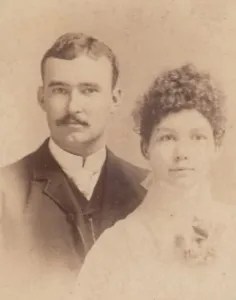
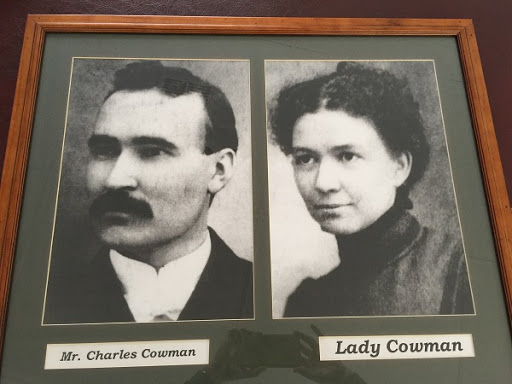
Missionaries in Japan and founders of the Oriental Missionary Society Charles and Lettie Cowman from The ScriptoriumBorn in Toulon, Illinois, Charles Cowman moved with his family to Thayer, Iowa, birthplace of Lettie Burd, when he was two years old. They became childhood sweethearts and were married in 1889. They moved to Chicago and were converted at Grace Methodist Episcopal Church. After hearing A.B. Simpson, founder of the Christian and Missionary Alliance, give a missionary challenge, they dedicated themselves to missionary service. After brief training at Martin Wells Knapp’s God’s Bible School in Cincinnati, they went to Japan as independent missionaries in early 1901. There they teamed up with Juji Nakada, a Japanese whom they met when Nakada was a student at Moody Bible Institute in the late 1890s.
Leasing a hall in Tokyo, they began by conducting nightly evangelistic rallies and a daytime Bible training school for workers. A distinctive feature of their ministry was the Every Creature Crusade, an effort to reach every home in Japan with the gospel of Jesus Christ, a feat they claimed was accomplished between the years 1912 and 1918. Together with Nakada and E.A. Kilbourne, they organized their work as the Oriental Missionary Society (today, OMS International). Eventually they also established work in Korea and China as well as Japan.
After Charles’s untimely death, Lettie continued to play a significant role in OMS. After Kilbourne’s death in 1928 she held the office of president until 1949, longer than anyone else. She traveled the world speaking in behalf of missions, and is best remembered for her compilation of devotional materials in Streams in the Desert (1925). OMS International was born in the holiness movement and continues today in the tradition of Wesleyan Arminian theology, with an emphasis on evangelism, church planting, and training.
Everett N. Hunt, Jr. “Cowman, Charles Elmer and Lettie (Burd),” in Biographical Dictionary of Christian Missions, ed. Gerald H. Anderson (New York: Macmillan Reference USA, 1998), 156.
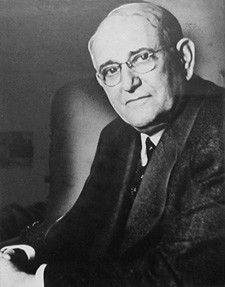
Lloyd Cassel Douglas, an American minister and author, was born Doya C. Douglas.
American writer who published popular novels about religious and moral issues. Douglas’s first book, MAGNIFICENT OBSESSION, appeared in 1929 and became a huge success. The work was rejected by two major publishers. It was issued by a small religious publishing firm and sold in a few years three million copies. In the 1930s Douglas was one of the most popular novelist in the United States. THE ROBE (1942), set in Christ’s time, was made into a lavish Technicolor film in 1953, starring Richard Burton, Jean Simmons, Victor Mature. It received 5 Academy Award nominations and won 2.
“Most of the people they knew were in a constant dither about their slaves; buying and selling and exchanging. It wasn’t often that Father disposed of one; and when, rarely, he had done so, it was because the slave had mistreated another over whom he has some small authority. They had lost an excellent cook that way, about a year ago. Minna had grown crusty and cruel toward the kitchen crew, scolding then loudly and knocking them about, She had been warned a few times. Then, one day, Minna had slapped Tertia. Lucia wondered, briefly, where Minna was now. She certainly did know how to bake honey cakes.” (from The Robe) Lloyd Cassell Douglas was born in Columbia City, Indiana as the son of Alexander Jackson Douglas, a Lutheran clergyman, and Sarah Jane (Cassel) Douglas. He was educated as a minister at Wittenberg Seminary in Springfield, Ohio. After his ordination he served as pastor in North Manchester, Indiana. In 1904 he married Bessio Io Porch, by whom he had two daughters, Bessie L. Douglas (bc 1906) and Virginia V Douglas (bc 1908).
In 1905 Douglas moved to Lancaster, Ohio, and in 1908 to Washington, D.C. From 1911 to 1915 he was chaplain and director of religious work at the University of Illinois. Later Douglas became a Congregationalist. He spent many years as the pastor of churches in the United States and Canada. In 1933 he retired from the ministry and become a full time writer.
Magnificent Obsession introduced themes that reappeared in the author’s later books – a medical setting, the wealthy background, the conversion of the atheist hero to a practising Christian, due to feelings of guilt, this time after causing a death of a brain surgeon, Wayne Hudson. He is a genius who believes that if man harbors any sort of fear, no matter how benign and apparently harmless, it percolates through all his thinking and damages his personality. One of the characters says, “whoever loveth a genius is out of luck with his devotion except he beareth all things, endureth all things, suffered long and is kind.” DOCTOR HUDSON’S SECRET JOURNAL (1939) was a prequel to the story.
Several of Douglas’s books have been adapted into screen, Magnificent Obsession twice. GREEN LIGHT (1935) was filmed in 1936, starring Errol Flynn. After Captain Blood (1935) and The Charge of the Light Brigade (1936) Flynn was labelled a swashbuckler, but in Green Light he was a dedicated doctor, who gives up his practice when a patient dies. The Robe, published 1942, gained wide audience as the first film in Cinemascope. The book’s title refers to the crusifixion garment worn by Jesus. The protagonist of the story is a young Roman soldier, Marcellus, in charge of the Crusifixion. He wins in a dice game at the foot of the cross Christ’s robe. Marcellus then starts to his quest to find the truth about Jesus. He becomes a convert and a martyr in Colosseum to the new religion. Burton in the role of Marcellus – in a short Roman mini skirt – was in his first great role. The book has sold over six million copies.
Douglas’s last novel, THE BIG FISHERMAN (1948), shared the same New Testament world of Palestine and Rome and focused on Jesus, Peter, and a pair of young lovers., Esther and Voldi. The Roman world of the early Christian Church is carefully drawn. However, for a modern reader, the style is perhaps too tendentious. Douglas’s main purpose was to present a Christian thesis in the form of a novel and include in the gospel narratives the aspect of human interest.
His last book was the autobiographical Time To Remember which described his life up to his childhood and education for the ministry. He died before he was able to write the intended second volume but the task was completed in The Shape of Sunday by his daughters, Virginia Douglas Dawson and Betty Douglas Wilson.
Douglas is buried in Forest Lawn Memorial Park Cemetery in Glendale, California.
In your patience possess ye your souls. Luke 21:19.
When a man is born again, there is not the same robustness in his thinking or reasoning for a time as formerly. We have to make an expression of the new life, to form the mind of Christ. “Acquire your soul with patience.” Many of us prefer to stay at the threshold of the Christian life instead of going on to construct a soul in accordance with the new life God has put within. We fail because we are ignorant of the way we are made, we put things down to the devil instead of our own undisciplined natures. Think what we can be when we are roused! There are certain things we must not pray about—moods, for instance. Moods never go by praying, moods go by kicking. A mood nearly always has its seat in the physical condition, not in the moral: It is a continual effort not to listen to the moods which arise from a physical condition; never submit to them for a second. We have to take ourselves by the scruff of the neck and shake ourselves, and we will find that we can do what we said we could not. The curse with most of us is that we won’t. The Christian life is one of incarnate spiritual pluck.
“Shall I refuse to drink the cup of sorrow which the Father has given me to drink?” (John 18:11.) (Weymouth.)
GOD takes a thousand times more pains with us than the artist with his picture, by many touches of sorrow, and by many colors of circumstance, to bring us into the form which is the highest and noblest in His sight, if only we receive His gifts of myrrh in the right spirit. But when the cup is put away, and these feelings are stifled or unheeded, a greater injury is done to the soul that can ever be amended. For no heart can conceive in what surpassing love God giveth us this myrrh; yet this which we ought to receive to our souls’ good we suffer to pass by us in our sleepy indifference, and nothing comes of it. Then we come and complain: “Alas, Lord! I am so dry, and it is so dark within me!” I tell thee, dear child, open thy heart to the pain, and it will do thee more good than if thou wert full of feeling and devoutness.—Tauler.
“The cry of man’s anguish went up to God, ‘Lord take away pain: The shadow that darkens the world Thou hast made, The close-coiling chain That strangles the heart, the burden that weighs On the wings that would soar, Lord, take away pain from the world Thou hast made, That it love Thee the more.’
“Then answered the Lord to the cry of His world: ‘Shall I take away pain, And with it the power of the soul to endure, Made strong by the strain? Shall I take away pity, that knits heart to heart And sacrifice high? Will ye lose all your heroes that lift from the fire White brows to the sky? Shall I take away love that redeems with a price And smiles at its loss? Can ye spare from your lives that would climb unto Me The Christ on His cross?”
‘Now the LORD had said unto Abram, Get thee out of thy country, and from thy kindred, and from thy father’s house, unto a land that I will show thee.’ Genesis 12:1 SUGGESTED FURTHER READING: Hebrews 11:8–16
The command was to leave his family and country and to go to an unknown land which God would show him. The calling of Abraham is supposed to have been less than 400 years after the flood. In this space of time it seems the knowledge of God was again almost lost upon the earth, and Abraham’s family, as well as others, was sinking into idolatry. The Lord was now about to fulfil his purpose of selecting a particular people to himself, by whom he would be known and worshipped, and amongst whom the types and prophecies concerning the Messiah should be revealed and perpetuated till, in the fullness of time, the Messiah should come of that nation, to be a light and salvation to the ends of the earth. He who has a right to do what he will with his own, as the potter over the clay, chose Abraham to be the head and origin of this nation, and marked out, long before they were a people, the land in which they should be fixed. And in the meanwhile he permitted, by his providence, that the land allotted to his own people should be settled by that branch of Noah’s family who, at his appointed season, should be cut off for their wickedness, and thereby make room for Abraham’s posterity. Thus Abraham is to be considered in a twofold light: as a public person—the head of the Israel of God—and likewise personally as a believer, and a pattern of the life of faith. FOR MEDITATION: If he his will reveal, His saints should stand prepared Let us obey his call; In duty’s path to run; And think whate’er the flesh may feel, Nor count their greatest trials hard, His love deserves our all. So that his will be done.
We should maintain in view With JESUS for our guide, His glory, as our end; The path is safe though rough Too much we cannot bear, or do, The promise says, ‘I will provide’, For such a matchless friend. And faith replies, ‘Enough!’
This is my personal collection of thoughts and writings, mainly from much smarter people than I, which challenge me in my discipleship walk. Don't rush by these thoughts, but ponder them.

 Milo
Milo 