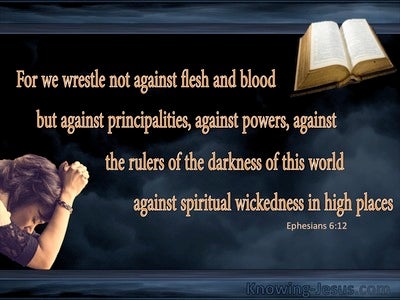
Against principalities, against powers

That there is a struggle, a “battle of life,” must be assumed at once by all who look at the world as it is; the question is whether it is against flesh and blood, or against a more unearthly power of evil.

Against the rulers . . .—“Principalities” and “powers” describe simply angelic powers, whether of good or evil. But in the following clauses St. Paul defines them as powers of evil, and appears to indicate two different aspects of this evil power. The original phrase is striking and powerful, “against the world-rulers of this darkness, against the spiritual powers of wickedness in the heavenly places.”

“spiritual hosts” of wickedness; and the phrase “in the heavenly places,” corresponding to “the power of the air” in Ephesians 2:2

The spiritual hosts of evil are described as fighting in the region above the earth.

Ephesians 6:12. For we wrestle not — Greek, ουκ εστιν ημιν η παλη, our struggle is not; against flesh and blood — Not merely against human adversaries, however powerful, subtle, and cruel, nor against fleshly appetites; but against principalities, against powers — The mighty princes of all the infernal legions: and great is their power, and that likewise of the legions which they command. Against the rulers of the darkness of this world — Greek, προς τους κοσμοκρατορας του σκοτους, του αιωνος τουτου, against the rulers of the world, of the darkness of this age. Dr. Whitby explains this of “those evil spirits that ruled in the heathen nations which were yet in darkness,” and of “those that had their stations in the region of the air.” “Perhaps,” says Mr. Wesley, “these principalities and powers” (spoken of in the former clause) “remain mostly in the citadel of the kingdom of darkness; but there are other evil spirits who range abroad, to whom the provinces of the world are committed.” By the darkness of this age, that spiritual darkness is intended, which prevails during the present state of things. “Evil spirits,” Macknight thinks, “are called rulers of this world, because the dominion which, by the permission of God, they exercise, is limited to the darkness of this world; that is, this world darkened by ignorance, wickedness, and misery, and which is the habitation or prison assigned them, until the judgment of the great day, Jude, Ephesians 6:6.” Against spiritual wickedness — Or rather, wicked spirits, as the Syriac translates the expression. The word πονηρια, rendered wickedness, properly signifies malice joined with cunning, and is fitly mentioned as the characteristic of those wicked spirits with whom we are at war; and it is a quality so much the more dangerous, in that it exists in beings whose natural faculties are very great. And it must be observed, that they continually oppose faith, love, holiness, either by force or fraud, and labour to infuse unbelief, pride, idolatry, malice, envy, anger, hatred. In high places — Greek, εν τοις επουρανιοις, in, or about, heavenly places. Those who translate it in the former way, think the expression refers to those places where they rebelled against the God of heaven, and drew in multitudes who were before holy and happy spirits, to take part with them in their impious revolt. But it seems more probable the sense is, about heavenly places; namely, the places which were once the abodes of those spirits, and which they still aspire to, as far as they are permitted; labouring at the same time to prevent our obtaining them.

But against principalities – There can be no doubt whatever that the apostle alludes here to evil spirits. Like good angels, they were regarded as divided into ranks and orders, and were supposed to be under the control of one mighty leader; see the notes on Ephesians 1:21. It is probable that the allusion here is to the ranks and orders which they sustained before their fall, something like which they may still retain. The word “principalities” refers to principal rulers, or chieftains.

“Against the world rulers of this (present) darkness”

On Satan and his demons being “world rulers

Though they be “world rulers,” they are not the ruler of the universe; and their usurped rule of the world is soon to cease, when He shall “come whose right it is” (Eze 21:27).

for we have not the wrestling with feeble men, but we have to contend with the diabolic powers.

What are familiar spirits?

The word familiar is from the Latin familiaris, meaning a “household servant,” and is intended to express the idea that sorcerers had spirits as their servants ready to obey their commands. Those attempting to contact the dead, even to this day, usually have some sort of spirit guide who communicates with them. These are familiar spirits.

Leviticus 19:31; 20:6, 27; and Deuteronomy 18:9-14 refer to “mediums and familiar spirits” and forbids being involved with them, as they are an abomination to the Lord. A medium is one who acts as a liaison to supposedly contact or communicate with the dead on behalf of the living. In reality mediums are contacting demons who convince the mediums that they are “familiar” and can be trusted and believed. The practices associated with mediums and familiar spirits were banned in Israel, and the punishment for practicing such things was death.

Familiar spirits and spirit guides are under the control of their master, Satan. They influence people to spread lies and deceit in order to thwart the kingdom of God. To knowingly open oneself to the work of demons is an evil thing: “Let no one be found among you who sacrifices his son or daughter in [a] fire, who practices divination or sorcery, interprets omens, engages in witchcraft, or casts spells, or who is a medium or spiritist or who consults the dead. Anyone who does these things is detestable to the LORD” (Deuteronomy 18:10-12a).

Some avenues through which demons or “familiar spirits” can gain entrance into a person’s life are divination, transcendental meditation, visualization, necromancy, witchcraft, drugs, and alcohol. These are all activities that believers are exhorted to avoid, or in the case of alcohol, limit. Instead, we are to be filled with the Holy Spirit, with love, with joy, and with the fullness of life that comes from Jesus Christ. We are also to be on guard, “for our struggle is not against flesh and blood, but against the rulers, against the authorities, against the powers of this dark world and against the spiritual forces of evil in the heavenly realms” (Ephesians 6:12).

What does it mean that the name of the demon was Legion?

In Mark 5, Jesus visits the region of the Gerasenes and is immediately confronted by a demon-possessed man who lived among the tombs, cut himself with stones, and could not be kept in captivity (Mark 5:1–5). When Jesus asked the demon what its name was, the demon replied, “My name is Legion . . . for we are many” (verse 9).

In common usage, a legion was the largest unit in the Roman army. At that time, a legion averaged about 5,000 fighting men, though it could have thousands more or fewer. So the term legion refers to any large number of beings; a multitude. When the demon in Mark 5 said that its name was Legion, it meant that the demoniac of the Gerasenes was possessed by a large number of unclean spirits.

Scripture does not say exactly how many demons comprised the Legion within the man. However, when Jesus cast them out, they entered a herd of pigs feeding nearby. Legion caused the pigs to rush down a hillside and into the sea, where they were all drowned (Mark 5:13). The number of pigs killed was “about two thousand.” That detail suggests that Legion was composed of about two thousand demons. The large number of demons may account for the afflicted man’s untamable nature and great strength—strength that was no match for God, of course.

There is one other mention of a “legion” in the context of spirit beings, this time of good angels. When Jesus was being arrested, Peter pulled out a sword and wounded a nearby member of the mob. Jesus healed the wound (Matthew 26:51) and told Peter to put away his sword. The Lord reminded Peter that, if He needed help, He could have God send “more than twelve legions of angels” (verse 53). That might total 60,000 angels, but the exact number wasn’t the point Jesus was making. Rather, it was to remind the terrified disciples that God is always in control of all circumstances, even during the horrible injustice of the murder of his own Son.

It is interesting that the Bible refers to both holy angels and demons as forming legions. Legion is a military term, one that fits the Bible’s descriptions of spiritual warfare in several places (Daniel 10:13; Ephesians 6:12; Revelation 12:7).

How can we stand against such numerous and powerful foes? God completely equips believers for battle against satanic forces: “Put on the full armor of God, so that when the day of evil comes, you may be able to stand your ground” (Ephesians 6:13). As Christians, we are “more than conquerors” through Christ (Romans 8:37). Jesus is our Commander. He is the One who dispatched the demons named Legion with just a word. He it is who will some day throw Legion and all the other demons “into the eternal fire prepared for the devil and his angels” (Matthew 25:41; cf. Revelation 20:10).

My name is Legion

InDesign PDF Preset: [High Quality Print]

Compare the “seven demons,” by whom Mary Magdalene was possessed (Luke 8:2), (ii) the “seven other spirits” “worse than the first,” which our Lord describes as taking up their abode in a man (Matthew 12:45).

And he answered, saying, My name is Legion: for we are many—or, as in Luke (Lu 8:30) “because many devils [demons] were entered into him.” A legion, in the Roman army, amounted, at its full complement, to six thousand; but here the word is used, as such words with us, and even this one, for an indefinitely large number—large enough however to rush, as soon as permission was given, into two thousand swine and destroy them.

And he asked him, what is thy name?…. Which question Christ put, not for his own sake; for he was not ignorant of his name, nor of the number of the unclean spirits which were in the man; but partly, that it might be known what a miserable condition this poor man was in, being infested, and vexed with such a large company of devils; and partly, that his own pity and power in delivering him, might be more manifest;
and he answered, saying, my name is Legion: the Syriac version renders it, “our name is Legion”; the reason of which name is given, for we are many:

How should a Christian understand orbs?

Many people have been puzzled by the appearance of “orbs”—spherical spots of light—in their photographs. These orbs can be various sizes, but usually they are small, white, and round. Most significantly, orbs are not apparent to the naked eye; they only show up in pictures and sometimes on video. Some people view orbs as evidence of paranormal or supernatural activity in a “haunted” location. Many others, including Christians, have a different perspective on the existence of orbs.

Some ghost chasers and paranormal investigators claim that orbs are manifestations of departed human spirits. They say that, as some ghosts seek to communicate with the living, the ghosts will exert psychic energy to make their presence visible, at least on film. From a Christian point of view, this theory has a major problem: there are no such things as ghosts, in the sense of “departed spirits of once-living humans.” The Bible teaches that, when a person dies, he or she is immediately in one of two places, heaven or hell (Luke 16:22–23). There is no time for “wandering” or “haunting.” There are spirits in this world, however—unclean spirits (demons) and holy spirits (angels).

Some Christians believe that orbs are real. If they see an orb in a picture taken inside their home, they conclude that there are spirits in the house. If they believe the spirits to be demonic, they might call a pastor or priest over to “cleanse” the house or pray through the rooms. If they believe the orbs are good, they might take comfort in the fact that God has sent His angels to watch over them. Again, from a biblical perspective, these theories have a problem. The Bible never mentions orbs. It never hints that spirits, good or bad, will manifest themselves to us as spherical globs of light. We have no reason to believe that our modern technology can coax a spirit to make itself visible. The belief that an orb is an angel or demon “caught on film” is based on ideas that do not come from the Bible.

There is a logical explanation for orbs. Orbs are almost always photographed 1) indoors, 2) using a flash, 3) on a digital camera, 4) with a low-resolution lens. These facts have led many to conclude that orbs are, in reality, dust particles floating between the camera and the subject of the photograph. The theory is that these airborne particles reflect the light of the camera’s flash. They appear blurry or transparent because they are out of focus; they are not visible to the naked eye because they must illuminated by the flash. Other small particles in the air, such as pollen, rain, or snow, can produce the same “orbs.”

Our belief in the supernatural does not come from photographic “proof” but from the Word of God. The Bible is our guide. Whether or not orbs have a supernatural origin does not change the fact that a Christian is to love God fearlessly, keep his eyes on Jesus, and be filled with the Spirit. “The one who is in you is greater than the one who is in the world” (1 John 4:4).

Stephen Boyd Blog

Belfast-born Hollywood and International Star from 1950-1970's Fan Tribute Page

Abundant Joy

Digging Deep Into The Word

Not My Life

The Bible as clear as possible

Seek Grow Love

Growing Throughout the Year

Smoodock's Blog

Question Authority

PleaseGrace

A bit on daily needs and provisions

Three Strands Lutheran Parish

"A cord of three strands is not easily broken." Ecclesiastes 4:12

1love1god.com

Romans 5:8

The Rev. Jimmy Abbott

read, watch, listen

BEARING CHRIST CRUCIFIED AND RISEN

To know Christ and Him crucified

Considering the Bible

Scripture Musings

rolliwrites.wordpress.com/

The Official Home of Rolli - Author, Cartoonist and Songwriter

Pure Glory

The heavens are telling the glory of God; and the firmament proclaims His handiwork. Psalms 19:1

The daily addict

The daily life of an addict in recovery

The Christian Tech-Nerd

-Reviews, Advice & News For All Things Tech and Gadget Related-

Thinking Through Scripture

to help you walk with Jesus in faith, hope, and love.

A disciple's study

This is my personal collection of thoughts and writings, mainly from much smarter people than I, which challenge me in my discipleship walk. Don't rush by these thoughts, but ponder them.

Author Scott Austin Tirrell

Maker of fine handcrafted novels!

In Pursuit of My First Love

Returning to the First Love