Robin Mark

Robin Mark lives in Belfast, with his wife Jacqueline and three children, Catherine, David and James. A successful businessman in his own right, heading his own company F.R. Mark and Associates and also a lecturer in Acoustics in Belfast’s Queens University, Robin has another gifting in life – that of worship leader and songwriter.
He has led worship in his local church, Christian Fellowship Church in Belfast, for over ten years now, recently appointed as Director of Worship. With the help and support of his church leadership, members and the many talented musicians in the body, he has matured not only as a worship leader but also as a truly gifted songwriter.
A first Church based cassette way back in 1992, “Captive Heart”, although it showed its lack of financial input, spawned several songs that are still being used in worship not only in his home church but throughout Northern Ireland and the world. It was the first time that “All for Jesus” was recorded.
“Not by Might” came next and over a three year period sold nearly 4,000 units in Ireland alone with little publicity. To put this in its proper perspective, given the population of Ireland, this would be equivalent to U.S. sales of around 350,000! News of Robin’s songs was spreading fast by word of mouth alone. At a small worship conference in 1995 Robin unleashed on an unsuspecting audience of 50 a song that was to change his life – Days of Elijah.
Further albums followed including the “Mandate” conference series with a unique blend of old and new songs presented in the context of the largest men’s conference in the U.K. held in Belfast’s Waterfront Hall. Further songs also followed including the anthem “Revival”, the poetic “Take us to the River”, and many other psalms, hymns and spiritual songs used throughout the world by congregations seeking to praise the King and Lord of all.
Not that Robin regards himself as a “songwriter” per se. In the Worship Together, Toronto worship conference in 2000 he stated, “…I write only when I feel I have something to say. I cannot sit down and write automatically or prolifically, God hasn’t given me that gift.
This, I suppose, is a bit scary because there’s always the possibility that I’ll never write another song! However, and what is the most important thing of all, I know I will always want to praise Him and worship Him with all my heart. If I do that in words and melodies that I, in some way, express, then that’s great! If not, then that’s great too. As long as I am praising Him, that’s all that matters.”
Perhaps it was this “heart” attitude that prompted Integrity Music (U.S.) to pursue the project which became known as “Revival in Belfast” in 1999. After a year or so of discussion the combination of a local church expression with an international recording company, along with a little additional help from some other musicians, was graced by God to become one of the most compelling worship albums of the year.
Two years later the follow up “Come Heal this Land” continues where “Revival” left off, introducing new songs of praise and worship with the Celtic flavour inherent in Robin’s work. And what of the future?
Well, doors have opened and pathways illuminated that have taken Robin and his musicians almost all around the world. He ministers in Europe, America, Canada, Australia and the Far East, and invitations come into his home base almost day and daily.
My Forever Friend’ – Charlie Landsborough
Greater Grace: A Story of God, Redemption, and Steve McQueen

They said he could act with the back of his head. No dialogue or frills required—his mere presence loomed larger than life in every shot. Put him next to some of the finest actors in the business, and he would undercut every one of them simply by being in the frame. His piercingly distinctive blue eyes were set in a rough-hewn, unconventionally handsome face that rarely betrayed strong emotion. His smallest physical gesture was precisely calculated and gracefully executed. You couldn’t best him, you couldn’t buy him, you couldn’t touch him. He was the King of Cool. He was Steve McQueen.
He was the definition of a self-made man, working his way up from a horrific childhood of neglect, paternal abuse and a tough life on the streets to the gold-plated life of a Hollywood icon. He once said that he often had nightmares of everything he had gained being suddenly taken away from him. A man of many paradoxes, he was both humble and defiant, stingy and generous, gentle and violent, self-assured and insecure. Perhaps it was director Norman Jewison (Fiddler On the Roof) who summed him up best: “He was a loner, and he was troubled, and he was looking for a father.”
Everyone had a Steve McQueen story. His superior officers in the Marines could have told you how he spent 41 days in the brig for resisting arrest when caught AWOL. The young men at the Boys’ Republic where Steve had spent some of his teenage years could tell you how he regularly came back and visited the school after becoming famous, personally responding to every boy’s letters and financially supporting the school until his death. Magnificent Seven co-star Yul Brynner could tell you how McQueen stole scene after scene by deliberately throwing in extra, distracting bits of business. Bruce Lee could have told you about a hair-raising ride in Steve’s Porsche that had Lee cowering in the foot-well (and threatening to kill Steve when they stopped, causing a fearful McQueen to hit the gas again and refuse to slow down until Lee promised not to hurt him).
He was known to say that he lived for himself and answered to no one. Asked once if he believed in God, the actor brazenly replied, “I believe in me. God will be number one as long as I’m number one.” That philosophy informed much of his life. All the money, cars, alcohol, drugs and women that a man could ever want were at his fingertips, and it was only a matter of time before he became addicted in every way. Professional successes only inflated his ego. Wild experimentation with substance abuse drove him to the edge of mental stability. Though he tried to be a good father to the son and daughter of his first wife, his addictions, serial womanizing, jealousy and violence burned through two marriages.
By the late 1970s, his star was fading. The washed-up, aging characters he portrayed reflected where he himself was in his life and career. He felt empty and unsatisfied. He began turning down huge offers and retreating into his own private shell. He was also developing health problems with his lungs. Doctors told him he should move, so in the spring of 1979, he left Malibu for the small, quiet town of Santa Paula, where he ultimately married his third wife Barbara Minty. For a period of time, they lived in an airport hangar which he had filled with his entire motorcycle collection. He bought a yellow Stearman bi-plane and learned to fly it, quickly mastering the craft as he had mastered motor racing before.
The pilot who taught him was a man in his early 60s by the name of Sammy Mason. Self-described as cranky and difficult to get along with, he became fast friends with McQueen. As they shared long hours in the air, talking together about the meaning of life, Steve sensed that there was something different about him. The more time they spent together, the more he wanted to know what Mason’s secret was. One day he asked him outright. Mason sat down with the aging actor and explained what, or rather who, had made the difference in his life. The answer, he said, was Jesus Christ.
McQueen was intrigued. He had so much respect for Mason and his family that he began regularly attending Ventura Missionary Church with them. The pastor was Leonard Dewitt. DeWitt later recalled that the famous icon had sat quietly in the balcony without even introducing himself for several months. When he finally requested a meeting with the pastor, he began firing off questions about life and faith, one after another. After a couple of hours, he leaned back and said, “Well, that about covers it for me.” Dewitt said, “Steve, I just have one question for you.” McQueen flashed his signature grin. “You want to know if I’ve become a born-again Christian,” he preempted. Then “still smiling, but very serious,” he told DeWitt that one morning when the pastor had given the invitation, he felt convicted by the Spirit and came forward. “When you invited people to pray with you to receive Christ, I prayed. So yes, I’m a born-again Christian.”Everybody around him could tell that he was changed.
In Sammy Mason’s words, it was “dramatic.” He said, “I doubt that I have ever seen a man flourish with more spiritual reality in such a short time.” Another close Christian friend, John Daly, said that the star’s conversion had stunned him. But when Steve talked about his new-found faith, there was no denying the seriousness of his commitment. In Daly’s words, “I think I had more faith that my saw and hammer would have gotten converted before Steve, but I was hearing it from the horse’s mouth. I was blown away.”
Under the discipleship of Mason and DeWitt, McQueen could often be found praying or poring over his Bible. Around that time, he heard Kris Kristofferson’s “Why Me, Lord” and embraced the lyrics as his own testimony. He also shared his testimony with friend and former personal assistant Mario Iscovich, who a decade earlier had been forced to stand by and watch as the actor “lost himself” down the “dark, ugly road” of his sin. As Iscovich puts it, McQueen “felt he had hurt a lot of people” but had finally “made peace with God.”
Shortly afterwards, McQueen traveled to Chicago to shoot his last film, The Hunter. Although his health was continuing to deteriorate, he was actively reaching out to various people in need. (He had always been generous, especially to kids, but now it sprang from a desire to serve God instead of trying to “cancel out” wrongdoings only Christ crucified could pay for.) One of the film’s extras was a feisty 15-year-old girl named Karen Wilson, who had no money to attend school and was working to provide for her family and dying mother. Immediately after visiting the family’s squalorous ghetto home, McQueen asked if he and Barbara could take the girl back to California with them and send her to school there. Eventually the mother agreed, and the couple went on to become Karen’s legal guardians. Her mother succumbed to cancer almost a year later. Today, Karen is happily married with a family of her own.
In December of that year, he was officially diagnosed with pleural mesothelioma, a fast-spreading and incurable form of cancer. The news was crushing because McQueen had expected God to use him in some great way now that he was converted. But he told Pastor DeWitt that he was able to endure it because at least he knew where he would spend eternity. Still, he was ready to try anything for the sake of his children—too ready, unfortunately. It led him down an almost year-long road of “unconventional” remedies where he was essentially taken advantage of by quack doctors (including a faith healer), all to no avail. We have a tape-recorded conversation from this time period where McQueen is talking about his illness, his faith, and the change in his life. “My body is broken,” he says, “but my spirit isn’t broken. My heart isn’t broken.” You can hear his voice crack when he shares dreams of “changing some people’s lives with what I know of the Lord, and what I have to offer with what’s happened to me.” He hoped to move to his wife’s ranch in Idaho and impact the community there. Sadly, he never got his wish.
One of the last people Steve talked to was none other than Billy Graham, whom the actor had long wanted to meet. DeWitt informed his contacts in the Graham organization that McQueen didn’t have much time left and wanted to see the evangelist if it could at all be arranged. Graham came right before McQueen was flown to a hospital for surgery to remove his tumors. Bed-ridden and on oxygen, McQueen was still, in Graham’s words, “a fighter.” Graham recalls, “Under that oxygen, he would talk. His eyes were just as bright, but he looked emaciated and old.” He poured out his life’s story to the evangelist, telling him about his friend Sammy Mason, telling him how God had made him a new man. McQueen had misplaced his Bible, so Graham personally inscribed his own Bible and gave it to the dying actor. He stayed by McQueen’s side and prayed with him until they reached the airport, then saw him off on the plane.
McQueen would not survive the operation. Four days after his meeting with Graham, he died of a heart attack with the evangelist’s Bible resting on his chest. It was opened to his favorite verse, that old, familiar promise so simple a child could grasp it, yet so profound the angels cannot comprehend it: For God so loved the world, that he gave his only begotten Son, so that whosoever believeth in him should not perish, but have everlasting life.
Today, he is still idolized and remembered for what he left behind in his films. But as remarkable as that legacy is, it will fade away like a forgotten dream at the dawning of eternity’s day. For when the grass has withered, and the young men have utterly fallen, and time like an ever-rolling stream has borne all its sons away, we shall be left with two wonders only: our own worthlessness and God’s redeeming love. May we all so pass through things temporal that we finally lose not the things eternal.
I’ll close with a fitting song, a beautiful marriage of lyrics and music by Marc Cohn. This is called “Old Soldier.” I created this video to go with it.
Listen, old soldier, wherever you are
The hills or the valleys, come near or come far
They say youth is a treasure we waste when we’re young
So come down from the place where your medals are hung
You’re forever returning and learning to fight
And you feel just like an old soldier tonight…
Carrickfergus


Carrickfergus (from Irish: Carraig Fhearghais [ˌkaːɾˠəɟ ˈaɾˠɣəʃ], meaning “Fergus‘ rock”) is a large town in County Antrim, Northern Ireland. It sits on the north shore of Belfast Lough, 11 miles (18 km) from Belfast. The town had a population of 27,998 at the 2011 Census. It is County Antrim’s oldest town and one of the oldest towns in Ireland as a whole. Carrickfergus was the administrative centre for Carrickfergus Borough Council, before this was amalgamated into the Mid and East Antrim District Council in 2015, and forms part of the Belfast Metropolitan Area. It is also a townland of 65 acres, a civil parish and a barony.
The town is the subject of the classic Irish folk song “Carrickfergus“, a 19th-century translation of an Irish-language song (Do Bhí Bean Uasal) from Munster, which begins with the words, “I wish I was in Carrickfergus”.
The British peerage title of Baron Carrickfergus, which had become extinct in 1883, was bestowed upon Prince William on his wedding day in 2011.
The town is said to take its name from Fergus Mór (Fergus the Great), the legendary king of Dál Riata. According to one tale, his ship ran aground on a rock by the shore, which became known as “Carraig Fhearghais” – the rock of Fergus.
As an urban settlement, Carrickfergus far pre-dates the capital city Belfast and was for a lengthy period both larger and more prominent than the nearby city. Belfast Lough itself was known as ‘Carrickfergus Bay’ well into the 17th century. Carrickfergus and the surrounding area was, for a time, treated as a separate county. The historical walled town originally occupied an area of around 97,000 square metres, which now comprises the town centre, bordered by Albert Road to the west, the Marine Highway to the south, Shaftesbury Park to the north and Joymount Presbyterian Church grounds to the east. Segments of the town wall are still visible in various parts of the town and in various states of preservation. Archaeological excavations close to the walls’ foundations have yielded many artefacts that have helped historians piece together a picture of the lives of the 12th and 13th century inhabitants.
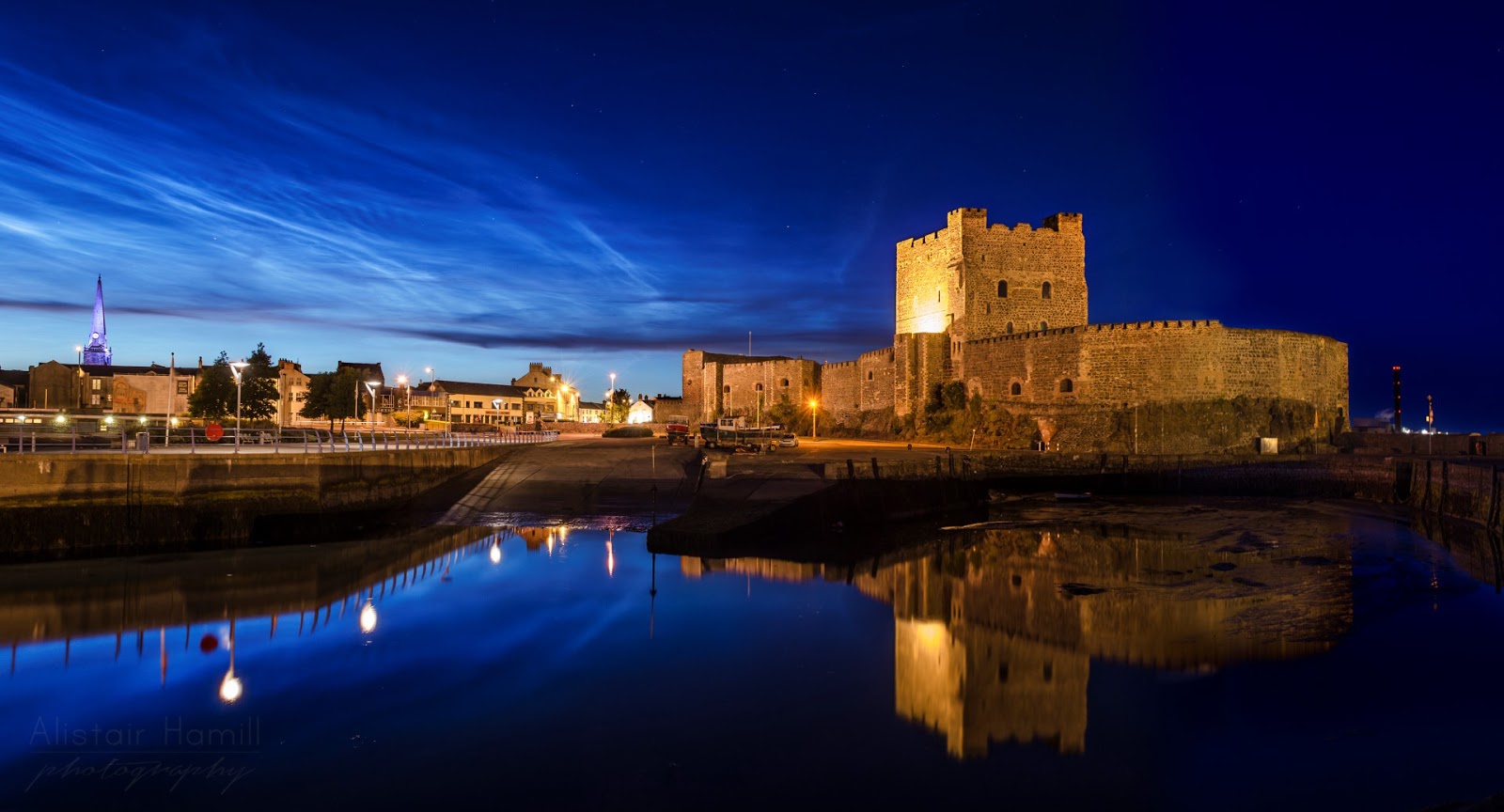
Carrickfergus became an inhabited town shortly after 1170, when Anglo-Norman knight John de Courcy invaded Ulster, established his headquarters in the area and built Carrickfergus Castle on the “rock of Fergus” in 1177. The castle, which is the most prominent landmark of Carrickfergus, is widely known as one of the best-preserved Norman castles in Ireland.
Sometime between 1203 and 1205, De Courcy was expelled from Ulster by Hugh de Lacy, as authorised by King John. de Lacy oversaw the final construction of the castle, which included the gatehouse, drum towers and outer ward. It was at this time that he established the nearby St Nicholas’ Church. de Lacy was relieved of his command of the town in 1210, when King John himself arrived and placed the castle under royal authority. de Lacy eventually regained his title of Earl of Ulster in 1227, however the castle and its walled town were captured several more times following his death (in 1242) and the town largely destroyed by the Scots in 1402.
The Battle of Carrickfergus, part of the Nine Years War, took place in and around the town in November 1597. It was fought between the crown forces of Queen Elizabeth I and the Scots clan of MacDonnell, and resulted in a defeat for the English. A contemporary Elizabethan illustration of Carrickfergus shows ten tower-houses, as well as terraces of single-storey houses, some detached cottages and 70 or more Irish beehive-type huts in the town. A drawing of Carrickfergus Castle circa 1840.
Sir Arthur Chichester was appointed by the Earl of Essex to govern the castle and town in 1599 and was responsible for the plantation of English and Scottish peoples in the town, as well as the building of the town wall.
In 1637 the Surveyor General of Customs issued a report compiled from accounts of customs due from each port and their “subsidiary creeks”. Of the Ulster ports on the list, Carrickfergus was first, followed by Bangor, Donaghadee, and Strangford. In the same year the town sold its customs rights – which ran from Groomsport, County Down, up to Larne, County Antrim, to Belfast. This in part led to its decline in importance as the province of Ulster grew. A plaque at the harbour commemorates the landing of William of Orange in the town in 1690.
Nevertheless, the decaying castle withstood several days of siege by the forces of William of Orange in 1689, before surrendering on 28 August. William himself subsequently landed at Carrickfergus on 14 June 1690.St Nicholas’ Church in the town of Carrickfergus
During the Seven Years’ War, in February 1760, the whole town was briefly captured and held to ransom by French troops landed from Francois Thurot‘s naval squadron, after the defenders ran out of ammunition. In 1711 Carrickfergus was the scene of the last witchcraft trial in Ireland. Eight women were charged with bewitching a young girl, and were convicted, despite a strong indication from one of the judges that the jury should acquit. They were sentenced to a year in prison and four sessions in the pillory.
In April 1778, during the American War of Independence, John Paul Jones, in command of the American ship Ranger, attempted to capture a British Royal Navy sloop of war, HMS Drake, moored at Carrickfergus. Having failed, he returned a few days later and challenged Drake to a fight out in the North Channel which the Americans won decisively.
During the 1790s there was considerable support in the Carrickfergus area for the United Irishmen.[15] On 14 October 1797 William Orr was hanged in the town following what was widely regarded as a show trial held in Carrickfergus Courthouse[16] (now the Town Hall) and in 1798 United Irish founder Henry Joy McCracken was captured on the outskirts of the town while trying to escape to America.
In 1912 the people of Carrickfergus turned out in their thousands to watch as the RMS Titanic made its first ever journey up the lough from its construction dock in Belfast. The famous passenger liner was anchored overnight just off the coast of Carrickfergus, before continuing on its journey. View of Carrickfergus Castle from the dock, June 2020.
During World War II, Northern Ireland was an important military base for United States Naval and Air Operations and a training ground for American G.I.s. The First Battalions of the elite US Rangers were activated and based in Sunnylands Camp for their initial training. The US Rangers Centre in nearby Boneybefore pays homage to this period in history. It is rumoured that Italian and German POWs were held in the town, the Italians in a camp at Sullatober mill, and Germans at Sunnylands.