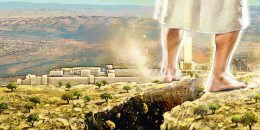

Where Does the Phrase ‘He Is Risen Indeed’ Come From?

If I could choose one fundamental hope Christians center our faith around, it would be Jesus’ proof that even death can be overcome. He is risen indeed, and lives! We have a Bible full of historical facts and promises as evidence.

Yes, we’re born with a finite earthly life, into what feels like a world of unknowns, but God knew the purpose from the very beginning. He offered his immeasurable power and inconceivable grace—in flesh and Spirit—to reconcile us to him eternally.

The fact that our Savior rose from the perceived grips of rejection, humiliation, abuse, and even death equips us to believe he will indeed make all things new (Revelations 21:5).

Christians celebrate the truth of the resurrection all year, but it comes sharply into focus each Easter. The empty cross takes on fresh significance as we revisit Jesus’ sacrifice during Holy Week.

And truly, a miracle so mind-blowing as resurrection from the grave bears repeating as we rejoice on Easter Sunday. As we proclaim “He is risen!” you may hear others doubly confirm, “He is risen indeed!”

But why is it worded this way? Let’s look at the history and heart of this phrase.

The Meaning behind ‘He Is Risen Indeed’
The phrase “He is risen indeed” is actually a response that is part of a paschal greeting exchanged on Easter Sunday, primarily in Orthodox churches. And although divisions in denominations developed over history, Christians agree Christ is risen. It’s a gift we celebrate, regardless of how various churches plan Resurrection Sunday service, or over what weeks the occasion is honored.

The phrase as a paschal greeting is an Easter custom among Eastern Orthodox, Oriental Orthodox, Eastern Catholic, Latin Catholic, and Anglican Christians. Paschal is derived from the Greek word pascha, which is a transliteration of the Hebrew word pesach meaning Passover.

Pascha is the feast of the Resurrection of the Lord, during which fasting, processions, and chants are customary over a period of 12 weeks. Its timeframe doesn’t always precisely coincide with when the Western church celebrates Easter, but it commemorates the same divine resurrection.

During the feast of Pascha and throughout Ascension (a time known as Paschal season), the paschal greeting is exchanged around the world in over 50 languages. It’s heard informally during this time, and also recited during liturgical services in churches. Instead of greeting one another with typical hellos, the greeting begins with “Christ is risen!” And the given response is “He is risen, indeed!” or “Truly, he is risen!”

Some cultures (Russians, for example), also exchange a “triple kiss of peace” after the greeting. The kiss of peace is an ancient traditional Christian greeting, sometimes called a “holy kiss.” It signifies a blessing of “peace be with you.”

This greeting of “Christ is risen,” met with “He is risen indeed,” is an act of unity around the belief in Christ’s resurrection.

Is ‘Risen Indeed’ in the Bible?
It’s interesting to note that the Eastern Orthodox Church suggests Mary Magdalene initiated this now-popular saying when she announced Jesus’ miraculous resurrection to Emperor Tiberius in Rome, saying, “Christ is risen.”

Stories are told, though not confirmed, of an egg that turned red in Mary’s hands as she addressed the Emperor, which so impressed him, he had Pilate removed.

Whether or not a red egg factored into Mary’s announcement of “Christ is risen,” it was compelled by the witnessed (and since recorded) fact that Jesus was buried, rose, and appeared again before ascending into heaven.

All four Gospel accounts record the true story of Jesus’ followers discovering that he was risen, indeed. And although the narrative may not read word-for-word as a call-and-response greeting, two sections of Scripture in the New Revised Standard version point to its likely inspiration:

He is not here; for he has been raised, as he said. Come, see the place where he lay. Then go quickly and tell his disciples, ‘He has been raised from the dead, and indeed he is going ahead of you to Galilee; there you will see him.’ This is my message for you. – Matthew 28:6-7

They were saying, “The Lord has risen indeed, and he has appeared to Simon!” – Luke 24:34

Why Christians Say ‘He Is Risen Indeed’
I believe Christians (no matter their timing, festivals, or denomination), express ‘ by sharing this beautiful phrase. It’s often shared in the Paschal season, or Easter, because this is a time set aside to remember that Jesus is truth, he offers life, and he is the way.

His prophesied arrival to call us to eternal life confirmed that God is with us, and death cannot keep us from him. Beyond whatever religious or pagan traditions we may enjoy, there was a stone rolled away and a Savior rose.

It’s worth mentioning that the word “indeed” originates from the the Middle English term “in dede” which means, “in truth, or in fact.”

Saying “indeed” either underscores that something is true, or it is used to segue into your next statement—that’s even more worth emphasizing. This is why when we recall that he is risen, we want to follow it with a resounding, “truth!” or “can’t top that!”

Best of all, Christianity.com explains that not only is Jesus risen, but by his resurrection, he raises us. Scripture is clear:

For the wages of sin is death, but the free gift of God is eternal life in Christ Jesus our Lord. – Romans 6:23

Because, if you confess with your mouth that Jesus is Lord and believe in your heart that God raised him from the dead, you will be saved. – Romans 10:9

Jesus didn’t only rise to show us. He rose to save us.

A Prayer to Celebrate That Jesus Is Risen Indeed
Dear Jesus,

Thank you for showing us what is true. Thank you for being our bridge, our Savior, and the way to eternal life in a world you will renew. This Easter, and all year, will you keep the flame of my joy for you burning? Will you remind me when things look bleak that you raise what may seem dead? Help me to not just hear that you are risen, but let me believe it in my bones, that because you are risen, indeed, we have a hope and a future worth celebrating.

Amen.

“He is risen; He is risen, indeed” 

He is risen indeed, Alleluia!”). This ancient phrase is similar to the Greek one, and echoes the greeting of the angel to Mary Magdalene and Mary, the mother of James, as they arrived at the sepulchre to anoint the body of Jesus: “He is not here; for he has risen, as he said” (Matthew 28:6).

Where does the saying “He is risen; He is risen, indeed” come from?

ANSWER

A traditional Easter greeting in the Western church is the exclamation “He is risen!” and the traditional response is “He is risen, indeed!” The words are sometimes accompanied by the exchange of three kisses on alternate cheeks, depending on the church. In the Orthodox and Catholic churches, the greeting is called the “Paschal greeting” and is a very old custom.

The greeting is ultimately based on Luke 24:34. Translations throughout church history, from the Latin Vulgate (c. AD 400) to the ESV (2001) have translated this verse nearly identically: “The Lord has risen indeed, and has appeared to Simon!” (ESV). Exactly how the saying became a standard greeting in the church is not known, although there are various theories regarding how it came into common usage.

We do know that, at first, the greeting was more common in Eastern and Byzantine liturgies than in the Western church. There is a tradition in the Eastern Orthodox Church that the saying was made popular by Mary Magdalene when she supposedly addressed Emperor Tiberius in Rome with the words “Christ is risen.”

Using this address should be more than an empty tradition. The words “He is risen!” remind us of the joyous news we celebrate at Easter, that Jesus’ death was not in vain, and that He has the power to overcome death. Saying “He is risen!” allows us to share this incredible truth with each other. The resurrection of Christ gives us hope for salvation and for our own resurrection and eternal life.

The 365-Day Devotional Commentary

OPPOSITION TO THE KING
Matthew 12–13

“A wicked and adulterous generation asks for a miraculous sign! But none will be given it except the sign of the Prophet Jonah” (Matt. 12:39).

As it became increasingly clear that one must choose for or against Jesus, opposition to Him and to His kingdom hardened. Today too some reject Christ not because they know so little about Him, but because they do not like the little they know!

Definition of Key Terms
Sabbath. The Sabbath Day was set aside as holy in Judaism. A person could do no work, but did worship, pray, and study the Scriptures. Over the years many rules of Sabbath observance had been propounded by the rabbis. These were intended to help the observant Jew keep from breaking the Sabbath inadvertently. But these rules, held by the Pharisees to be oral law given Moses on Mount Sinai and therefore just as binding as the written Law, were in fact only the notions of men. While Jesus was accused of being a Sabbath-breaker, He in fact only violated human rules that were not binding at all.
It’s all too easy to raise our applications or interpretations of Scripture to the status of Scripture itself. This is a tendency each individual, congregation, and denomination must guard carefully against.

Overview
Jesus’ claim to be Lord of the Sabbath (12:1–14) and the Servant predicted by Isaiah (vv. 15–21) brought direct conflict with the Pharisees (vv. 22–37). Christ rejected their demand for a miraculous sign (vv. 36–45), but announced kinship with those who do God’s will (vv. 46–50). In a series of parables told to puzzled crowds (13:1–35), and in another series told to His disciples (vv. 36–52), Jesus explained the unexpected aspects of His kingdom.

Understanding the Text
“Your disciples are doing what is unlawful on the Sabbath” Matt. 12:1–13.Two Sabbath incidents led to open conflict with the Pharisees. The first was provoked by Jesus’ disciples, who plucked and ate grain on the Sabbath Day. In the first century grain was planted right to the edge of paths and trails. According to Old Testament Law a traveler might break off a stalk and eat as he walked along. The Pharisees objected because they classified this as “harvesting,” one of the 39 kinds of work the sages prohibited on the Sabbath.
Christ answered in a familiar form of rabbinic argument. The Scripture says no layperson is to eat the temple showbread. But David ate, and was not condemned. If one wants to argue that David was special, all right: Jesus is more special. Again, the Law says not to work on the Sabbath. But the priests work then, offering sacrifices. If one wants to argue that the temple service is special, all right: Jesus is more special.
The argument makes a double point. The strict legalism of the Pharisees was not supported by the Old Testament. The written Law showed that God is more concerned with mercy than with sacrifice (i.e., with relationships than with rules and ritual). And, in the person of Jesus, the God who gave the Sabbath cleared the disciples: they were innocent of the crimes charged (vv. 7–8).
Shortly afterward Jesus entered a synagogue where there was a man with a withered hand. Looking for some crime to charge Jesus with, the Pharisees asked if it were right to heal (again “work”) on the Sabbath. Jesus’ reply was scornful. Even they would rescue an animal that had fallen in a pit on the Sabbath. Of course it is right to do good on the Sabbath. And then Jesus healed the man’s hand.
What a revelation of the heart of Jesus—and of the Pharisees. These men who were so concerned over their rules cared nothing for the crippled man’s suffering. They only wanted to use his injury to attack Jesus. In contrast, Jesus cared about the man, and willingly faced criticism to help him.
You and I are much closer to Jesus when we consider how we can meet others’ needs than when trying to force others to live by our convictions.

“The Pharisees went out and plotted how they might kill Jesus” Matt. 12:14. Jesus’ sayings and actions exposed the cold hearts of the Pharisees, and the emptiness of an approach to religion to which they had dedicated their entire lives. When so exposed, only two courses of action are open. One can humble himself, confess, and repent. Or with cold fury one can strike out at the person who threatens his very identity. The Pharisees chose to strike back, and determined to kill Jesus.
We must not be surprised when some are furious at the Gospel message. Like the Pharisees, many today have built their lives on a faulty foundation that they hold very dear.

“Jesus withdrew from that place” Matt. 12:15–21. Jesus responded to their hostility by simply leaving the area. Matthew explained by quoting a passage from one of Isaiah’s “servant songs.” Messiah “will not quarrel or cry out.” He will be so gentle that He will not even snap a worthless reed flute, or discard a soot-filled candle wick.
You and I seldom win those who are deeply antagonistic. It’s far better to leave them, as Jesus did, and go on healing the sick. Debate is never as effective as loving service. We win many more by showing compassion to those in need than by showing up those who want to argue.

“Could this be the Son of David?” Matt. 12:22–29 The Greek suggests the question should read, “This can’t be the Son of David, can it?” There were doubts. But there was the growing awareness that Jesus might be the prophesied Messiah.
The Pharisees must have been driven to distraction when they learned the crowds were asking such a question. The zealous Pharisees were respected by all and viewed as prime examples of godly, spiritual men. If Jesus were accepted as the Messiah, this Man who showed up the spiritual void of the way they had chosen would surely rob them of all respect. In desperation the Pharisees began a whispering campaign. They couldn’t argue that Jesus had performed no miracles. But they could plant doubt by suggesting He was in league with the devil.
When people can’t do anything else to harm believers, they can lie about us. What is important is that our lives be so pure that everyone sees the lies are as ridiculous as the charge raised against Jesus.

“Blasphemy against the Spirit will not be forgiven” Matt. 12:30–32. What is the unforgivable sin? It is a denial of that which one knows God must be doing, even as it was clear that Christ performed His miracles by the Spirit of God. The sin is unforgivable because the person who commits it has so hardened himself that he willfully rejects what he knows to be true.
If you’ve ever worried that you might have committed this sin, relax. The very fact that you’re concerned shows that your heart is not hardened like the hearts of the Pharisees.

“It finds the house unoccupied” Matt. 12:43–45. Self-reform is possible. Ben Franklin developed a list of desirable traits, and worked hard at developing them. But even if our bad habits are overcome, our lives are empty unless we invite Christ in, to empower us for godly living. The Pharisees were great at sweeping out. But their failure to welcome Jesus left them vulnerable to demons far worse than the ones they worked so hard to brush away.
Let’s be careful to open our lives to Jesus, and let His love fill us with the compassion, mercy, and love these very religious opponents of Jesus lacked.

“He told them many things in parables” Matt. 13:1–35. A parable is a story that makes one central point, and relates every element in the story to this point. The parables in this chapter concern Jesus’ kingdom, but are not obvious. In fact, Jesus said that He spoke in parables so that those who believed might understand and those who did not believe would not understand (vv. 11–15).
What an illustration of God’s grace. Those who showed that they would not hear the King were spared the revelation of further truth, for which they would have been held responsible. Those who were willing to respond were given truth in a form they alone would grasp.
This section of the Gospel closes with Christ’s return to Nazareth, His hometown. He was famous now, known all over Galilee and Judea too for His miracles and teaching. Did the hometown folks roll out the red carpet, to welcome the returning hero?
No; instead they resented His fame. Wasn’t He just the carpenter’s Son? Weren’t His brothers just ordinary folks? How did Jesus get off, putting on such airs?
Often the hardest people we have to minister to are those who know us well. Others are impressed. Our family and neighbors seem almost resentful. If this has happened to you, try not to be too upset. It happened to Jesus first.
Of course, there’s also the rest of the story. Among those hometown folks who rejected Jesus were His own brothers (cf. John 7:3–5). Yet in Acts 1:14, on a list of those who were gathered in the Upper Room after Christ’s resurrection, praying and waiting for the coming of the Spirit, we find “Mary the mother of Jesus, and his brothers.”
Yes, it hurt to be misunderstood and rejected at home. But in the end, all the family did respond. All came to know Jesus as Saviour and as Lord. What an encouragement for you and me. We may be misunderstood at home, or even scorned. But a faithful, loving witness will bear fruit.

Parables of the Kingdom
The Parable
Expected Form
Unexpected Form

  1. Sower 13:3–9, 18–23
    Messiah turns Israel and all nations to himself
    Individuals respond dofferently to the Word’s invitation
  2. Wheat/tares 13:24–30, 37–43
    The kingdom’s righteous citizens rule over the world with the King.
    The kingdom’s citizens are among the men of the world, growing together till God’s harvestime.
  3. Mustard Seed 13:31–32
    Kingdom begins in majestic glory
    kingdom begins in insignificance; its greatness comes as a surprise.
  4. Leaven 13:33
    Only righteousness enters the kingdom; other “raw material” is excluded.
    The Kingdom is implanted in a different “raw material” and grows to fill the whole personality with righteousness.
  5. Hidden treasure 13:44
    Kingdom is public and for all.
    Kingdom is hidden and for individual “purchase.”
  6. Priceless pearl 13:45–46
    Kingdom brings all valued things to men.
    Kingdom demands abandonment of all other values (cf. 6:33).
  7. Dragnet 13:47–50
    Kingdom begins with initial separation of righteous and unrighteous.
    Kingdom ends with final separation of the unrighteous from the righteous.

DEVOTIONAL
Careless Words
(Matt. 12:1–37)
The Pharisees just didn’t realize what they were saying until it was too late. They figured they had Jesus dead to rights when they criticized His disciples for picking wheat on the Sabbath. And then they rubbed their hands together in glee when they thought of tricking Him into healing a cripple on the Sabbath.
Then, oops! They realized all they’d done was expose their own failure to understand God’s Word and their own cold hearts. They had accused the innocent (the disciples) and used the helpless (the man with the shriveled hand). They hadn’t been thinking when they spoke.
That’s the meaning of the “careless words” that Jesus speaks of in verse 36. It wasn’t the mean, hateful accusations that the Pharisees hurled against Jesus that exposed them (vv. 22–32).
Actually, each person’s heart can be read in his or her actions and words. Those things we say without thinking, like the Pharisees’ challenges of Jesus, reveal the heart. In the Pharisees’ case their words, so quickly uttered, revealed cold and uncaring hearts, totally unconcerned with the guilt or innocence of those they accused or with the suffering of the cripple they intended to use to trap Jesus.
What people say coming out of church or in public does not reveal their hearts. It’s the words that slip out when they speak casually to their family, coworkers, or friends.
It’s good every now and then to check on our own careless words. When we do, we’ll be able to tell a lot about the quality of our personal relationship with Christ.

Personal Application
Careless words can reveal a loving heart as well as a hard one.

Quotable
“What will it mean in practice for me to put God first? This much at least. The 101 things I have to do each day and the 101 demands on me which I know I must try to meet will all be approached as ventures of loving service to Him, and I shall do the best I can in everything for His sake.”— J.I. Packer

The 365-Day Devotional Commentary

DISCIPLES OF THE KING
Matthew 10–11

“I am sending you out like sheep among wolves. Therefore be as shrewd as snakes and as innocent as doves” (Matt. 10:16).

There is no greater challenge than to live our lives as disciples of Jesus, the Servant-King.

Definition of Key Terms
Disciple. In the first century an apprenticeship system was used to train spiritual leaders. Those in training attached themselves to a rabbi, and literally lived with him. Their goal was to both learn all their teacher knew, and to imitate his way of life.
Jesus used this then-familiar model to train His Twelve. Matthew 10 records special instructions Jesus gave them for a preaching mission, and further instructions that relate more to the period after His death and resurrection.
The word “disciple” is also used in a looser sense in the Gospels, to mean “believer” or “follower.” But it is used in the narrower, technical sense of “leader-in-training” whenever applied to the Twelve.

Overview
Jesus commissioned the Twelve (10:1–4). He instructed them on an immediate preaching mission (vv. 5–16), and spoke of future challenges (vv. 17–31). Jesus explained what He expects of disciples (vv. 32–39) and the disciple’s reward (vv. 40–42).
A demoralized John was encouraged (11:1–6) and praised (vv. 7–19) by Jesus, who damned the cities that refused to repent despite His miracles (vv. 20–24). Yet the weary who come to Jesus will find rest (vv. 25–30).

Understanding the Text
“He called His twelve disciples to Him and gave them authority” Matt. 10:1–4. We may be impressed at the authority Jesus gave His disciples. Driving out evil spirits and healing the sick sounds so impressive. But note that Jesus gave this authority only to the Twelve whom He had chosen and trained.
You and I may sometimes wish we had special spiritual powers. Let’s remember that the only way to receive them is to serve our apprenticeship with Jesus as the Twelve did. We must stay close to Jesus, and learn from Him, before we can be trusted with spiritual authority.
This is one of four lists of the Twelve found in the New Testament (cf. Mark 3:16–19; Luke 6:13–16; Acts 1:13). Simon Peter is first on each list, and Andrew, James, and John always complete the first four. In each list, Judas Iscariot is last.
Each of the Twelve except Judas was a fully committed follower of Jesus. Yet there is no doubt that some were closer to Christ than others. Let’s not only be disciples of Jesus, but be disciples who concentrate on remaining close to our Lord.

“Freely you have received, freely give” Matt. 10:5–10. At first Christ’s ministry was directed to God’s covenant people, the Jews.
This first mission of the disciples was also directed to Israel. What’s most significant here, however, is Christ’s directive to take no extra money, clothing, or traveling equipment. The disciples were to shun luxury. They were to depend on God to supply their needs through the hospitality of others. They were to give freely what they had themselves freely received.
If every Christian in ministry today were to adopt the attitudes commanded here—a contempt for material possessions, matched by a bold reliance on God alone—many who have exposed the Gospel to ridicule would today be ministering to the glory of God.

“Search for some worthy person there” Matt. 10:11–15. In New Testament times travelers seldom stayed at inns, but rather stayed with any householder who invited them. Hospitality was considered a great virtue among Jews, and few travelers had to sleep out overnight unless they wished to.
But Jesus encouraged His disciples to find some “worthy” person to stay with. The text defines a worthy person: it is one who “welcomes you,” and who “listens to your words” (v. 14). Both are important. The disciples came as emissaries of Jesus, not ordinary travelers. The “worthy” are still identified by their response to the Master, not the disciple, and by their willingness to listen to His words.

Most travel in the first century was on foot. From Matthew 10 and other written sources, as well as the finds of archeologists, we can reconstruct how the disciples must have looked as they set out by twos on their mission of preaching and healing.

“Be as shrewd as snakes and as innocent as doves” Matt. 10:16. Jesus’ disciples were like sheep surrounded by a pack of wolves. They had no obvious defense against the hostility of the world. So they had to be both “shrewd” and “innocent.”
In the Near East serpents were viewed as prudent beasts, who avoided danger. Hosea 7:11 pictures doves as “easily deceived and senseless.” Yet the dove was also a harmless and innocent bird, while the serpent was seen as a dangerous and repelling beast. Somehow the believer is to walk a very fine line in carrying out Christ’s mission to the world. Jesus’ disciples were to be prudent without being dangerous, and innocent without being foolish.
How much we need Christ’s help to deal wisely with the challenges of our Christian life.

“On My account you will be brought before governors and kings” Matt. 10:17–23. In these verses the focus of Christ’s instruction seems to shift from the immediate, local mission, to the post-Resurrection mission to the whole world. Jesus warned of future hostility and suffering, but gave a very special promise.
In the first century those charged in court relied on orator-lawyers to plead their cases. Usually a person without this kind of expert help could expect the verdict to go against him! But Jesus told His own not to worry when arrested, for the Spirit of God would show them what to say when the time to speak in court came.
What a promise! Who speaks for us when we are persecuted or accused unjustly? God Himself is our Orator-Lawyer. We need never fear with the Holy Spirit handling our defense!

“So do not be afraid of them” Matt. 10:24–31. Jesus had bluntly warned His disciples that they must face danger and hostility (vv. 17–23). Now He told them not to fear.
Some fears—as of those proverbial things that go bump in the night—are imaginary. But sometimes disciples face very real dangers and truly hostile enemies. In this passage Jesus wasn’t speaking about neurotic fear, but about the fear generated by very real perils. How do disciples deal with fear of real and present dangers?
First, we remember the men of Jesus’ day were hostile to Him. Why should we who follow Jesus expect to have things better than our Lord? Second, we remember that one day all they do to us will be exposed to the light—and they will face judgment. Third, we remember that even if Christ’s enemies kill our bodies, our essential selves do not perish, and we enter the realm of eternal life. Finally, we remember that nothing happens to us “apart from the will of your Father.” Confidence in God’s Father-love sustains us.
If you’re an anxious kind of person, meditate for a time on these verses. Let the perspective of Jesus reshape your way of looking at life, and bring you peace.

“Whoever acknowledges Me before men” Matt. 10:32–42. What are the marks of Jesus’ disciples, and their rewards? We can list the following.
A disciple of Jesus acknowledges Him before men (v. 32). A disciple of Jesus places loyalty to Christ above even the bonds of family (vv. 34–35). A disciple of Jesus takes up his cross and follows Jesus, a phrase which means subjecting one’s will to God even as Jesus chose to subject Himself to the cross (v. 38). A disciple of Jesus surrenders all for the sake of his Lord (v. 37). (See Matt. 16 for “taking up the cross” and “losing oneself.”)
So far it seems that the disciple’s life is all “give up” and no “gain.” But there are rewards! In the world of the New Testament a person’s representative was treated as that person himself. As Jesus’ disciples minister, some will welcome them as Christ’s emissaries. Those who do so will gain rewards in the world to come—and the follower of Jesus will have the joy of knowing that it was through him or her that others were thus blessed. The Apostle Paul put it this way in his Letter to the Thessalonians: “For what is our hope, our joy, or the crown in which we will glory in the presence of our Lord Jesus when He comes? Is it not you? Indeed, you are our glory and joy” (1 Thes. 2:19).
You and I, with Paul, have the same joy in discipleship that Jesus had in fulfilling His mission. Jesus had the joy of knowing that because of His faithfulness, many would be saved. As others respond to our witness to Christ, we who share Christ’s sufferings in discipleship will also experience this joy.

“Are you the One who was to come?” Matt. 11:2–6 John was imprisoned for over a year in the fortress of Machaerus, east of the Dead Sea. There he began to doubt. John had announced a Messiah who would bless but also judge (3:11–12). Jesus truly blessed the people by His healings and teachings. But where was the judgment of evil men, like Herod who had imprisoned John?
Jesus answered by quoting from Isaiah 35:5–6; 61:1, with possible reference to 26:19 and 29:18–19. Each of these passages speaks of blessings—and judgment! In essence Jesus was telling John, I am blessing now. In God’s time, I will also judge.
We want to remember Christ’s careful selection of the blessing sections of these verses. We too rightly emphasize the grace and love of God. After all, today is the day of blessing! Let’s spread the Good News while we can. The day of judgment will come all too soon.

“There has not risen anyone greater than John the Baptist” Matt. 11:7–14. Jesus praised John as the greatest of the Old Testament prophets. Why? Because of all the prophets, John pointed most clearly to the Messiah. Many prophets spoke of Jesus’ day. But John was privileged not only to announce that the Messiah was at hand, but also to point directly to Jesus and say, “I have seen and I testify that this is the Son of God” (John 1:34).
What did Jesus mean when He said that “he who is least in the kingdom of heaven is greater than [John]”? Simply that now, looking back on Jesus’ cross, the simplest believer can point even more clearly to the Messiah, and more fully explain the meaning of His life, death, and resurrection for lost humankind.
What a stunning thought. When you or I point someone to Jesus as Saviour and Lord, we perform a ministry greater than that of any prophet of old.

“Woe to you, Korazin!” Matt. 11:16–24 John and Jesus both preached the kingdom of God and presented Israel with her King. But the people, like children bored with playing children’s games (vv. 16–17), were satisfied with neither.
And so Jesus pronounced, “Woe,” an expression communicating both grief and denunciation, on the cities where He had performed so many miracles. Even the most wicked pagan city would have responded if such wonders had been performed there. But God’s own people refused to believe.
We have to be careful not to lose our own sensitivity to Jesus’ voice. It’s all too easy to let what we’ve been taught close our minds to fresh interpretations of Scripture, or to the guidance of God’s Spirit.

“Come to Me, all you who are weary” Matt. 11:25–30. God reveals His Son to little children, but hides Him from “the wise and learned.” Christ isn’t teaching predestination here, but judgment. The little child responds trustingly to Jesus’ word. The “wise and learned” stand back, evaluate, and rely on their own judgment. In the same way the person who is weary and burdened is ready to respond to Christ, while the individual who arrogantly rushes on in his own strength sees no need of the Lord.

DEVOTIONAL
Discipleship’s Cost
(Matt. 10:16–31; 11:28–29)
Here it is again! A description of a job nobody wants.
I mean, who wants work as a sheep among wolves? (10:16) Who wants to be handed over to local councils to be flogged? (v. 18) Who wants family conflict? (v. 21) Who wants to be hated? (v. 22) Who wants to be persecuted? (v. 23)
It’s fine to say things like, all this happened to Jesus first (vv. 24–25). And, hey, they can only kill your body, can’t they? (v. 28) But no matter how you cut it, this business of being a disciple doesn’t look all that attractive. Try putting this kind of ad in the paper, and see how many applicants you get.
But then, at the end of Matthew 11, Jesus added something that makes it all worthwhile. He invites us, “Take My yoke upon you and learn from Me” (11:29). The yoke, which rested on the shoulders of oxen hitched to a plow, was used to distribute the burden of work. The oxen pulled together, and neither was overwhelmed.
Being yoked to Jesus doesn’t so much mean that we take on His burdens, but that He, pulling alongside us, takes on ours. Yes, it’s tough to be a disciple. It’s a challenging and disciplined life. Yet the disciple by the very fact of his commitment is yoked to Jesus. And in that relationship, with Jesus taking on most of the load, we find not added burdens but an amazing inner rest.
Despite all appearances, the disciple of Jesus knows the truth. Jesus’ “yoke is easy and My burden is light.”

Personal Application
The lightest load we try to carry alone is crushing.

Quotable
“I have read in Plato and Cicero sayings that are wise and very beautiful; but I never read in either of them: ’Come unto Me all ye that labour and are heavy laden.’ “—St. Augustine

The 365-Day Devotional Commentary

KINGLY POWER
Matthew 8–9

” ‘But so that you may know that the Son of man has authority on earth to forgive sins. . . . ’ Then He said to the paralytic, ‘Get up, take your mat and go home’ ” (Matt. 9:6).

Jesus had called for citizens to populate His kingdom. Now He displayed a royal power over all forces in natural and supernatural worlds.

Definition of Key Terms
Authority. The Greek word for “authority” is exousia. Its basic meaning is “freedom of action.” A person with total authority has total freedom of action. No human being has total freedom of action. All of us are limited by others who act in ways that limit our freedom, as a slave is limited by his master, a soldier by his commander, a student by his teacher, or a citizen by his ruler. We are also limited by circumstances: our state of health, our financial condition, sex, size, etc.
Yet in Matthew 8–9 Jesus demonstrated an authority that is total! He is not limited by natural laws, by the sicknesses or sin that bind humanity, or by the demonic forces that attack us. His freedom to act is not even limited by death!
In the Sermon on the Mount (Matt. 5–7) Jesus laid down principles by which to live. His miracles of healing remind us that we can trust ourselves totally to Him, for He is Lord of all.

Overview
King Jesus, willing and able to heal (8:1–17), expects total allegiance (vv. 18–22). His authority to overcome nature (vv. 23–27), demons (vv. 28–34), and even human sin (9:1–13), shows that God was doing a new work among men (vv. 14–17). Jesus raised a dead girl (vv. 18–26) and continued to heal and cast out demons (vv. 27–34), providing a ministry model for workers in His kingdom (vv. 35–38).

Understanding the Text
“Lord, if You are willing, You can make me clean” Matt. 8:1–4. The old argument raised by skeptics states that if God has power to correct the evils that torment mankind, He must not be good, for He has not done so. On the other hand, if He does not have that power, He must not be God.
The argument breaks down as soon as we introduce the element of free will. A good and all-powerful God has given human beings freedom of choice, even though the choices men have made introduced pain and evil into our world.
The argument also breaks down when we read these chapters of Matthew’s Gospel. Here we see a Jesus who is both good and all-powerful. Again and again Jesus exercised His power as God, and each time it was to help or heal a human being in need. Christ is willing. And He is able too.

“I do not deserve to have You come under my roof” Matt. 8:5–8.The centurion was a Roman army officer, not a Jew. Yet when one of his servants was stricken, he himself hurried to Jesus. Christ was willing to go with the centurion and heal his sick servant. But the Roman officer, one of the conquering race that dominated Judea and most of the world, humbly replied, “I am not worthy” (KJV).
What an example this is. At the feet of Jesus all human distinctions are lost, and every man becomes a supplicant no matter how high his worldly position.
At our local church we often serve Communion at the altar rail. Each person comes and kneels there, to receive the bread and wine. The wealthy and poor, the young and the old, the men and the women, the sick and the well, kneel together to worship and receive the elements that remind us of the price Jesus paid for our redemption. Kneeling there each of us is nothing more than a sinner saved by grace, yet nothing less than a citizen of Jesus’ kingdom and a member of God’s forever family.
In bowing before a mere Jew the Roman centurion affirmed a great truth. The most important rank a human being can carry is that of subject to the King of kings.

“I myself am a man under authority” Matt. 8:9–13. There is more in the story of the centurion for us. He felt unworthy to entertain Jesus under his roof. But he also knew that Jesus’ authority over sickness was not limited by distance.
When he said, “I myself am a man under authority,” the centurion meant that his authority in the Roman army did not depend on him, but was granted him by his commanders in a chain leading ultimately to the Emperor himself. The centurion’s orders were obeyed because the full weight of mighty Rome lay behind each command. In asking Jesus to “just say the word,” and in affirming his faith that “my servant will be healed,” the centurion confessed his belief that Christ too was one “under authority.” When Jesus spoke, the full weight of God’s sovereign power was available to enforce Christ’s decree.
The centurion’s faith was honored. Christ did speak the word, and the power of God, which neither distance nor evil forces can limit, flowed.
Let’s remember the centurion’s faith when we pray. Jesus has the power to meet any and every need.

“First let me go and bury my father” Matt. 8:18–22. The first flurry of healings stimulated great excitement. Many were eager to join the “Jesus Brigade,” undoubtedly supposing that Christ would use His powers to break the grip of Rome and usher in the Messianic Age.
Two incidents cooled the early ardor. One “teacher of the Law” offered to follow Jesus wherever He went. Such persons were highly respected in first-century Judaism, and typically were relatively well off. When Christ answered that “the Son of man has no place to lay His head,” the man’s fervor faded away! A follower of Jesus must be willing to live as He did, and abandon hope of worldly gain.
Another man promised to follow, but “first” he must go and “bury my father.” In Judaism the corpse was buried the very day of death. This man’s father was not yet dead. What his words meant was, “First let me fulfill my obligation to stay with my father until he dies.” Jesus’ answer, “Follow Me, and let the dead bury their own dead,” was clearly understood. No competing loyalty must outweigh our allegiance to Christ the King.
These words of Jesus are spoken to us too. God gives us many material blessings, and many fulfilling relationships. But neither possessions nor relationships can be more important to us than serving Christ.

In Jesus’ time some 300 small fishing boats like this one were operated on the Sea of Galilee. The preserved remains of one of these boats was recently found buried under the lake bottom, telling us how the boat was constructed and its inner frame designed. Jesus undoubtedly was in just this kind of boat when He stilled the storm that threatened Him and His disciples (vv. 23–27).

“Why are you so afraid?” Matt. 8:23–27 Those who were already committed followers of Jesus were privileged to see Him display His power over nature. A furious storm came up as the little company traveled by boat on the Sea of Galilee, terrifying even Christ’s fishermen disciples. Christ’s question after He had stilled the storm is one we can ask ourselves when we face trials or danger today: “Why are you so afraid?”
The question seems a foolish one if we look only at the tossing waves and hear only the shrieking winds. If we stop to realize that we are never alone, but Christ Himself is with us, the question is prudent indeed. Jesus has all power, and He can use it to deliver those who are His. Nothing can touch us that He does not permit. We have no need to go through life “so afraid.”

“They pleaded with Him to leave their region” Matt. 8:28–34. Jesus’ healing of two demon-possessed men in a Gentile district brought an unexpected reaction. It seems the demons Christ released went into a herd of pigs, and “the whole herd rushed down the steep bank into the lake and died in the water.” The local folk were terribly upset. Maybe two men were delivered from demonic possession. But their pigs were gone!
Wherever human beings place more value on possessions than people, Jesus will be unwelcome. Let’s be sure that we never drive Him away by caring more for our “pigs” than for our fellow human beings.

“The Son of Man has authority on earth to forgive sins” Matt. 9:1–7. Christ had demonstrated His authority as King—over sickness, over nature, and even over evil spirits. But how could Christ demonstrate His authority over man’s greatest antagonist, sin? The answer is contained in this story and the one that follows it.
When Jesus told a paralytic that his sins were forgiven, some “teachers of [biblical] Law” thought He was speaking blasphemy. After all, God alone can forgive sin. So Jesus proposed a test. It would be easy for anyone to say, “You’re forgiven.” After all, there’s no way to prove forgiveness one way or another! But Jesus could prove that He spoke with God’s own authority. He could tell the paralytic, “Get up and walk.” Then everyone could see whether or not the paralyzed man walked.
This is exactly what Jesus did, and the Bible says that all who saw were “filled with awe.” It adds “and they praised God, who had given such authority to men.” Jesus’ works proved that He did speak with God’s own authority. His works in the physical realm were conclusive proof that His promise of forgiveness was valid indeed.
God still gives us physical proof of inner forgiveness—a truth we discover in the calling of Matthew (vv. 9–13). (See DEVOTIONAL.)

“Pour new wine into new wineskins” Matt. 9:14–17. Jesus puzzled nearly all who watched Him heal and listened to Him speak. Neither His actions nor His teachings seemed to fit the religion they knew so well. Even John’s disciples were puzzled, and so asked Him questions about His practices.
Jesus responded with two illustrations from ordinary life. A person doesn’t patch an old garment with new cloth. And a person doesn’t pour new (unfermented) wine in an old wineskin.
In biblical times some containers for liquid were made of animal skins, typically scraped clean of flesh and then sewn tightly at the legs and other openings. Freshly squeezed grape juice was poured into a new skin, which would stretch as the wine fermented. Old skins lost the capacity to stretch, and would split if “new wine” were poured in them.
By these stories Jesus warned His listeners not to try to fit Him or His teachings in the categories in use in first-century Judaism. Jesus must be permitted to define a new way to think and to live in the kingdom He was even then about to establish.
You and I too have to be careful. It’s so easy to force Jesus’ teachings into our old ways of thinking. Jesus is Lord, and He alone has the right to define our way of life. Never try to make a teaching of Jesus fit one of our prejudices. Let’s let Jesus’ words reveal His own fresh, new way to face life’s challenges.

“My daughter has just died” Matt. 9:18–26. The New Testament pictures death as the “last enemy” (1 Cor. 15:26). When Jesus went to the home of a ruler and spoke to his dead daughter, she revived. What a foretaste of the victory we will experience when Christ raises us from the dead, gives us resurrection bodies, and welcomes us to an eternity with Him.

“Nothing like this has ever been seen in Israel” Matt. 9:27–34. The evidence of King Jesus’ authority that Matthew presents is summed up here, in the report of many more healings and exorcisms. The evidence was conclusive: all who saw it acknowledged that even in the wonder-working ages of Moses or Elijah, no comparable miracles had been performed. Even the Pharisees could not deny the miracle, but muttered, “Well, He must be doing them in Satan’s power.”
The evidence is in. And each person today too must determine for himself or herself whether to gladly submit to Jesus as Lord, or to reject Him and turn away.

“The harvest is plentiful but the workers are
few” Matt. 9:35–38 How do we display a decision to submit to Jesus as Lord? Very simply. We take the burden of continuing His mission on ourselves. We become the workers who, moved by compassion for the lost, go out as Jesus did “preaching the Good News of the kingdom and healing every disease and sickness.”
Evangelicals have been accused of emphasizing evangelism and disregarding the physical and social needs of humanity. Let’s remember that Jesus in compassion sought to heal the whole person. We are to preach and teach, yes. But we are to model our ministry on Christ’s, and communicate the love of God as Jesus did by also feeding the hungry, caring for the sick, and doing justice to the oppressed.

DEVOTIONAL
That You May Know
(Matt. 9:1–13)
Some folks scoff at Christianity as “pie in the sky by and by.” Others just shrug, and say they’ll wait and find out after they die.
When Jesus was here He made sure no one had to wait to see. He told a paralytic, “Your sins are forgiven” (vv. 1–8). When some bystanders were upset by this claim, He offered proof. “So that you may know the Son of man has authority on earth to forgive sins.” He told the paralyzed man, “Get up, take your mat and go home.”
When the man stood up, and walked, the authority of Jesus was proved. The men of that day knew that Jesus could forgive sins.
But how about our day? The next story is for us. It’s the story of a man named Matthew who sat at a tax booth (vv. 9–13). In the first century such men were scorned as sinners, and most did extort more money than was due. Jesus came to Matthew’s booth and told him, “Follow Me.” And Matthew got up and followed.
Matthew the tax collector. Matthew, whose friends were the outcasts of pious society, became a follower of Jesus.
This is the proof we see all around us of the fact that when Jesus says, “Your sins are forgiven,” our sins truly are. Forgiveness makes just as dramatic a change in the moral life of the believer as Jesus’ healing did in the frozen limbs of the paralytic.
A world that wants proof that Jesus saves can find it in the transformed lives of those who have accepted Him as Saviour.

Personal Application
Your life is to be presented to the world as evidence that Jesus saves.

Quotable
“Non-Christians first need to detect the reality of genuine Christian experience in our lives. Then they will be attracted by our words about Jesus Christ and what it means to know Him personally. After I have spoken to a group, students often approach me with personal questions: ’How does it work?’ ’How can I have the kind of life you’ve been talking about?’ ’Is there any hope for me?’ It’s always a privilege to sit down and explain how forgiveness, cleansing, and power can be individually ours in and through the Lord Jesus Christ.”—Paul Little

Stephen Boyd Blog

Belfast-born Hollywood and International Star from 1950-1970's Fan Tribute Page

Abundant Joy

Digging Deep Into The Word

Not My Life

The Bible as clear as possible

Seek Grow Love

Growing Throughout the Year

Smoodock's Blog

Question Authority

PleaseGrace

A bit on daily needs and provisions

Three Strands Lutheran Parish

"A cord of three strands is not easily broken." Ecclesiastes 4:12

1love1god.com

Romans 5:8

The Rev. Jimmy Abbott

read, watch, listen

BEARING CHRIST CRUCIFIED AND RISEN

To know Christ and Him crucified

Considering the Bible

Scripture Musings

rolliwrites.wordpress.com/

The Official Home of Rolli - Author, Cartoonist and Songwriter

Pure Glory

The heavens are telling the glory of God; and the firmament proclaims His handiwork. Psalms 19:1

The daily addict

The daily life of an addict in recovery

The Christian Tech-Nerd

-Reviews, Advice & News For All Things Tech and Gadget Related-

Thinking Through Scripture

to help you walk with Jesus in faith, hope, and love.

A disciple's study

This is my personal collection of thoughts and writings, mainly from much smarter people than I, which challenge me in my discipleship walk. Don't rush by these thoughts, but ponder them.

Author Scott Austin Tirrell

Maker of fine handcrafted novels!

In Pursuit of My First Love

Returning to the First Love