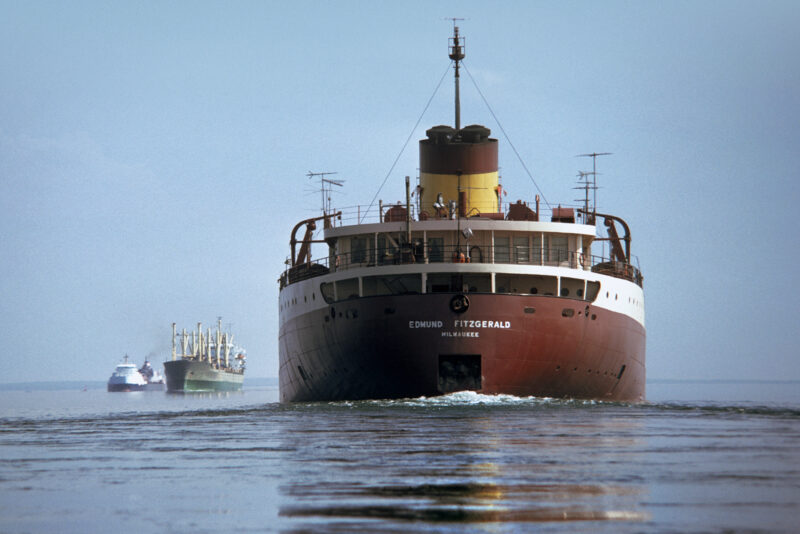
The Edmund Fitzgerald

The legend of the Edmund Fitzgerald remains the most mysterious and controversial of all shipwreck tales heard around the Great Lakes. Her story is surpassed in books, film and media only by that of the Titanic. Canadian folksinger Gordon Lightfoot inspired popular interest in this vessel with his 1976 ballad, “The Wreck of the Edmund Fitzgerald.”

The Edmund Fitzgerald was lost with her entire crew of 29 men on Lake Superior November 10, 1975, 17 miles north-northwest of Whitefish Point, Michigan. Whitefish Point is the site of the Whitefish Point Light Station and Great Lakes Shipwreck Museum. The Great Lakes Shipwreck Historical Society (GLSHS) has conducted three underwater expeditions to the wreck, 1989, 1994, and 1995.

Fitzgerald’s Bell

Fitzgerald’s 200 lb. bronze bell was recovered on July 4, 1995. This expedition was conducted jointly with the Great Lakes Shipwreck Historical Society, National Geographic Society, Canadian Navy, Sony Corporation, and Sault Ste. Marie Tribe of Chippewa Indians. The bell is now on display in the Great Lakes Shipwreck Museum at Whitefish Point as a memorial to her lost crew.

About the Ship
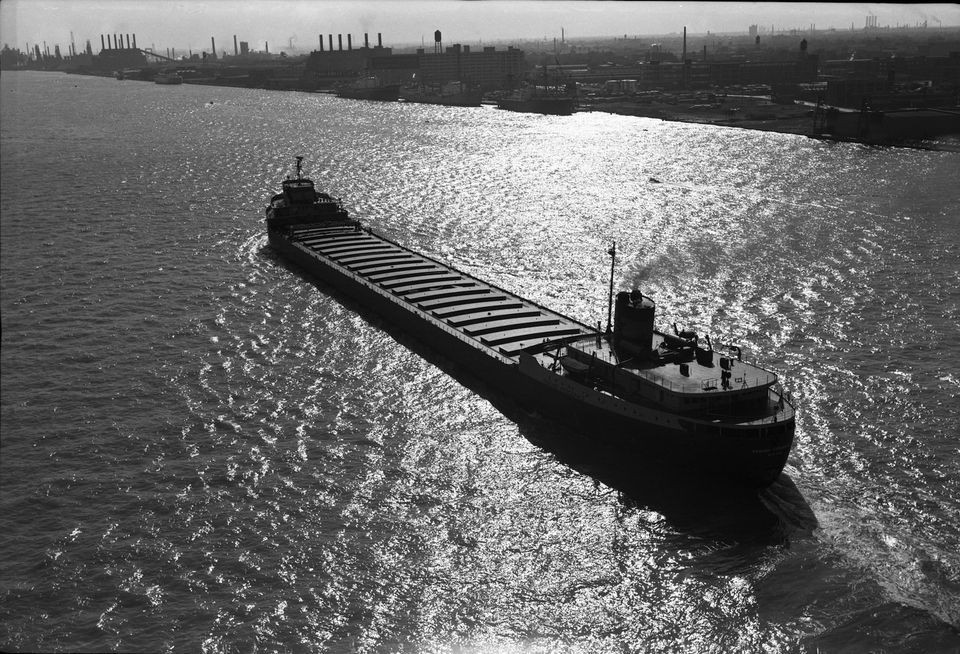
The S.S. Edmund Fitzgerald was conceived as a business enterprise of the Northwestern Mutual Life Insurance Company of Milwaukee, Wisconsin. Northwestern Mutual contracted with Great Lakes Engineering Works of Ecorse, Michigan to construct a “maximum sized” Great Lakes bulk carrier. Her keel was laid on August 7, 1957 as Hull No. 301.

Named after the President and Chairman of the Board of Northwestern Mutual, Fitzgerald was launched June 8, 1958 at River Rouge, Michigan. Northwestern Mutual placed her under permanent charter to the Columbia Transportation Division of Oglebay Norton Company, Cleveland, Ohio. At 729 feet and 13,632 gross tons she was the largest ship on the Great Lakes, for thirteen years, until 1971.

The Fitzgerald’s normal course during her productive life took her between Silver Bay, Minnesota, where she loaded taconite, to steel mills on the lower lakes in the Detroit and Toledo area. She was usually empty on her return trip to Silver Bay. On November 9, 1975 Fitzgerald was to transport a load of taconite from Superior, Wisconsin, to Zug Island, Detroit, Michigan.

Learn some of the “odd” things that happened during the launch of the Fitzgerald in 1958 in this short story!
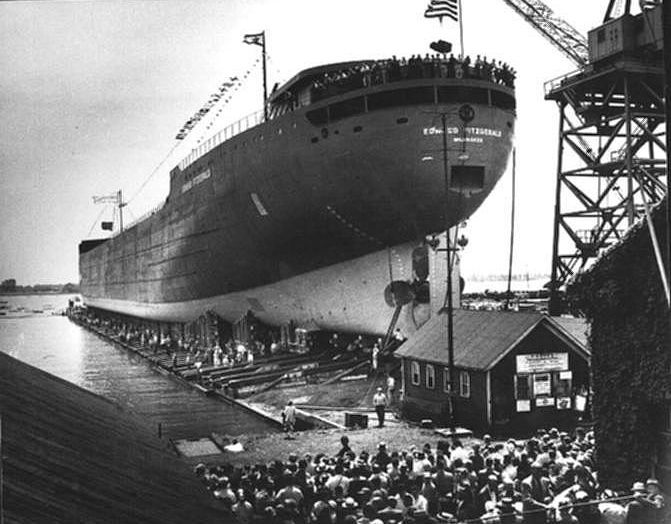
Launch Date – June 8, 1958

The Fateful Journey
by Sean Ley, Development Officer

The final voyage of the Edmund Fitzgerald began November 9, 1975 at the Burlington Northern Railroad Dock No.1, Superior, Wisconsin. Captain Ernest M. McSorley had loaded her with 26,116 long tons of taconite pellets, made of processed iron ore, heated and rolled into marble-size balls. Departing Superior about 2:30 pm, she was soon joined by the Arthur M. Anderson, which had departed Two Harbors, Minnesota under Captain Bernie Cooper. The two ships were in radio contact. The Fitzgerald being the faster took the lead, with the distance between the vessels ranging from 10 to 15 miles.

Aware of a building November storm entering the Great Lakes from the great plains, Captain McSorley and Captain Cooper agreed to take the northerly course across Lake Superior, where they would be protected by highlands on the Canadian shore. This took them between Isle Royale and the Keweenaw Peninsula. They would later make a turn to the southeast to eventually reach the shelter of Whitefish Point.

Weather conditions continued to deteriorate. Gale warnings had been issued at 7 pm on November 9, upgraded to storm warnings early in the morning of November 10. While conditions were bad, with winds gusting to 50 knots and seas 12 to 16 feet, both Captains had often piloted their vessels in similar conditions. In the early afternoon of November 10, the Fitzgerald had passed Michipicoten Island and was approaching Caribou Island. The Anderson was just approaching Michipicoten, about three miles off the West End Light.

Captain Cooper maintained that he watched the Edmund Fitzgerald pass far too close to Six Fathom Shoal to the north of Caribou Island. He could clearly see the ship and the beacon on Caribou on his radar set and could measure the distance between them. He and his officers watched the Fitzgerald pass right over the dangerous area of shallow water. By this time, snow and rising spray had obscured the Fitzgerald from sight, visible 17 miles ahead on radar.

At 3:30 pm that afternoon, Captain McSorley radioed Captain Cooper and said: “Anderson, this is the Fitzgerald. I have a fence rail down, two vents lost or damaged, and a list. I’m checking down. Will you stay by me till I get to Whitefish?” McSorley was checking down his speed to allow the Anderson to close the distance for safety. Captain Cooper asked McSorley if he had his pumps going, and McSorley said, “Yes, both of them.”

As the afternoon wore on, radio communications with the Fitzgerald concerned navigational information but no extraordinarily alarming reports were offered by Captain McSorley. At about 5:20 pm the crest of a wave smashed the Anderson’s starboard lifeboat, making it unusable. Captain Cooper reported winds from the NW x W (305 ) at a steady 58 knots with gusts to 70 knots, and seas of 18 to 25 feet.

According to Captain Cooper, about 6:55 pm, he and the men in the Anderson’s pilothouse felt a “bump”, felt the ship lurch, and then turned to see a monstrous wave engulfing their entire vessel from astern. The wave worked its way along the deck, crashing on the back of the pilothouse, driving the bow of the Anderson down into the sea.

“Then the Anderson just raised up and shook herself off of all that water – barrooff – just like a big dog. Another wave just like the first one or bigger hit us again. I watched those two waves head down the lake towards the Fitzgerald, and I think those were the two that sent her under.”

Keeping Watch
Morgan Clark, first mate of the Anderson, kept watching the Fitzgerald on the radar set to calculate her distance from some other vessels near Whitefish Point. He kept losing sight of the Fitzgerald on the radar from sea return, meaning that seas were so high they interfered with the radar reflection. First mate Clark spoke to the Fitzgerald one last time, about 7:10 pm:

“Fitzgerald, this is the Anderson. Have you checked down?”

“Yes, we have.”

“Fitzgerald, we are about 10 miles behind you, and gaining about 1 1/2 miles per hour. Fitzgerald, there is a target 19 miles ahead of us. So the target would be 9 miles on ahead of you.”

“Well,” answered Captain McSorley, “Am I going to clear?”

“Yes, he is going to pass to the west of you.”

“Well, fine.”

“By the way, Fitzgerald, how are you making out with your problems?” asked Clark.

“We are holding our own.”

“Okay, fine, I’ll be talking to you later.” Clark signed off.

The radar signal, or “pip” of the Fitzgerald kept getting obscured by sea return. And around 7:15 pm, the pip was lost again, but this time, did not reappear. Clark called the Fitzgerald again at about 7:22 pm. There was no answer.

Captain Cooper contacted the other ships in the area by radio asking if anyone had seen or heard from the Fitzgerald. The weather had cleared dramatically. His written report states:

“At this time I became very concerned about the Fitzgerald – couldn’t see his lights when we should have. I then called the William Clay Ford to ask him if my phone was putting out a good signal and also if perhaps the Fitzgerald had rounded the point and was in shelter, after a negative report I called the Soo Coast Guard because I was sure something had happened to the Fitzgerald. The Coast Guard were at this time trying to locate a 16-foot boat that was overdue.”

With mounting apprehension, Captain Cooper called the Coast Guard once again, about 8:00 pm, and firmly expressed his concern for the welfare of the Fitzgerald. The Coast Guard then initiated its search for the missing ship. By that time the Anderson had reached the safety of Whitefish Bay to the relief of all aboard. But the Coast Guard called Captain Cooper back at 9:00 pm:

“Anderson, this is Group Soo. What is your present position?”

“We’re down here, about two miles off Parisienne Island right now…the wind is northwest forty to forty-five miles here in the bay.”

“Is it calming down at all, do you think?”

“In the bay it is, but I heard a couple of the salties talking up there, and they wish they hadn’t gone out.”

“Do you think there is any possibility and you could…ah…come about and go back there and do any searching?”

“Ah…God, I don’t know…ah…that…that sea out there is tremendously large. Ah…if you want me to, I can, but I’m not going to be making any time; I’ll be lucky to make two or three miles an hour going back out that way.”

“Well, you’ll have to make a decision as to whether you will be hazarding your vessel or not, but you’re probably one of the only vessels right now that can get to the scene. We’re going to try to contact those saltwater vessels and see if they can’t possibly come about and possibly come back also…things look pretty bad right now; it looks like she may have split apart at the seams like the Morrell did a few years back.”

“Well, that’s what I been thinking. But we were talking to him about seven and he said that everything was going fine. He said that he was going along like an old shoe; no problems at all.”

“Well, again, do you think you could come about and go back and have a look in the area?”

“Well, I’ll go back and take a look, but God, I’m afraid I’m going to take a hell of a beating out there… I’ll turn around and give ‘er a whirl, but God, I don’t know. I’ll give it a try.”

“That would be good.”

“Do you realize what the conditions are out there?”

No reply from the Coast Guard. Captain Cooper tries again.

“Affirmative. From what your reports are I can appreciate the conditions. Again, though, I have to leave that decision up to you as to whether it would be hazarding your vessel or not. If you think you can safely go back up to the area, I would request that you do so. But I have to leave the decision up to you.”

“I’ll give it a try, but that’s all I can do.”

The Anderson turned out to be the primary vessel in the search, taking the lead. With the ship pounding and rolling badly, the crew of the Anderson discovered the Fitzgerald’s two lifeboats and other debris but no sign of survivors. Only one other vessel, the William Clay Ford, was able to leave the safety of Whitefish Bay to join in the search at the time. The Coast Guard launched a fixed-wing HU-16 aircraft at 10 pm and dispatched two cutters, the Naugatuck and the Woodrush. The Naugatuck arrived at 12:45 pm on November 11, and the Woodrush arrived on November 14, having journeyed all the way from Duluth, Minnesota.

The Coast Guard conducted an extensive and thorough search. On November 14, a U.S. Navy plane equipped with a magnetic anomaly detector located a strong contact 17 miles north-northwest of Whitefish Point. During the following three days, the Coast Guard cutter Woodrush, using a sidescan sonar, located two large pieces of wreckage in the same area. Another sonar survey was conducted November 22-25.

Finding the Fitzgerald
The following May, 1976, Woodrush was again on the scene to conduct a third sidescan sonar survey. Contacts were strong enough to bring in the U.S. Navy’s CURV III controlled underwater recovery vehicle, operating from Woodrush.

The CURV III unit took 43,000 feet of video tape and 900 photographs of the wreck. On May 20, 1976, the words “Edmund Fitzgerald” were clearly seen on the stern, upside down, 535 feet below the surface of the lake.

On April 15, 1977 the U.S. Coast Guard released its official report of “Subject: S.S. Edmund Fitzgerald, official number 277437, sinking in Lake Superior on 10 November 1975 with loss of life.” While the Coast Guard said the cause of the sinking could not be conclusively determined, it maintained that “the most probable cause of the sinking of the S.S. Edmund Fitzgerald was the loss of buoyancy and stability resulting from massive flooding of the cargo hold. The flooding of the cargo hold took place through ineffective hatch closures as boarding seas rolled along the spar deck.”

However, the Lake Carrier’s Association vigorously disagreed with the Coast Guard’s suggestion that the lack of attention to properly closing the hatch covers by the crew was responsible for the disaster. They issued a letter to the National Transportation Safety Board in September, 1977. The Lake Carrier’s Association was inclined to accept that Fitzgerald passed over the Six Fathom Shoal Area as reported by Captain Cooper.

Later, in a videotaped conversation with GLSHS, Captain Cooper said that he always believed McSorley knew something serious had happened to Fitzgerald as the ship passed over Caribou Shoal. Cooper believes that from that point on, McSorley knew he was sinking.

Conflicting theories about the cause of the tragedy remain active today. GLSHS’ three expeditions to the wreck revealed that it is likely she “submarined” bow first into an enormous sea, as damage forward is indicative of a powerful, quick force to the superstructure. But what caused the ship to take on water, enough to lose buoyancy and dive to the bottom so quickly, without a single cry for help, cannot be determined.

Twenty-nine men were lost when the Fitzgerald went down. There is absolutely no conclusive evidence to determine the cause of the sinking. The bell of the ship is now on display in the Great Lakes Shipwreck Museum as a memorial to her lost crew.

Remarkable Answers to Prayer

THE FAMOUS “PRAYING JOHNNY

This eminent saint of God labored in England during the early history of Methodism. His biographer, Harvey Leigh, says: “Our brother was an extraordinary man in the importunity and prevalence of his prayers. What has been said of the strength and constancy of his faith may be said, with equal propriety, of his importunate and prevalent prayers; that is, he was second to none. In fact, we need not be surprised at this, for generally these two excellences walk hand in hand. For some years he was known in the religious world to thousands by the singular name of ‘Praying Johnny.’ This epithet he justified in the whole of his conduct. His prayers were long and very fervent in his own closet.

Mr. Bottomley, who was stationed with him in the Halifax circuit, says: ‘During the time of his stay at Halifax, he was much given up to prayer, and generally spent about six hours each day upon his knees, pleading earnestly with God, in behalf of himself, the church and sinners, whose salvation he most ardently desired.

“Frequently, when harassed by any particular temptation, when concerned about the temporal condition of any person in dangerous affliction, when under engagement to pray for one who was troubled with an evil spirit, when foiled some late attempt to do good, when travailing in anguish of mind for a revival of religion in the neighborhood in which he was laboring, and when deeply anxious to see the glory of the Lord revealed, he has spent many hours in the most decided abstinence and secluded retirement; and has sometimes, in this manner, devoted whole days and nights to God. “In the public services of the sanctuary, John had great influence with God in prayer. In answer to the earnest breathings of his soul, a whole assembly has been moved as the trees are moved when shaken with a strong wind. A mighty shaking has been felt, and a great noise heard, amongst the dry bones. The breath of Jehovah has been felt, numbers among the slain have been quickened, and a great army has been raised up.”A strange fact connected with the history of this good man, and strikingly illustrative of his close communion with God in prayer, and of the results of such communion, we shall here relate.

When in Hull circuit, he visited Burlington Quay, and was rendered eminently useful. When there, his home was with Mr. Stephenson, whose family was one of the most influential in the place. Their mercantile engagements were numerous; at home they carried on a considerable business, and were extensively connected with the shipping department. About the year 1825, Mr. Stephenson had a ship at sea, on a foreign and distant voyage, about the safety of which he and the family began to feel anxious. There had not been any tidings of the vessel extending over a period far beyond what they had expected. And what tended much to increase their solicitude, they had a son on board for whom they feared the worst – feared that they should see him no more. At this time Mr. Oxtoby was sojourning in the family, and was painfully concerned at witnessing their anxiety. Pressed in spirit for them, and desirous to be the instrument of their relief, he fell back upon his usual and safe resort-special fasting and protracted prayer to God– in which he besought the Almighty to give him an assurance whether the ship was really lost, or whether it would return home in safety. In his protracted travail, he clearly ascertained that the ship, which had been the object of so much solicitude, was not lost, but that it and the son for whose safety the family were so anxious, would, in due course, return in safety, and that all would be well. This welcome intelligence he communicated to the anxious family; and did it with as much confidence as characterized St. Paul’s mind, when he uttered his noble speech to the embarrassed ship’s crew, while they drew near to the island of Melita, and, contrary to all human appearance, assured them that not a hair of their heads should perish. Rut high as our brother stood in the estimation of the family, and exalted as was their opinion of his extraordinary piety, and the power and prevalency of his prayers, yet his calm and positive assertions on this subject almost exceeded the powers of their belief; and though they did not distrust them, they staggered at them. But John remained unmoved. He smiled at their doubts; reiterated his expressions of confidence; told them that God had ‘shown him the ship while at prayer;’ that he was as certain of her safe return as if she were in the harbor then; and that when the vessel returned, though he had never seen her, excepting when revealed to him in prayer, he should know her, and could easily distinguish her from any other.

Time rolled on, John pursued his work, and the family remained anxious, when news reached them, one day, that the vessel was safe and on her way home. It soon after arrived, at which time Mr. Oxtoby was about ten miles distant in the country. The Stephenson family were, however, so delighted with the occurrence-with the realization of all/~their devoted friend had uttered-with the accomplishment of what, to them, appeared like a prediction, and from which the good man had never wavered-no, not for a moment-that a gig was immediately sent for him, by which he was to return with the least possible delay. When he reached Burlington Quay, Mr. Stephenson asked him if he should know the ship about which he had sought Divine counsel, providing he could see her. ‘I should,’ said John; ‘God so clearly revealed her, to me in prayer, that I could distinguish her among a hundred.’ Then they walked out on the pier, and on their left were many vessels, some near and some remote, floating at anchor in the spacious bay. Among them John looked, and exclaimed; while pointing in a certain direction : ‘That’s the ship which God showed me while at prayer. I knew she would come home safely, and that I should see her.’ We need scarcely add that in this he was correct; and that this last particular of the strange account filled Mr. Stephenson with overwhelming amazement.” – Shining Lights.

Revelation 20:13

The Final Judgment
…And I saw the dead, great and small, standing before the throne. And there were open books, and one of them was the Book of Life. And the dead were judged according to their deeds, as recorded in the books. The sea gave up its dead, and Death and Hades gave up their dead, and each one was judged according to his deeds. Then Death and Hades were thrown into the lake of fire. This is the second death—the lake of fire.…

And the sea gave up the dead which were in it – All that had been buried in the depths of ocean. This number in the aggregate will be great. If we include all who were swept off by the flood, and all who have perished by shipwreck, and all who have been killed in naval battles and buried in the sea, and all who have been swept away by inundations of the ocean, and all who have peacefully died at sea, as sailors, or in the pursuits of commerce or benevolence, the number in the aggregate will be immense – a number so vast that it was proper to notice them particularly in the account of the general resurrection and the last judgment.
And death and hell delivered up the dead which were in them – That is, all the dead came, from all regions where they were scattered – on the land and in the ocean – in this world and in the invisible world. “Death and hell” are here personified, and are represented as having dominion over the dead, and as now “delivering” up, or “surrendering” those who were held tinder them. On the meaning of the words used here, see the notes on Revelation 1:18; Revelation 6:8. Compare the Matthew 10:23 note; Job 10:21-22 notes; Isaiah 14:9 note. This whole representation is entirely inconsistent with the supposition that a large part of the dead had been already raised up at the beginning of the millennial period, and had been permitted, in their glorified bodies, to reign with Christ.

And they were judged, … – All these were judged – the righteous and the wicked; those buried at sea, and those buried on the land; the small and the great; the dead, in whatever world they may have been.

Praying for peace in times of trouble

In The Life of D.L. Moody, William R. Moody (D.L.’s son) records his father’s reflections on his experience aboard the Spree, a passenger ship that was to take him from London to New York. At some point in the voyage, the Spree’s drive shaft broke, putting a hole in the hull. The ship began to sink. Dwight Moody describes the experience:

“The officers and crew did all that they could to save the vessel. But it was soon found that the pumps were useless, for the water poured into the ship too rapidly to be controlled. There was nothing more in the power of man to do, and the ship was absolutely helpless, while the passengers could only stand still on the poor, drifting, sinking ship and look into our possible watery graves.”

After several more days on the ship, the situation seemed increasingly dire and Mr. Moody entered what he called “the darkest hour of my life.” Yet, even in that dark hour, Dwight Moody turned to God. It was in that moment that he found peace:

“I could not endure it. I must have relief, and relief came in prayer. God heard my cry, and enabled me to say, from the depth of my soul, ‘Thy will be done!’ Sweet peace came to my heart. Let it be Northfield or Heaven, it made no difference now. I went to bed, fell asleep almost immediately, and never slept more soundly in all my life. Out of the depths I cried unto my Lord, and He heard me and delivered me from all my fears. I can no more doubt that God gave answer to my prayer for relief than I can doubt my own existence.”

In reflecting on Moody’s experience at sea, I am reminded that God is with us in the midst of our troubles, and that He is not constrained by our troubles. His limits are never challenged. There is never a moment when there is nothing more He can do. God works beyond the possibilities we can imagine.

The Nearly Fatal Voyage

D.L. Moody faced a crisis at sea, and God confronted him with a life-changing decision.

D.L. Moody and his son Will boarded the ocean liner Spree at Southampton, England, on November 23, 1892. Moody had just finished revival meetings in London, including eight days of services in Spurgeon’s Tabernacle, and now he was bound for New York. Foremost in his mind, besides seeing his family and students again, was the great campaign he was planning for the Chicago World’s Exhibition the following year.


On the third morning of the trip, passengers were startled by a loud crash and a shock going through the ship. Will hurried out to the deck. He quickly returned to say that the shaft of the vessel was broken. “The ship’s sinking, Father,” he said.

The disabled ship, carrying hundreds of passengers, drifted helplessly away from the sea lanes. The vessel was taking on so much water that its pumps were useless. The crew prepared lifeboats and provisions, but they realized the small boats would soon perish in the rough seas. So they mustered passengers into a main saloon and waited, hoping to be discovered by a passing vessel.

On the second evening of their torturous wait, Moody led a prayer service that calmed many of the passengers, including himself. Although he was sure of heaven, the thought of his work ending and of never again seeing his family had unsettled him.

One biographer includes another angle to the incident. Prior to the trip, a doctor had found irregularities in Moody’s heart and urged him to ease his schedule; if Moody did not, he would die early. Moody determined to slow down, and while sailing homeward, decided to scale down plans for the World’s Fair campaign.

During the crisis at sea, however, Moody perceived that God confronted him with a decision: Would Moody press on with all his might to deliver the gospel or would he be cautious, allowing fear to diminish his fervor? Facing death, Moody decided that if God would spare his life, he would work with “all the power that He would give me.” And if he should die this year or next, that was in God’s hands.

The following morning, however, the steamer Lake Huron discovered the stranded ship and towed it one thousand miles to safety. D.L. Moody pressed on with his World’s Fair campaign, six months of unceasing labor, from which, in Moody’s estimate, “millions … heard the simple gospel” and “thousands [were] genuinely converted to Christ.” Moody died in the midst of his work—seven years later.

Stephen Boyd Blog

Belfast-born Hollywood and International Star from 1950-1970's Fan Tribute Page

Abundant Joy

Digging Deep Into The Word

Not My Life

The Bible as clear as possible

Seek Grow Love

Growing Throughout the Year

Smoodock's Blog

Question Authority

PleaseGrace

A bit on daily needs and provisions

Three Strands Lutheran Parish

"A cord of three strands is not easily broken." Ecclesiastes 4:12

1love1god.com

Romans 5:8

The Rev. Jimmy Abbott

read, watch, listen

BEARING CHRIST CRUCIFIED AND RISEN

To know Christ and Him crucified

Considering the Bible

Scripture Musings

rolliwrites.wordpress.com/

The Official Home of Rolli - Author, Cartoonist and Songwriter

Pure Glory

The heavens are telling the glory of God; and the firmament proclaims His handiwork. Psalms 19:1

The daily addict

The daily life of an addict in recovery

The Christian Tech-Nerd

-Reviews, Advice & News For All Things Tech and Gadget Related-

Thinking Through Scripture

to help you walk with Jesus in faith, hope, and love.

A disciple's study

This is my personal collection of thoughts and writings, mainly from much smarter people than I, which challenge me in my discipleship walk. Don't rush by these thoughts, but ponder them.

Author Scott Austin Tirrell

Maker of fine handcrafted novels!

In Pursuit of My First Love

Returning to the First Love