GOD, in olden time suffered man to be kept in ward by the law that he might learn the more excellent way of faith. For by the law he would see God’s holy standard and by the law he would see his own utter helplessness; then he would be glad to learn God’s way of faith. God still shuts us up to faith. Our natures, our circumstances, trials, disappointments, all serve to shut us up and keep us in ward till we see that the only way out is God’s way of faith. Moses tried by self-effort, by personal influence, even by violence, to bring about the deliverance of his people. God had to shut him up forty years in the wilderness before he was prepared for God’s work. Paul and Silas were bidden of God to preach the Gospel in Europe. They landed and proceeded to Philippi. They were flogged, they were shut up in prison, their feet were put fast in the stocks. They were shut up to faith. They trusted God. They sang praises to Him in the darkest hour, and God wrought deliverance and salvation. John was banished to the Isle of Patmos. He was shut up to faith. Had he not been so shut up, he would never have seen such glorious visions of God. Dear reader, are you in some great trouble? Have you had some great disappointment, have you met some sorrow, some unspeakable loss? Are you in a hard place? Cheer up! You are shut up to faith. Take your trouble the right way. Commit it to God. Praise Him that He maketh “all things work together for good,” and that “God worketh for him that waiteth for him.” There will be blessings, help and revelations of God that will come to you that never could otherwise have come; and many besides yourself will receive great light and blessing because you were shut up to faith.—C. H. P.
“Great things are done when men and mountains meet. These are not done by jostling in the street.”
25 AUGUST (PREACHED 20 JANUARY 1767 & 30 MAY 1779)
The brightest rainbow on the darkest cloud
‘And it shall come to pass, when I bring a cloud over the earth, that the bow shall be seen in the cloud.’ Genesis 9:14 SUGGESTED FURTHER READING: Genesis 9:8–17
The rainbow is promised in the cloud and in due time it shall appear. This may signify: (i) that their troubles shall be moderated. ‘I will correct thee in measure, but will not make a full end of thee.’ The degree and the duration of their trials are limited and have bounds beyond which they cannot pass. He remembers their frame and considers they are but dust. (ii) they are supported. They wonder how it is possible, but they find they do hold out. Had they been told what they were to go through, they would have sunk at the thought, but they are brought through the storm, because, though his face may be hid, his arm is underneath them. (iii) they are at last comforted. The rainbow does not usually appear in the cloud at first, but rather when the rain is going off. And as the brightest rainbow is painted upon the darkest cloud, so their greatest distresses are often accompanied or succeeded by their brightest and sweetest consolations. Remember therefore when you see the rainbow, that it is a witness for the truth of God’s promise—that he will not contend for ever, that all shall work together for good, that though weeping may endure for a night, joy shall come in the morning. But to sinners, out of Christ, the rainbow gives you but small comfort as a pledge that you shall not be destroyed by a deluge. Yet the rainbow signifies to you that the day of God’s grace and patience is not yet ended; it encourages you to seek him for pardon and salvation. FOR MEDITATION: When the sun, with cheerful beams, Thus the Lord’s supporting power Smiles upon a lowering sky; Brightest to his saints appears, Soon its aspect softened seems, When affliction’s threatening hour And a rainbow meets the eye: Fills their sky with clouds and fears: While the sky remains serene, He can wonders then perform, This bright arch is never seen. Paint a rainbow on the storm.
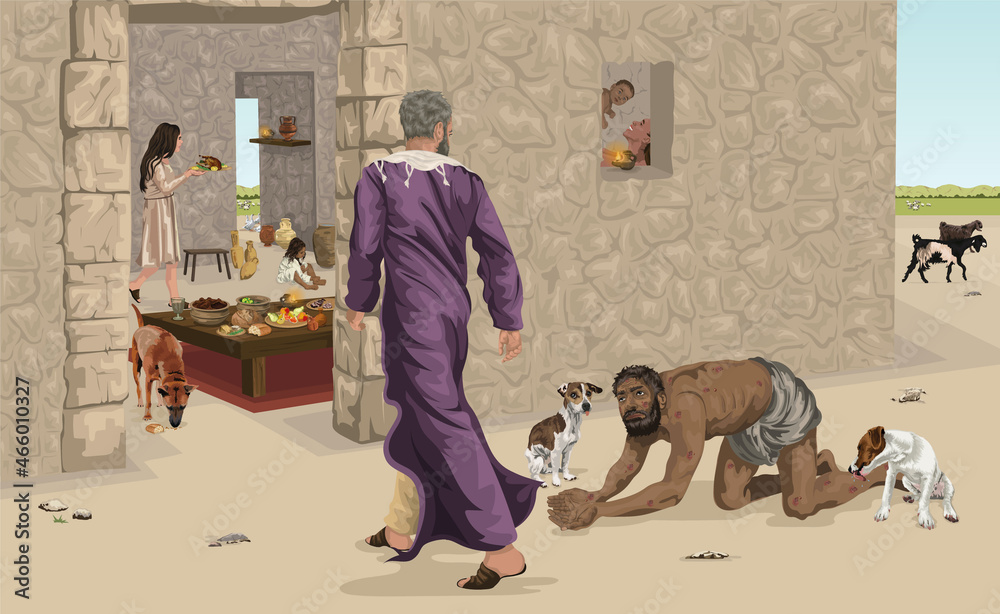
Luke 16:19-31 contains the account of a very rich man who lived a life of extreme luxury. Laid outside the gate of this rich man’s house, however, was an extremely poor man named Lazarus who simply hoped “to eat what fell from the rich man’s table” (v. 21). The rich man was completely indifferent to the plight of Lazarus, showing him no love, sympathy, or compassion whatsoever. Eventually, they both died. Lazarus went to heaven, and the rich man went to hell. Appealing to “Father Abraham” in heaven, the rich man requested that Lazarus be sent to cool his tongue with a drop of water to lessen his “agony in this fire.” The rich man also asked Abraham to send Lazarus back to earth to warn his brothers to repent so that they would never join him in hell. Both requests were denied. Abraham told the rich man that if his brothers did not believe in Scripture, neither would they believe a messenger, even if he came straight from heaven.
There is some question as to whether this story is a true, real-life account or a parable, since two of its characters are named (making it unique among parables). Parable or not, however, there is much we can learn from this passage:
First of all, Jesus teaches here that heaven and hell are both real, literal places. Sadly, many preachers shy away from uncomfortable topics such as hell. Some even teach “universalism” – the belief that everyone goes to heaven. Yet Christ spoke about hell a great deal, as did Paul, Peter, John, Jude, and the writer of Hebrews. The Bible is clear that every person who has ever lived will spend eternity in either heaven or hell. Like the rich man in the story, multitudes today are complacent in their conviction that all is well with their soul, and many will hear our Savior tell them otherwise when they die (Matthew 7:23).
This story also illustrates that once we cross the eternal horizon, that’s it. There are no more chances. The transition to our eternal state takes place the moment we die (2 Corinthians 5:8; Luke 23:43; Philippians 1:23). When believers die, they are immediately in the conscious fellowship and joys of heaven. When unbelievers die, they are just as immediately in the conscious pain, suffering, and torment of hell. Notice the rich man didn’t ask for his brothers to pray for his release from some purgatorial middle ground, thereby expediting his journey to heaven. He knew he was in hell, and he knew why. That’s why his requests were merely to be comforted and to have a warning sent to his brothers. He knew there was no escape. He was eternally separated from God, and Abraham made it clear to him that there was no hope of ever mitigating his pain, suffering, or sorrow. Those in hell will perfectly recollect missed opportunities and their rejection of the gospel.
Like many these days who buy into the “prosperity gospel,” the rich man wrongly saw his material riches as evidence of God’s love and blessing. Likewise, he believed the poor and destitute, like Lazarus, were cursed by God. Yet, as the apostle James exhorted, “You have lived on earth in luxury and self-indulgence. You have fattened yourselves in the day of slaughter” (James 5:5). Not only do riches not get one into heaven, but they have the power to separate a person from God in a way that few other things can. Riches are deceitful (Mark 4:19). It is certainly not impossible for the very rich to enter heaven (many heroes of the Bible were wealthy), but Scripture is clear that it is very hard (Matthew 19:23-24; Mark 10:23-25; Luke 18:24-25).
True followers of Christ will not be indifferent to the plight of the poor like the rich man in this story was. God loves the poor and is offended when His children neglect them (Proverbs 17:5; 22:9, 22-23; 29:7; 31:8-9). In fact, those who show mercy to the poor are in effect ministering to Christ personally (Matthew 25:35-40). Christians are known by the fruit they bear. The Holy Spirit’s residence in our hearts will most certainly impact how we live and what we do.
Abraham’s words in verses 29 and 31 referring to “Moses and the Prophets” (Scripture) confirms that understanding the revealed Word of God has the power to turn unbelief into faith (Hebrews 4:12; James 1:18; 1 Peter 1:23). Furthermore, knowing Scripture helps us to understand that God’s children, like Lazarus, can suffer while on this earth—suffering is one of the many tragic consequences of living in a sinful and fallen world.
The Bible says our earthly lives are a “mist that appears for a little while and then vanishes” (James 4:14). Our earthly sojourn is exceedingly brief. Perhaps the greatest lesson to learn from this story, then, is that when death comes knocking on our door there is only one thing that matters: our relationship with Jesus Christ. “What good will it be for a man if he gains the whole world, yet forfeits his soul?” (Matthew 16:26; Mark 8:36). Eternal life is only found in Christ. “God has given us eternal life, and this life is in His Son. He who has the Son has life; he who does not have the Son of God does not have life” (1 John 5:11-12). The truth is, if we wish to live apart from God during our time on earth, He will grant us our wish for eternity as well. As one pastor aptly said, “If you board the train of unbelief, you will have to take it all the way to its destination.”
“There was a rich man who was clothed in purple and fine linen and who feasted sumptuously every day. And at his gate was laid a poor man named Lazarus, covered with sores, who desired to be fed with what fell from the rich man’s table. Moreover, even the dogs came and licked his sores. The poor man died and was carried by the angels to Abraham’s side. The rich man also died and was buried, and in Hades, being in torment, he lifted up his eyes and saw Abraham far off and Lazarus at his side. And he called out, ‘Father Abraham, have mercy on me, and send Lazarus to dip the end of his finger in water and cool my tongue, for I am in anguish in this flame.’ But Abraham said, ‘Child, remember that you in your lifetime received your good things, and Lazarus in like manner bad things; but now he is comforted here, and you are in anguish. And besides all this, between us and you a great chasm has been fixed, in order that those who would pass from here to you may not be able, and none may cross from there to us.’ And he said, ‘Then I beg you, father, to send him to my father’s house— for I have five brothers—so that he may warn them, lest they also come into this place of torment.’ But Abraham said, ‘They have Moses and the Prophets; let them hear them.’ And he said, ‘No, father Abraham, but if someone goes to them from the dead, they will repent.’ He said to him, ‘If they do not hear Moses and the Prophets, neither will they be convinced if someone should rise from the dead.’”
Or what man is there of you, whom if his son ask bread, will he give him a stone? Matthew 7:9.
The illustration of prayer that Our Lord uses here is that of a good child asking for a good thing. We talk about prayer as if God heard us irrespective of the fact of our relationship to Him (cf. Matthew 5:45.) Never say it is not God’s will to give you what you ask, don’t sit down and faint, but find out the reason, turn up the index. Are you rightly related to your wife, to your husband, to your children, to your fellow-students—are you a ‘good child’ there? ‘Oh, Lord, I have been irritable and cross, but I do want spiritual blessing.’ You cannot have it, you will have to do without until you come into the attitude of a good child. We mistake defiance for devotion; arguing with God for abandonment. We will not look at the index. Have I been asking God to give me money for something I want when there is something I have not paid for? Have I been asking God for liberty while I am withholding it from someone who belongs to me? I have not forgiven someone his trespasses; I have not been kind to him; I have not been living as God’s child among my relatives and friends (see v. 12). I am a child of God only by regeneration, and as a child of God I am good only as I walk in the light. Prayer with most of us is turned into pious platitude, it is a matter of emotion, mystical communion with God. Spiritually we are all good at producing fogs. If we turn up the index, we will see very clearly what is wrong—that friendship, that debt, that temper of mind. It is no use praying unless we are living as children of God. Then, Jesus says—“Everyone that asketh receiveth.”
This is my personal collection of thoughts and writings, mainly from much smarter people than I, which challenge me in my discipleship walk. Don't rush by these thoughts, but ponder them.



 Milo
Milo 