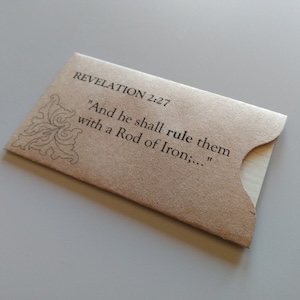
This verse continues Jesus’ words about His kingdom, given to John to send to the church at Thyatira (Revelation 2:18). This continues His reference, in verse 26, to one who “overcomes,” by faithfully enduring. Jesus announces that He will give the conqueror the authority to rule the nations with a rod of iron.
This ruling action will be in cooperation with Jesus. Psalm 2:9 predicts that Jesus will rule the nations with a rod of iron and dash them in pieces like a potter’s vessel. The word “rod” refers to a shepherd’s staff. Jesus will be not only King over all the nations but also their Shepherd. The fact that He and the conquerors use a staff of iron indicates that not everyone will voluntarily submit to Jesus’ rule, but everyone will have to submit to it. At the end of Jesus’ earthly reign, those who submitted unwillingly will rebel. They will marshal themselves against Jesus but fall dead when He strikes them with a sharp sword that proceeds from His mouth (Revelation 19:15–21).
The authority to rule the nations follows an order. The father grants it to Jesus, and in turn Jesus grants it to His faithful followers.
Context Summary Revelation 2:18–29 reveals what Jesus instructed John to write to the church at Thyatira. Although the church exhibited commendable virtues, it allowed an evil woman—here referred to as Jezebel—to lead its members into immorality and idolatry. Jesus predicted strict punishment for her and her followers. The churches would know by Jesus’ action that He searches the mind and heart and deals with everyone according to his or her works. Those who did not follow Jezebel’s teachings would not be punished, but Jesus encouraged them to stay loyal to Him until His return, when He will rule the nations and permit the faithful to rule with Him.
Chapter Summary The contents of Revelation 2 are miniature letters to four churches, dictated by Jesus to John. Ephesus and Smyrna were coastal cities, whereas Pergamum and Thyatira were inland cities. Three more such letters are in Revelation 3. Each of these messages contains a unique description of Jesus, a command, a promise. All but one—the church in Laodicea—receive some commendation. All but two of the seven letters—those to the churches in Smyrna and Philadelphia—also contain a critical rebuke. Like churches today, most of the congregations addressed by Jesus had both good characteristics and at least one point which needed correction.
Bible Question: Does God appoint evil leaders to lead nations?
Bible Answer: The answer to the question, “Does God appoint evil leaders to lead nations?” is yes! That is the message of Romans 13:1, but Hosea 8:4 seems to contradict.
Every person is to be in subjection to the governing authorities. For there is no authority except from God, and those which exist are established by God. Romans 13:1 (NASB)
Here is Hosea 8:4,
They have set up kings, but not by Me; They have appointed princes, but I did not know it. With their silver and gold they have made idols for themselves, That they might be cut off. Hosea 8:4 (NASB)
Does God Appoint Evil Leaders?
Romans 13:1 States That God Establishes All Governments
The key statement that we want to examine in Romans 13:1 is “no authority except from God, and those which exist are established by God.” There are two words of interest. The first is the word “authority” which in the Greek is exousia. It refers to anyone who has power or can exercise authority. In the context of Romans 13:1-7, it refers to governmental authority. The Greek word that is translated as “established” is tasso. This word appears eight times in the New Testament (Matthew 28:16; Luke 7:8; Acts 13:48; 15:2; 22:10; 28:23; Romans 13:1; 1 Corinthians 16:15). The word means “to appoint, to order, or to arrange”. That is, every governmental leader has been appointed, arranged or established by God.
Earlier in Romans 9:17, we are reminded that God put the Pharaoh of Egypt in his position of authority. We learn from Exodus 7-11 that this Pharaoh was an evil ruler. Romans 9:17 is a quote from Exodus 9:16-17, and it illustrates the principle of Romans 13:1.
For the Scripture says to Pharaoh, “FOR THIS VERY PURPOSE I RAISED YOU UP, TO DEMONSTRATE MY POWER IN YOU, AND THAT MY NAME MIGHT BE PROCLAIMED THROUGHOUT THE WHOLE EARTH.” Romans 9:17 (NASB)
In John 19:11 Jesus told Pontius Pilate, who was an evil governor, that his authority came from God the Father. In Daniel 4:17, the evil ruler of the Babylonian empire, King Nebuchadnezzar, reports part of a dream that God gave him.
This sentence is by the decree of the angelic watchers And the decision is a command of the holy ones, In order that the living may know That the Most High is ruler over the realm of mankind, And bestows it on whom He wishes And sets over it the lowliest of men.” Daniel 4:17 (NASB)
The same principle is communicated throughout Scripture (Psalms 75:6-7; Proverbs 8:15).
God Allows Nations to Select Rulers and Then He Establishes Them
In 1 Samuel 8, an amazing event is described that illustrates how God establishes or appoints rulers over nations. In 1 Samuel 8:1-7, we are told that the nation of Israel had rejected God as their king. Verse 7 summarizes Israel’s request.
The LORD said to Samuel, “Listen to the voice of the people in regard to all that they say to you, for they have not rejected you, but they have rejected Me from being king over them.” 1 Samuel 8:7 (NASB)
Consequently, God allowed Israel to have their own king. Verses 10-18 record what God told Samuel to communicate to Israel that they would experience with their new king. The entire description is negative and in verse 18 we read this,
Then you will cry out in that day because of your king whom you have chosen for yourselves, but the LORD will not answer you in that day. 1 Samuel 8:18 (NASB)
The message to Israel was simple. They would be allowed to select their ruler, but it was not the ruler God wanted for them. The ruler would be an evil one who would oppress them. Yet God would establish his throne, but he would not be God’s choice.
Later in Hosea 13:9-11, God rebukes Israel for rejecting Him as their king. Notice that God says they had asked the judges for a king. The prophet Samuel was also a judge (1 Samuel 3:20; 7:15). They had asked for a king, and God gave them a king. In verse 11, God reveals that this was not His choice. Yet God appointed him and established his throne.
It is your destruction, O Israel, That you are against Me, against your help. Where now is your king That he may save you in all your cities, And your judges of whom you requested, “Give me a king and princes”? I gave you a king in My anger And took him away in My wrath. Hosea 13:9-11 (NASB)
King Saul proved to be an evil king. Most of the kings of the northern Kingdom of Israel and the southern Kingdom of Judah were evil kings. The people of Israel or the leaders of Israel selected their kings without consulting God. He allowed their choices. Yet He granted these men the authority to rule as kings.
Hosea 8:4 Records God’s Appointment Of The Kings Israel Selected
Therefore, how should we understand Hosea 8:4?
They cry out to Me, “My God, we of Israel know You!” Israel has rejected the good; The enemy will pursue him. They have set up kings, but not by Me; They have appointed princes, but I did not know it. With their silver and gold they have made idols for themselves, That they might be cut off. Hoses 8:2-4 (NASB)
The answer is that as Israel rejected God as their king in 1 Samuel 8:1-18, God granted their choice. God repeatedly supported their horrible choices of subsequent kings. There is no contradiction between Romans 13:1 and Hosea 8:4.
The Purpose of Government
Government exists and survives because God supports it. Yet when the rulers become too evil, God will judge them and punish them. Zechariah 1:15 tells us that God tolerates some evil from nations; but when they are excessively evil, God punishes them.
Romans 13:4 gives us the purpose of government and rulers. They were appointed by God to suppress evil or keep evil in check. When they fail to do this, it is time for judgment. God has not established human government to Christianize the world. The purpose of government is to suppress evil and maintain some semblance of justice and care for the oppressed (Isaiah 1:16-17). Isaiah 1:16-17 is not a Christian statement. It describes the rebuke of the nation of Israel. Amos 5:15 is another rebuke of the nation for failing to hate evil, love good and establish justice.
Conclusion: The government of the United States of America is currently failing to hate evil, love good, and establish justice. The government is accepting evil, even loving evil. Lady Justice is lifting the blindfold so that one eye can see who is being accused, and then she often fails to render justice. There is one standard of justice for the politically connected, powerful and wealthy, and another standard of law for everyone else. Judges 21:25 describes our nation.
In those days there was no king in Israel; everyone did what was right in his own eyes. Judges 21:25 (NASB)
Judgment is coming upon the United States unless it changes. Remember the purpose of government is to suppress evil. Yet, God commands us to submit to whatever government He has established.
1 Peter 2:13-15 tells us that it is His will that we submit to government. We encourage the reader to visit, “Seeking God’s Will.” In Scripture individual Christians are never encouraged to demonstrate or commit acts of violence in response to repressive governments. To do so would be to rebel against God’s established authority (Romans 13:2-4; Titus 3:1). Evil governments are God’s ministers as long they are not excessively evil (Zechariah 1:15). There is only one reason for Christians to disobey government. That is when government commands us to violate God’s laws (Acts 4:19-20; 5:27-29). Otherwise, Jesus calls us to be peacemakers (Matthew 5:9). In the United States of America, we have the privilege and responsibility to express our disagreement or approval of our government by voting. So, Christian, vote according to biblical principles and pray for your nation! Pray that its leaders would come to faith in Jesus Christ.
As informed Bible students have observed so many times in the past, the providential activity of God is beyond human analysis. I sometimes refer to it as a provable-nonprovable proposition.
This is what I mean: the Lord’s providential operations are certain; for, in principle, Bible examples demonstrating such are very clear. The experiences of Joseph are sufficient within themselves to establish this point (see Genesis 45:5-9; 50:20).
It is equally certain, however, that providential actions are veiled from human perception at the time they are transpiring (Ruth 2:3; Esther 4:14). Paul, in referring to the conversion of Onesimus, could not be sure whether providence figured into the glorious event or not (Philemon 15). He suspected that it did, but he could not positively affirm it.
One aspect of Jehovah’s providence is his international operation. He is “ruler over the nations” (Psalm 22:28), and civil powers rise and fall at his behest (Daniel 2:21; 4:35). The general rule seems to be, “righteousness exalts a nation” (Proverbs 14:34), but “nations that forget God” are consigned to Sheol, i.e., the region of the wicked dead (Psalms 9:17).
Let us note several categories of this mysterious process of national providence.
The Use of Righteous Nations The Lord can use a righteous nation to overthrow a wicked one. This certainly was the case in Israel’s early history when God led his people into Canaan and commanded them to destroy the tribes of that land (Deuteronomy 20:16-17). The ultimate potential redemption of humanity was at the root of this moral surgery. The failure of the nation to carry out completely the instructions was a source of severe hardship in the years that followed.
The Use of Wicked Nations Jehovah may use an evil nation to chastise a relatively better one. There is no question but that the nations of Assyria and Babylon were far worse than both Israel and Judah, yet the Lord employed both of these pagan powers to punish his people who gradually (and sometimes more than gradually) were drifting into apostasy.
The Assyrians came marching against the northern kingdom of Israel under Tiglath-pileser (2 Kings 15:29; 16:7-9), and then twelve years later under Shalmaneser and Sargon. The capital city of Samaria was under siege for three years. It subsequently fell, and over twenty-seven thousand Jews were taken to Assyria as captives. All of this was because “they obeyed not the voice of Jehovah their God” (2 Kings 18:9-12).
A little more than a century later, Judah fell as well. Through the prophet Jeremiah, Jehovah pledged that he would send his “servant,” Nebuchadnezzar, against Judah, bringing desolation upon the land, and most of the people would be taken captive into Babylon.
This punishment was “because you have not heard my words” (Jeremiah 25:8ff). It is estimated that some seventy thousand Hebrews were transported into the pagan king’s land. The prophet Habakkuk disputed with God about the use of a heathen king to chastise his own people; but the Lord assured him such was necessary, and Nebuchadnezzar would be dealt with in due time (Habakkuk 1:5-11; cf. Jeremiah 25:12ff).
When the Jewish nation reached the zenith of its rebellion, even to the extent of murdering its long-awaited Messiah, God determined to send the Roman armies (called “his armies”) to destroy many of the Jews and burn their city (see Matthew 22:7). According to the Jewish historian, Josephus, more than a million Hebrews were slain and thousands more were sold into slavery.
The Lord had instructed Jewish Christians to “flee” the city (Matthew 24:15ff). What do you suppose would have been the fate of these children of God had they insisted they were patriots and therefore had the right to defend their Hebrew kinsmen and their homes against the evil empire of Rome?
Does the Principle Still Prevail? Now here is the intriguing question: is God still working internationally—raising up and overthrowing powers, consistent with his ultimate will for mankind? Paul argues that he is.
The apostle contends that God “made of one [literally, out of one male] every nation of men to dwell on all the face of the earth, having determined their appointed seasons, and the bounds of their habitations” (Acts 17:26). The providential purpose in this international orchestration is revealed in v. 27.
How, then, does one know which nations to favor and which to condemn? He doesn’t! That is God’s affair. He acts consistent with his own sovereignty and purpose (regardless of whether we understand the reasons or not), and no one is wise enough to question him (see Daniel 4:35; Romans 11:33-35).
The Christian’s duty is to love the Lord, do his will, serve his kinsmen in Christ, work for the conversion of the lost, and conduct his attitude and life so as to facilitate his enemies’ salvation, if at all possible. Unfortunately these are biblical truths which all too many appear to have forgotten—if indeed they ever understood them.
The voice of the Spirit is as gentle as a zephyr, so gentle that unless you are living in perfect communion with God, you never hear it. The checks of the Spirit come in the most extraordinarily gentle ways, and if you are not sensitive enough to detect His voice you will quench it, and your personal spiritual life will be impaired. His checks always come as a still small voice, so small that no one but the saint notices them. Beware if in personal testimony you have to hark back and say—‘Once, so many years ago, I was saved.’ If you are walking in the light, there is no harking back, the past is transfused into the present wonder of communion with God. If you get out of the light you become a sentimental Christian and live on memories, your testimony has a hard, metallic note. Beware of trying to patch up a present refusal to walk in the light by recalling past experiences when you did walk in the light. Whenever the Spirit checks, call a halt and get the thing right, or you will go on grieving Him without knowing it. Suppose God has brought you up to a crisis and you nearly go through but not quite, He will engineer the crisis again, but it will not be so keen as it was before. There will be less discernment of God and more humiliation at not having obeyed; and if you go on grieving the Spirit, there will come a time when that crisis cannot be repeated, you have grieved Him away. But if you go through the crisis, there will be the psalm of praise to God. Never sympathize with the thing that is stabbing God all the time. God has to hurt the thing that must go.
“If the clouds be full of rain, they empty themselves upon the earth.” (Eccles. 11:3.)
WHY, then, do we dread the clouds which now darken our sky? True, for a while they hide the sun, but the sun is not quenched; he will be out again before long. Meanwhile those black clouds are filled with rain; and the blacker they are, the more likely they will yield plentiful showers. How can we have rain without clouds? Our troubles have always brought us blessings, and they always will. They are the dark chariots of bright grace. These clouds will empty themselves before long, and every tender herb will be gladder for the shower. Our God may drench us with grief, but He will refresh us with mercy. Our Lord’s love-letters often come to us in black-edged envelopes. His wagons rumble, but they are loaded with benefits. His rod blossoms with sweet flowers and nourishing fruits. Let us not worry about the clouds, but sing because May flowers are brought to us through the April clouds and showers. O Lord, the clouds are the dust of Thy feet! How near Thou art in the cloudy and dark day! Love beholds Thee, and is glad. Faith sees the clouds emptying themselves and making the little hills rejoice on every side.—C. H. Spurgeon.
“What seems so dark to thy dim sight May be a shadow, seen aright Making some brightness doubly bright.
“The flash that struck thy tree—no more To shelter thee—lets heaven’s blue floor Shine where it never shone before.
“The cry wrung from thy spirit’s pain
May echo on some far-off plain,
And guide a wanderer home again.”
This is my personal collection of thoughts and writings, mainly from much smarter people than I, which challenge me in my discipleship walk. Don't rush by these thoughts, but ponder them.




 Milo
Milo 