What does the Bible teach about the Trinity?

ANSWER

The most difficult thing about the Christian concept of the Trinity is that there is no way to perfectly and completely understand it. The Trinity is a concept that is impossible for any human being to fully understand, let alone explain. God is infinitely greater than we are; therefore, we should not expect to be able to fully understand Him. The Bible teaches that the Father is God, that Jesus is God, and that the Holy Spirit is God. The Bible also teaches that there is only one God. Though we can understand some facts about the relationship of the different Persons of the Trinity to one another, ultimately, it is incomprehensible to the human mind. However, this does not mean the Trinity is not true or that it is not based on the teachings of the Bible.

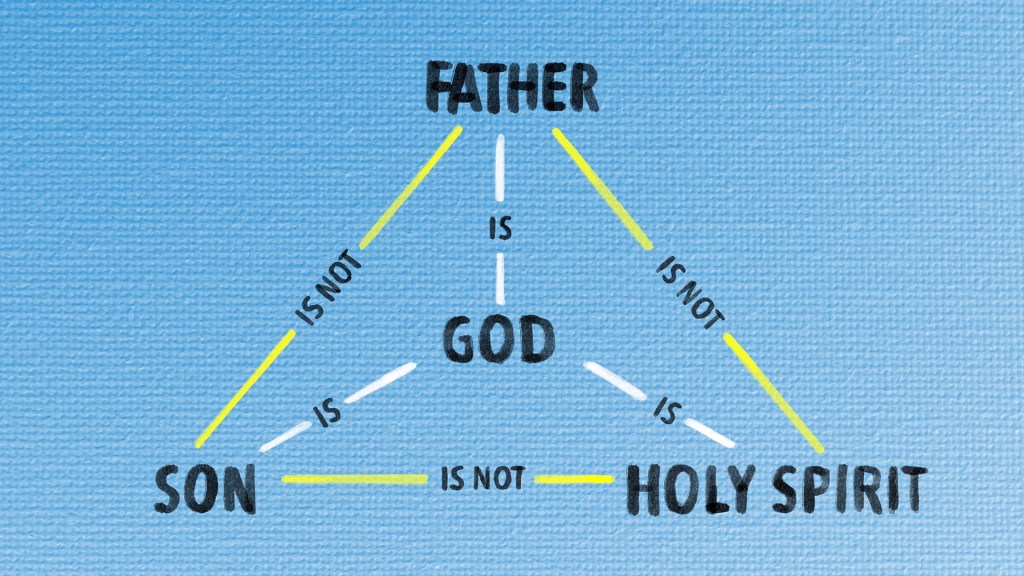
The Trinity is one God existing in three Persons. Understand that this is not in any way suggesting three Gods. Keep in mind when studying this subject that the word “Trinity” is not found in Scripture. This is a term that is used to attempt to describe the triune God—three coexistent, co-eternal Persons who are God. Of real importance is that the concept represented by the word “Trinity” does exist in Scripture. The following is what God’s Word says about the Trinity:

1) There is one God (Deuteronomy 6:4; 1 Corinthians 8:4; Galatians 3:20; 1 Timothy 2:5).

2) The Trinity consists of three Persons (Genesis 1:1, 26; 3:22; 11:7; Isaiah 6:8, 48:16, 61:1; Matthew 3:16-17, 28:19; 2 Corinthians 13:14). In Genesis 1:1, the Hebrew plural noun “Elohim” is used. In Genesis 1:26, 3:22, 11:7 and Isaiah 6:8, the plural pronoun for “us” is used. The word “Elohim” and the pronoun “us” are plural forms, definitely referring in the Hebrew language to more than two. While this is not an explicit argument for the Trinity, it does denote the aspect of plurality in God. The Hebrew word for “God,” “Elohim,” definitely allows for the Trinity.

In Isaiah 48:16 and 61:1, the Son is speaking while making reference to the Father and the Holy Spirit. Compare Isaiah 61:1 to Luke 4:14-19 to see that it is the Son speaking. Matthew 3:16-17 describes the event of Jesus’ baptism. Seen in this passage is God the Holy Spirit descending on God the Son while God the Father proclaims His pleasure in the Son. Matthew 28:19 and 2 Corinthians 13:14 are examples of three distinct Persons in the Trinity.

3) The members of the Trinity are distinguished one from another in various passages. In the Old Testament, “LORD” is distinguished from “Lord” (Genesis 19:24; Hosea 1:4). The LORD has a Son (Psalm 2:7, 12; Proverbs 30:2-4). The Spirit is distinguished from the “LORD” (Numbers 27:18) and from “God” (Psalm 51:10-12). God the Son is distinguished from God the Father (Psalm 45:6-7; Hebrews 1:8-9). In the New Testament, Jesus speaks to the Father about sending a Helper, the Holy Spirit (John 14:16-17). This shows that Jesus did not consider Himself to be the Father or the Holy Spirit. Consider also all the other times in the Gospels where Jesus speaks to the Father. Was He speaking to Himself? No. He spoke to another Person in the Trinity—the Father.

4) Each member of the Trinity is God. The Father is God (John 6:27; Romans 1:7; 1 Peter 1:2). The Son is God (John 1:1, 14; Romans 9:5; Colossians 2:9; Hebrews 1:8; 1 John 5:20). The Holy Spirit is God (Acts 5:3-4; 1 Corinthians 3:16).

5) There is subordination within the Trinity. Scripture shows that the Holy Spirit is subordinate to the Father and the Son, and the Son is subordinate to the Father. This is an internal relationship and does not deny the deity of any Person of the Trinity. This is simply an area which our finite minds cannot understand concerning the infinite God. Concerning the Son see Luke 22:42, John 5:36, John 20:21, and 1 John 4:14. Concerning the Holy Spirit see John 14:16, 14:26, 15:26, 16:7, and especially John 16:13-14.

6) The individual members of the Trinity have different tasks. The Father is the ultimate source or cause of the universe (1 Corinthians 8:6; Revelation 4:11); divine revelation (Revelation 1:1); salvation (John 3:16-17); and Jesus’ human works (John 5:17; 14:10). The Father initiates all of these things.

The Son is the agent through whom the Father does the following works: the creation and maintenance of the universe (1 Corinthians 8:6; John 1:3; Colossians 1:16-17); divine revelation (John 1:1, 16:12-15; Matthew 11:27; Revelation 1:1); and salvation (2 Corinthians 5:19; Matthew 1:21; John 4:42). The Father does all these things through the Son, who functions as His agent.

The Holy Spirit is the means by whom the Father does the following works: creation and maintenance of the universe (Genesis 1:2; Job 26:13; Psalm 104:30); divine revelation (John 16:12-15; Ephesians 3:5; 2 Peter 1:21); salvation (John 3:6; Titus 3:5; 1 Peter 1:2); and Jesus’ works (Isaiah 61:1; Acts 10:38). Thus, the Father does all these things by the power of the Holy Spirit.

There have been many attempts to develop illustrations of the Trinity. However, none of the popular illustrations are completely accurate. The egg (or apple) fails in that the shell, white, and yolk are parts of the egg, not the egg in themselves, just as the skin, flesh, and seeds of the apple are parts of it, not the apple itself. The Father, Son, and Holy Spirit are not parts of God; each of them is God. The water illustration is somewhat better, but it still fails to adequately describe the Trinity. Liquid, vapor, and ice are forms of water. The Father, Son, and Holy Spirit are not forms of God, each of them is God. So, while these illustrations may give us a picture of the Trinity, the picture is not entirely accurate. An infinite God cannot be fully described by a finite illustration.

The doctrine of the Trinity has been a divisive issue throughout the entire history of the Christian church. While the core aspects of the Trinity are clearly presented in God’s Word, some of the side issues are not as explicitly clear. The Father is God, the Son is God, and the Holy Spirit is God—but there is only one God. That is the biblical doctrine of the Trinity. Beyond that, the issues are, to a certain extent, debatable and non-essential. Rather than attempting to fully define the Trinity with our finite human minds, we would be better served by focusing on the fact of God’s greatness and His infinitely higher nature. “Oh, the depth of the riches of the wisdom and knowledge of God! How unsearchable his judgments, and his paths beyond tracing out! Who has known the mind of the Lord? Or who has been his counselor?” (Romans 11:33-34).


What did Jesus mean when He said, “I and the Father are one” (John 10:30)?

ANSWER

In John 10 Jesus presents Himself as the Good Shepherd and, in a debate with the Jewish leaders, makes the claim, “I and the Father are one” (John 10:30). It was a bold statement—one His audience found quite audacious—and it reveals much about who Jesus is.

Five key observations can be made concerning this passage. First, Jesus claimed to be one with God in the sense of being equal to Him. Jesus did not claim to be merely a messenger or prophet of God, but of equal power with God.

Second, His audience understood that Jesus was claiming equality with God the Father. In verse 31, “The Jews picked up stones again to stone him.” Why? Blasphemy was a crime punishable by death according to the Jewish Law. When Jesus asked why they were planning to kill Him, they answered, “For blasphemy, because you, being a man, make yourself God” (John 10:33). If Jesus had been lying or deceived, His statement would have been blasphemous. In fact, the only way His words were not blasphemy is if Jesus was telling the truth about His equality with God.

Third, Jesus referred to Himself as God’s Son and to God as His Father (John 10:36–37). He used Psalm 82:6 to show that the Messiah has the right to claim the title “Son of God.”

Fourth, Jesus claimed that that Father sent Him: “the one whom the Father set apart as his very own and sent into the world” (John 10:36). In this statement, Jesus claimed preexistence in the Father’s presence. No biblical prophet had ever made such a claim before; yet Jesus claimed to exist before Abraham (John 8:58).

Fifth, Jesus only stated that the Jews did not believe Him; He never said they misunderstood His claim to be God. John 10:38 notes, “Even though you do not believe me, believe the works, that you may know and understand that the Father is in me, and I in the Father.” Jesus was not correcting a misunderstanding. They understood what He said perfectly. He was correcting their willful rejection of Him.

Colossians 1:16–17 affirms Jesus’ same teaching: “In him all things were created: things in heaven and on earth, visible and invisible, whether thrones or powers or rulers or authorities; all things have been created through him and for him. He is before all things, and in him all things hold together.” John 1:1 explicitly notes that Jesus was both with God in the beginning and was God.

In summary, Jesus claimed to be one with the Father as part of a larger argument to note that He had existed from eternity past, lived in perfect oneness with the Father, held the same power as God, and was sent by God the Father’s authority. Unfortunately, He was rejected as divine by the Jewish leaders. Jesus’ claim to have equal power as the Father was not blasphemy. It was the plain truth.

What is the significance of Jesus saying, “I am with you always even to the end of the age” (Matthew 28:20)?

ANSWER

The final verses of Matthew 28 contain what we refer to as the Great Commission. Jesus gave believers their mission—to make disciples—as they live under His authority and as His representatives on earth. This mission will continue to the end of the age. Christians have the assurance that God is with us, no matter what happens, even “to the very end of the age” (Matthew 28:20).

As Jesus’ time on earth neared its end, He often told His disciples of what was to come, including what would happen at the end of the age. The “end of the age” or “the end of the world” (KJV) means the end of this present era and the commencement of the next dispensation. At the end of the church age, the end-times events will occur, God will judge the wicked, and Christ will return again to establish His kingdom (Matthew 24).

Jesus had told His disciples that He would be killed but would rise again (Matthew 16:21). He intentionally gave them specific ways to recognize that the end was near (Matthew 24:4–14). Although Jesus did not give the disciples all the details of the end of the age, knowing they would not fully understand, His warnings came with assurances that would sustain them. Each time He warned them or gave them a command, He also gave them hope. For example, when He forewarned His followers that they would have trouble in this world, He also assured them, saying, “‘Take heart. I have overcome the world’” (John 16:33). Jesus’ warnings and commands to His own are never found apart from His assurances.

Before Jesus ascended into heaven, He instructed His disciples, “All authority in heaven and on earth has been given to me. Therefore go and make disciples of all nations, baptizing them in the name of the Father and of the Son and of the Holy Spirit, and teaching them to obey everything I have commanded you. And surely I am with you always, to the very end of the age” (Matthew 28:19–20). This promise that He would be with His disciples even to the end of the age still holds true for believers today. We are not yet to the end of the age.

In His promise to be with His disciples always, even to the end of the age, Jesus did not mean He would physically be with them. God is with us always through His Spirit. Before Jesus ascended into heaven, He promised His disciples that He would send the Advocate, the Holy Spirit, to them (John 14:26). Since Pentecost, the Holy Spirit indwells all believers from the moment they are saved. He guards and guarantees our salvation (Ephesians 1:13; 4:30), leads us into righteousness (Galatians 5:16–18), reminds us of what is true (John 14:26), and gives us godly wisdom (1 Corinthians 2:10–11). Through the Holy Spirit, we have assurance that God is in control and that He is with us always, even to the end of the age.

Just as God promised Joshua that He would never leave him or forsake him (Deuteronomy 31:6), so Jesus told His disciples, “I am with you always, even to the end of the age” (NKJV). This promise sustains us as we seek to make disciples and live as God’s representatives on earth, no matter what trials or difficulties come our way.

My Utmost for His Highest

August 10th

The sacrament of the saint

Let them that suffer according to the will of God, commit the keeping of their souls to Him in well-doing. 1 Peter 4:19.

To choose to suffer means that there is something wrong; to choose God’s will even if it means suffering is a very different thing. No healthy saint ever chooses suffering; he chooses God’s will, as Jesus did, whether it means suffering or not. No saint dare interfere with the discipline of suffering in another saint.
The saint who satisfies the heart of Jesus will make other saints strong and mature for God. The people who do us good are never those who sympathize with us, they always hinder, because sympathy enervates. No one understands a saint but the saint who is nearest to the Saviour. If we accept the sympathy of a saint, the reflex feeling is—‘Well, God is dealing hardly with me.’ That is why Jesus said self-pity was of the devil (see Matt. 16:23). Be merciful to God’s reputation. It is easy to blacken God’s character because God never answers back, He never vindicates Himself. Beware of the thought that Jesus needed sympathy in His earthly life; He refused sympathy from man because He knew far too wisely that no one on earth understood what He was after. He took sympathy from His Father only, and from the angels in heaven. (Cf. Luke 15:10.)
Notice God’s unutterable waste of saints. According to the judgment of the world, God plants His saints in the most useless places. We say—‘God intends me to be here because I am so useful.’ God puts His saints where they will glorify Him, and we are no judges at all of where that is.

Streams in the Desert

August 10

“When he had heard therefore that he was sick, he abode two days still in the same place where he was.” (John 11:6.)

IN the forefront of this marvelous chapter stands the affirmation, “Jesus loved Martha, and her sister, and Lazarus,” as if to teach us that at the very heart and foundation of all God’s dealings with us, however dark and mysterious they may be, we must dare to believe in and assert the infinite, unmerited, and unchanging love of God. Love permits pain. The sisters never doubted that He would speed at all hazards and stay their brother from death, but, “When he had heard therefore that he was sick, he abode two days still in the same place where he was.”
What a startling “therefore”! He abstained from going, not because He did not love them, but because He did love them. His love alone kept Him back from hasting at once to the dear and stricken home. Anything less than infinite love must have rushed instantly to the relief of those loved and troubled hearts, to stay their grief and to have the luxury of wiping and stanching their tears and causing sorrow and sighing to flee away. Divine love could alone hold back the impetuosity of the Savior’s tender-heartedness until the Angel of Pain had done her work.
Who can estimate how much we owe to suffering and pain? But for them we should have little scope for many of the chief virtues of the Christian life. Where were faith, without trial to test it; or patience, with nothing to bear; or experience, without tribulation to develop it?—Selected.

“Loved! then the way will not be drear;
For One we know is ever near,
Proving it to our hearts so clear
  That we are loved.

“Loved when our sky is clouded o’er,
And days of sorrow press us sore;
Still we will trust Him evermore,
  For we are loved.

“Time, that affects all things below,
Can never change the love He’ll show;
The heart of Christ with love will flow,
  And we are loved.”

Stephen Boyd Blog

Belfast-born Hollywood and International Star from 1950-1970's Fan Tribute Page

Abundant Joy

Digging Deep Into The Word

Not My Life

The Bible as clear as possible

Seek Grow Love

Growing Throughout the Year

Smoodock's Blog

Question Authority

PleaseGrace

A bit on daily needs and provisions

Three Strands Lutheran Parish

"A cord of three strands is not easily broken." Ecclesiastes 4:12

1love1god.com

Romans 5:8

The Rev. Jimmy Abbott

read, watch, listen

BEARING CHRIST CRUCIFIED AND RISEN

To know Christ and Him crucified

Considering the Bible

Scripture Musings

rolliwrites.wordpress.com/

The Official Home of Rolli - Author, Cartoonist and Songwriter

Pure Glory

The heavens are telling the glory of God; and the firmament proclaims His handiwork. Psalms 19:1

The daily addict

The daily life of an addict in recovery

The Christian Tech-Nerd

-Reviews, Advice & News For All Things Tech and Gadget Related-

Thinking Through Scripture

to help you walk with Jesus in faith, hope, and love.

A disciple's study

This is my personal collection of thoughts and writings, mainly from much smarter people than I, which challenge me in my discipleship walk. Don't rush by these thoughts, but ponder them.

Author Scott Austin Tirrell

Maker of fine handcrafted novels!

In Pursuit of My First Love

Returning to the First Love