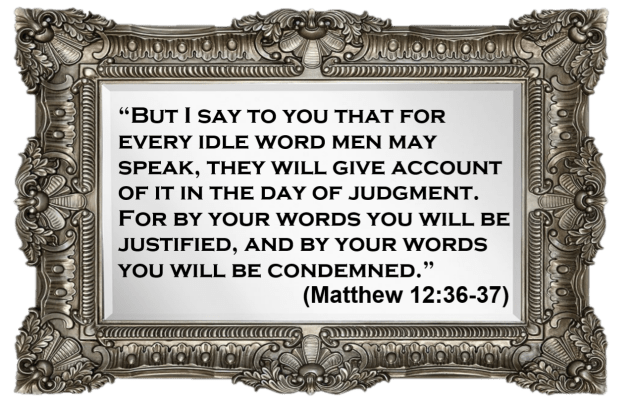
I tell you, on the day of judgment people will give account for every careless word they speak, Matthew 12:36
Context Good and Bad Fruit …The good man brings good things out of his good store of treasure, and the evil man brings evil things out of his evil store of treasure. But I tell you that men will give an account on the day of judgment for every careless word they have spoken. For by your words you will be acquitted, and by your words you will be condemned.”…
Benson Commentary Matthew 12:36-37. But I say unto you — You may perhaps think God does not much regard your words, but I assure you, that not only for blasphemous and profane, malicious, false, slanderous, and reviling words, but for every idle word which men shall speak: for all light, vain, trifling expressions; for all useless, unprofitable conversation, and all discourse uttered without seriousness and caution, and which does not conduce to the glory of God and the good of mankind; that men shall speak — At any time, or on any occasion, they shall give an account in the day of judgment — “I cannot think,” says Dr. Doddridge, “that our Lord here uses αργον, idle, merely to signify mischievous. We are certainly accountable for useless as well as wicked discourses, and they will be taken into that last survey which is to determine our character and state: which they whose life is one continued scene of whim, or sneering raillery, would do well seriously to consider. And it was to our Lord’s purpose to observe it here, as it inferred, by the strongest consequence, the danger of such vile and criminal discourses as those of the Pharisees in this case. But discourse tending to exhilarate the spirits is not idle discourse; as the time spent in necessary recreation is not idle time; nor does a wise and gracious God expect from men the life of angels. If any are dissatisfied with the account of things here given, I would beg leave to ask them whether unprofitable talk be not a sinful wasting of time? and whether that must not render a man in some degree criminal before God?” For by thy words — That is, by the evidence of thy words, as well as of thy tempers and works, thou shall be justified, &c. — Shalt be either acquitted or condemned; since by the tenor of these the disposition of thy heart is shown, and thy true character discovered. Therefore these shall be produced in evidence for or against thee at the great day, and by this evidence thou shalt then stand or fall.
Matthew Henry’s Concise Commentary 12:33-37 Men’s language discovers what country they are of, likewise what manner of spirit they are of. The heart is the fountain, words are the streams. A troubled fountain, and a corrupt spring, must send forth muddy and unpleasant streams. Nothing but the salt of grace, cast into the spring, will heal the waters, season the speech, and purify the corrupt communication. An evil man has an evil treasure in his heart, and out of it brings forth evil things. Lusts and corruptions, dwelling and reigning in the heart, are an evil treasure, out of which the sinner brings forth bad words and actions, to dishonour God, and hurt others. Let us keep constant watch over ourselves, that we may speak words agreeable to the Christian character. Barnes’ Notes on the Bible But I say unto you … – Christ closes this address to his malignant and wicked hearers by a solemn declaration that for these things God would bring them into judgment. Therefore. They who had spoken so malignantly against him, could not escape. Idle word – This literally means a vain, thoughtless, useless word; a word that accomplishes no good. Here it means, evidently, “wicked, injurious, false, malicious, for such” were the words which they had spoken.
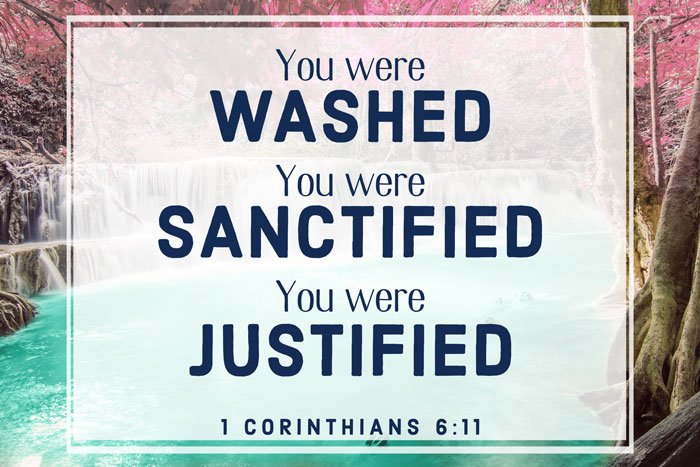
And such were some of you. But you were washed, you were sanctified, you were justified in the name of the Lord Jesus Christ and by the Spirit of our God. 1 Corinthians 6:11
Context Members of Christ …nor thieves, nor the greedy, nor drunkards, nor verbal abusers, nor swindlers, will inherit the kingdom of God. And that is what some of you were. But you were washed, you were sanctified, you were justified, in the name of the Lord Jesus Christ and by the Spirit of our God. “Everything is permissible for me,” but not everything is beneficial. “Everything is permissible for me,” but I will not be mastered by anything.…
Matthew Henry’s Concise Commentary 6:9-11 The Corinthians are warned against many great evils, of which they had formerly been guilty. There is much force in these inquiries, when we consider that they were addressed to a people puffed up with a fancy of their being above others in wisdom and knowledge. All unrighteousness is sin; all reigning sin, nay, every actual sin, committed with design, and not repented of, shuts out of the kingdom of heaven. Be not deceived. Men are very much inclined to flatter themselves that they may live in sin, yet die in Christ, and go to heaven. But we cannot hope to sow to the flesh, and reap everlasting life. They are reminded what a change the gospel and grace of God had made in them. The blood of Christ, and the washing of regeneration, can take away all guilt. Our justification is owing to the suffering and merit of Christ; our sanctification to the working of the Holy Spirit; but both go together. All who are made righteous in the sight of God, are made holy by the grace of God.
Barnes’ Notes on the Bible And such – Such drunkards, lascivious, and covetous persons. This shows: (1) The exceeding grace of God that could recover even such persons from sins so debasing and degrading.
(2) it shows that we are not to despair of reclaiming the most abandoned and wretched people.
(3) it is well for Christians to look back on what they once were. It will produce:
(a) humility,
(b) gratitude,
(c) a deep sense of the sovereign mercy of God,
(d) an earnest desire that others may be recovered and saved in like manner; compare Ephesians 2:1, Ephesians 2:2; Ephesians 5:8; Colossians 3:7; Titus 3:3, Titus 3:6 – The design of this is to remind them of what they were, and to show them that they were now under obligation to lead better lives – by all the mercy which God had shown in recovering them from sins so degrading, and from a condition so dreadful.
But ye are washed – Hebrews 10:22. Washing is an emblem of purifying. They had been made pure by the Spirit of God. They had been, indeed, baptized, and their baptism was an emblem of purifying, but the thing here particularly referred to is not baptism, but it is something that had been done by the Spirit of God, and must refer to his agency on the heart in cleansing them from these pollutions. Paul here uses three words, “washed, sanctified, justified,” to denote the various agencies of the Holy Spirit by which they had been recovered from sin. The first, that of washing, I understand of that work of the Spirit by which the process of purifying was commenced in the soul, and which was especially signified in baptism – the work of regeneration or conversion to God. By the agency of the Spirit the defilement of these pollutions had been washed away or removed – as filth is removed by ablution – The agency of the Holy Spirit in regeneration is elsewhere represented by washing, Titus 3:5,” The washing of regeneration.” compare Hebrews 10:22.
Ye are sanctified – This denotes the progressive and advancing process of purifying which succeeds regeneration in the Christian. Regeneration is the commencement of it – its close is the perfect purity of the Christian in heaven; see the note at John 17:17. It does not mean that they were perfect – for the reasoning of the apostle shows that this was far from being the case with the Corinthians; but that the work was advancing, and that they were in fact under a process of sanctification.
But ye are justified – Your sins are pardoned, and you are accepted as righteous, and will be treated as such on account of the merits of the Lord Jesus Christ; see the note at Romans 1:17; note at Romans 3:25-26; note at Romans 4:3. The apostle does not say that this was last in the order of time, but simply says that this was done to them. People are justified when they believe, and when the work of sanctification commences in the soul.
In the name of the Lord Jesus – That is, by the Lord Jesus; by his authority, appointment, influence; see the note at Acts 3:6. All this had been accomplished through the Lord Jesus; that is, in his name forgiveness of sins had been proclaimed to them Luke 24:47; and by his merits all these favors had been conferred on them.
And by the Spirit of our God – The Holy Spirit. All this had been accomplished by his agency on the heart – This verse brings in the whole subject of redemption, and states in a most emphatic manner the various stages by which a sinner is saved, and by this single passage, a man may obtain all the essential knowledge of the plan of salvation. All is condensed here in few words:
(1) He is by nature a miserable and polluted sinner – without merit, and without hope.
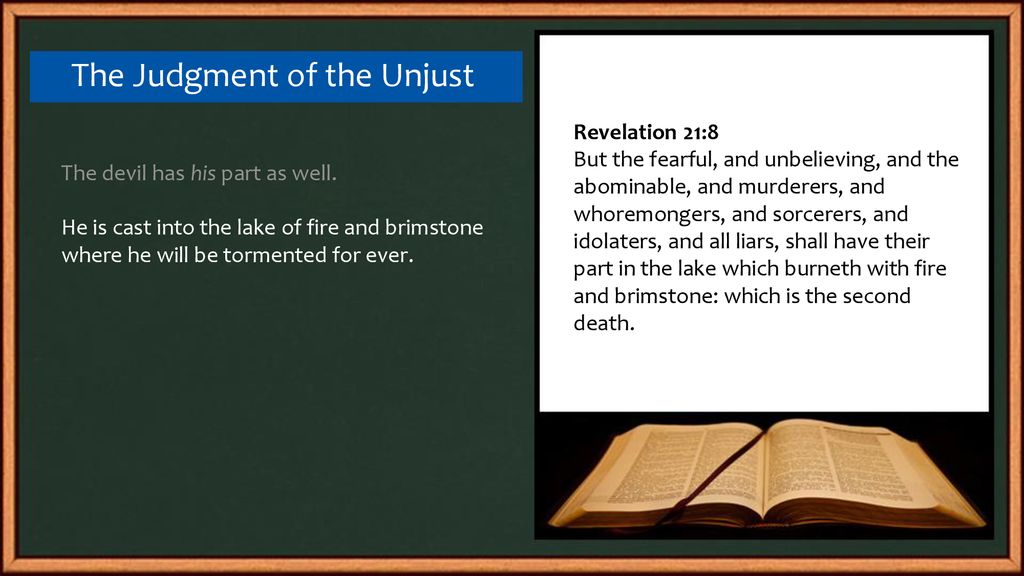
The devil has his part as well. He is cast into the lake of fire and brimstone where he will be tormented for ever.
But as for the cowardly, the faithless, the detestable, as for murderers, the sexually immoral, sorcerers, idolaters, and all liars, their portion will be in the lake that burns with fire and sulfur, which is the second death.” Revelation 21:8
Context A New Heaven and a New Earth …The one who overcomes will inherit all things, and I will be his God, and he will be My son. But to the cowardly and unbelieving and abominable and murderers and sexually immoral and sorcerers and idolaters and all liars, their place will be in the lake that burns with fire and sulfur. This is the second death.” Then one of the seven angels with the seven bowls full of the seven final plagues came and said to me, “Come, I will show you the bride, the wife of the Lamb.”…
Matthew Henry’s Concise Commentary 21:1-8 The new heaven and the new earth will not be separate from each other; the earth of the saints, their glorified, bodies, will be heavenly. The old world, with all its troubles and tumults, will have passed away. There will be no sea; this aptly represents freedom from conflicting passions, temptations, troubles, changes, and alarms; from whatever can divide or interrupt the communion of saints. This new Jerusalem is the church of God in its new and perfect state, the church triumphant. Its blessedness came wholly from God, and depends on him. The presence of God with his people in heaven, will not be interrupt as it is on earth, he will dwell with them continually. All effects of former trouble shall be done away. They have often been in tears, by reason of sin, of affliction, of the calamities of the church; but no signs, no remembrance of former sorrows shall remain. Christ makes all things new. If we are willing and desirous that the gracious Redeemer should make all things new in order hearts and nature, he will make all things new in respect of our situation, till he has brought us to enjoy complete happiness. See the certainty of the promise. God gives his titles, Alpha and Omega, the Beginning and the End, as a pledge for the full performance. Sensual and sinful pleasures are muddy and poisoned waters; and the best earthly comforts are like the scanty supplies of a cistern; when idolized, they become broken cisterns, and yield only vexation. But the joys which Christ imparts are like waters springing from a fountain, pure, refreshing, abundant, and eternal. The sanctifying consolations of the Holy Spirit prepare for heavenly happiness; they are streams which flow for us in the wilderness. The fearful durst not meet the difficulties of religion, their slavish fear came from their unbelief; but those who were so dastardly as not to dare to take up the cross of Christ, were yet so desperate as to run into abominable wickedness. The agonies and terrors of the first death will lead to the far greater terrors and agonies of eternal death.
Barnes’ Notes on the Bible But the fearful – Having stated, in general terms, who they were who would be admitted into that blessed world, he now states explicitly who would not. The “fearful” denote those who had not firmness boldly to maintain their professed principles, or who were afraid to avow themselves as the friends of God in a wicked world. They stand in contrast with those who “overcome,” Revelation 21:7. And unbelieving – Those who have not true faith; avowed infidels; infidels at heart; and all who have not the sincere faith of the gospel. See the notes on Mark 16:16.
And the abominable – The verb from which this word is derived means to excite disgust; to feel disgust at; to abominate or abhor; and hence the participle – “the abominable” – refers to all who are detestable, to wit, on account of their sins; all whose conduct is offensive to God. Thus it would include those who live in open sin; who practice detestable vices; whose conduct is suited to excite disgust and abhorrence. These must all, of course, be excluded from a pure and holy world; and this description, alas! would embrace a lamentably large portion of the world as it has hitherto been. See the notes on Romans 1:26 ff.
And murderers – See the Romans 1:29 note; Galatians 5:21 note.
And whoremongers – See the notes on Galatians 5:19.
And sorcerers – See the word used here – φαρμακεῦσι pharmakeusi – explained in the notes on Galatians 5:19, under the word “witchcraft.”
And idolaters – 1 Corinthians 6:9; Galatians 5:19.
And all liars – All who are false in their statements, their promises, their contracts. The word would embrace all who are false toward God Acts 5:1-3, and false toward human beings. See Romans 1:31.
Shall have their part in the lake which burneth, … – notes on Revelation 20:14. That is, they will be excluded from heaven, and punished for ever. See the 1 Corinthians 6:9-10 notes; Galatians 5:19-21 notes.
Gill’s Exposition of the Entire Bible But the fearful,…. Not the timorous sheep and lambs of Christ, the dear children of God, who are sometimes of a fearful heart, on account of sin, temptation, and unbelief; but such who are of cowardly spirits, and are not valiant for the truth, but who, through fear of men, either make no profession of Christ and his Gospel, or having made it, drop it, lest they should be exposed to tribulation and persecution; these are they that are afraid of the beast, and live in servile bondage to him. And unbelieving; meaning not merely atheists, who do not believe there is a God, or deists only, that do not believe in Christ; but such who profess his name, and are called by it, and yet do not truly believe in him, nor embrace his Gospel and the truths of it, but believe a lie; these are condemned already, and on them the wrath of God abides, and they will be damned at last; though it may have a regard to such also who are infidels as to the second coming of Christ to judgment, and who are scoffers and mockers at it:
and the abominable: every sinful man is so in the sight of God; but here it denotes such who are the worst of sinners, given up to sinning; who are abominable, and to every good work reprobate; who are addicted to the worst of crimes, as were the Sodomites and others; the Ethiopic version renders it, “who pollute themselves” with unnatural lusts. The Syriac and Arabic versions express it by two words, “sinners and polluted”, filthy sinners; the character well agrees with Babylon, the mother of harlots and abominations of the earth, and to all that adhere to her, and join with her in her abominable idolatries.
And murderers; of the saints, and prophets, and martyrs of Jesus, with whose blood Babylon, or the whore of Rome, has made herself drunk, and in whom it will be found.
And whoremongers; all unclean persons, that indulge themselves in impure lusts, in fornication, adultery, and all lewdness; as the clergy of the church of Rome, who being forbidden to marry, and being under a vow of celibacy, and making great pretensions to chastity and singular holiness, give up themselves to all lasciviousness, to work all uncleanness with greediness.
And sorcerers; conjurers, dealers with familiar spirits, necromancers, and such as use the magic art, as many of the popes did to get into the chair, and poisoners of kings and princes; whoredoms and witchcrafts go together sometimes, as they did in Jezebel, an emblem of the Romish antichrist.
And idolaters; that worship devils, idols of gold, silver, brass, stone, and wood, representing God, and Christ, and the virgin Mary, and saints departed, Revelation 9:20.
And all liars; in common, and particularly such who speak lies in hypocrisy, as the followers of the man of sin, and who are given up to believe a lie, that they might be damned; all lies being of the devil, and abominable to God. All and each of these
shall have their part in the lake which burneth with fire and brimstone. The Jews (a) speak of several distinct places in hell, for several sorts of sinners, as particularly for sabbath breakers, adulterers, and liars; and say of the wicked, that when he is condemned he shall take “his part” in hell (b); See Gill on Revelation 19:20.
which is the second death; See Gill on Revelation 2:11.
Where the self-interest sleeps and the real interest awakens: Master, where dwellest Thou?… Come and see.… Come with Me. John 1:39.
“They abode with Him that day.” That is about all some of us ever do, then we wake up to actualities, self-interest arises and the abiding is passed. There is no condition of life in which we cannot abide in Jesus. “Thou art Simon, thou shalt be called Cephas.” God writes the new name on those places only in our lives where He has erased the pride and self-sufficiency and self-interest. Some of us have the new name in spots only, like spiritual measles. In sections we look all right. When we have our best spiritual mood on, you would think we were very high-toned saints; but don’t look at us when we are not in that mood. The disciple is one who has the new name written all over him; self-interest and pride and self-sufficiency have been completely erased. Pride is the deification of self, and this to-day in some of us is not of the order of the Pharisee, but of the publican. To say ‘Oh, I’m no saint,’ is acceptable to human pride, but it is unconscious blasphemy against God. It literally means that you defy God to make you a saint. ‘I am much too weak and hopeless, I am outside the reach of the Atonement.’ Humility before men may be unconscious blasphemy before God. Why are you not a saint? It is either that you do not want to be a saint, or that you do not believe God can make you one. It would be all right, you say, if God saved you and took you straight to heaven. That is just what He will do! “We will come unto Him, and make our abode with Him.” Make no conditions, let Jesus be everything, and He will take you home with Him not only for a day, but for ever.
“In everything ye are enriched by him.” (1 Cor. 1:5)
HAVE you ever seen men and women whom some disaster drove to a great act of prayer, and by and by the disaster was forgotten, but the sweetness of religion remained and warmed their souls? So have I seen a storm in later spring; and all was black, save where the lightning tore the cloud with thundering rent. The winds blew and the rains fell, as though heaven had opened its windows. What a devastation there was! Not a spider’s web that was out of doors escaped the storm, which tore up even the strong-branched oak. But ere long the lightning had gone by, the thunder was spent and silent, the rain was over, the western wind came up with its sweet breath, the clouds were chased away, and the retreating storm threw a scarf of rainbows over her fair shoulders and resplendent neck, and looked back and smiled, and so withdrew and passed out of sight. But for weeks long the fields held up their hands full of ambrosial flowers, and all the summer through the grass was greener, the brooks were fuller, and the trees cast a more umbrageous shade, because the storm passed by—though all the rest of the earth had long ago forgotten the storm, its rainbows and its rain.—Theodore Parker. God may not give us an easy journey to the Promised Land, but He will give us a safe one.—Bonar.
It was a storm that occasioned the discovery of the gold mines of India. Hath not a storm driven some to the discovery of the richer mines of the love of God in Christ?
Is it raining, little flower?
  Be glad of rain;
Too much sun would wither thee;
  ’Twill shine again.
The clouds are very black, ’tis true;
But just behind them shines the blue.

Art thou weary, tender heart?
  Be glad of pain:
In sorrow sweetest virtues grow,
  As flowers in rain.
God watches, and thou wilt have sun,
When clouds their perfect work have done.
This is my personal collection of thoughts and writings, mainly from much smarter people than I, which challenge me in my discipleship walk. Don't rush by these thoughts, but ponder them.


 Milo
Milo 