365 days with Newton

12 JUNE

Hope and quietly wait

‘It is good that a man should both hope and quietly wait for the salvation of the LORD.’ Lamentations 3:26
SUGGESTED FURTHER READING: Lamentations 3:25–33

This observation is recorded for the use of the church and has been confirmed by the experience of the Lord’s people. I shall endeavour to show the meaning of the need. I would not have any go away with a mistake and say, ‘If so, I am right enough; to be sure I hope to be saved, and I am quietly waiting for it.’ But enquire whether you have any ground for your hope, whether you know what the salvation is, and what it is quietly to wait. Salvation is a deliverance from sin and a renewal of heart, and the having or obtaining this salvation is to arrive at well grounded persuasion that it is thus with us, that our sins are forgiven, that we have the spirit of adoption which is the earnest of the full inheritance. The hope here spoken of implies a sense of the worth of this salvation and a regard to the promise of God. It is suited to the case of a convinced soul. If you see you have deserved to perish and believe there is forgiveness with God, it is good and right for you to hope that though at present you cannot feel an interest in this salvation so as to call it your own, yet in the Lord’s due time it shall be yours. Quietly to wait for it is not to sit down easy and careless about it. This is not good, but dangerous, and, if persisted, destructive. Neither is it possible when once the evil and bitterness of sin is known. To wait signifies a careful and diligent attendance on the means of grace, as it is expressed in Proverbs 8:34, watching daily at my gates, waiting at the posts of my doors. And the word quietly expresses the temper in which it becomes a sinner to wait—without complaining or repining—to be content to wait on, whatever delays or seeming disappointments we may meet with.

FOR MEDITATION: Surely, O Lord, the word that thou hast spoken concerning thy creature and upon which thou hast enabled me beyond hope to believe in hope shall not be spoken in vain. I trust that thou who hast said it art also fully able to perform all thy good promises in me and that as thou never yet didst finally cast out any poor wretch that came to thee for mercy, thou wilt not suffer me to be the first.
Diary, 1 July 1752

SERMON: LAMENTATIONS 3:26 [1/3]
My Utmost for His Highest

June 11th

Getting there

Where the sin and the sorrow cease, and the song and the saint commence. Come unto Me. Matthew 11:28.

Do I want to get there? I can now. The questions that matter in life are remarkably few, and they are all answered by the words—“Come unto Me.” Not—‘Do this, or don’t do that’; but—“Come unto Me.” If I will come to Jesus my actual life will be brought into accordance with my real desires; I will actually cease from sin, and actually find the song of the Lord begin.
Have you ever come to Jesus? Watch the stubbornness of your heart, you will do anything rather than the one simple childlike thing—“Come unto Me.” If you want the actual experience of ceasing from sin, you must come to Jesus.
Jesus Christ makes Himself the touchstone. Watch how He used the word ‘Come.’ At the most unexpected moments there is the whisper of the Lord—“Come unto Me.” and you are drawn immediately. Personal contact with Jesus alters everything. Be stupid enough to come and commit yourself to what He says. The attitude of coming is that the will resolutely lets go of everything and deliberately commits all to Him.
“and I will give you rest,” i.e., I will stay you. Not—I will put you to bed and hold your hand and sing you to sleep; but—I will get you out of bed, out of the languor and exhaustion, out of the state of being half dead while you are alive; I will imbue you with the spirit of life, and you will be stayed by the perfection of vital activity. We get pathetic and talk about ‘suffering the will of the Lord!’ Where is the majestic vitality and might of the Son of God about that?

Streams in the Desert

June 11

“The servant of the Lord must be gentle.” (2 Tim. 2:24.)

WHEN God conquers us and takes all the flint out of our nature, and we get deep visions into the Spirit of Jesus we then see as never before the great rarity gentleness of spirit in this dark and unheavenly world.
The graces of the Spirit do not settle themselves down upon us by chance, and if we do not discern certain states of grace, and choose them, and in our thoughts nourish them, they never become fastened in our mature or behavior.
Every advance step in grace must be preceded by first apprehending it, and then a prayerful resolve to have it.
So few are willing to undergo the suffering out of which thorough gentleness comes. We must die before we are turned into gentleness, and crucifixion involves suffering; it is a real breaking and crushing of self, which wrings the heart and conquers the mind.
There is a good deal of mere mental and logical sanctification nowadays, which is only a religious fiction. It consists of mentally putting one’s self on the altar, and then mentally saying the altar sanctifies the gift, and then logically concluding therefore one is sanctified; and such an one goes forth with a gay, flippant, theological prattle about the deep things of God.
But the natural heartstrings have not been snapped, and the Adamic flint has not been ground to powder, and the bosom has not throbbed with the lonely, surging sighs of Gethsemane; and not having the real death marks of Calvary, there cannot be that soft, sweet, gentle, floating, victorious, overflowing, triumphant life that flows like a spring morning from an empty tomb.—G. D. W.

“And great grace was upon them all.” (Acts 4:33.)

365 days with Newton

11 JUNE

Abundant grace

‘Speak ye comfortably to Jerusalem, and cry unto her, that her warfare is accomplished, that her iniquity is pardoned: for she hath received of the LORD’S hand double for all her sins.’ Isaiah 40:2
SUGGESTED FURTHER READING: Ephesians 1:1–10

She has received double. Not, as some suppose, that her afflictions had already been over-proportioned to their procuring cause—sin. We shall always have reason to say, He has not dealt with us according to our iniquities. Others, who are rather too eager to strain texts beyond their proper import in order to support a favourite doctrine, suppose that the suffering of the Messiah would be greater than the exigency of the case—more than necessary. But the truth is best proved and supported by texts which expressly teach it. The efficacy of the atonement is indeed greater than the actual application and sufficient to save the whole race of mankind, if they believed in the Son of God. But he groaned and bled upon the cross till he could say, It is finished [John 19:30]—but no longer. It becomes us to refer to infinite wisdom the reasons why his sufferings were for such a precise time, but we may be sure they were not beyond what the cause required. I think the true sense of the words is that Jerusalem should receive blessings double, much greater, than all her former afflictions. And in general to us, to every believing sinner, that the blessings of the gospel would be an unspeakably great over-balance and compensation for all afflictions of every kind by which we have been or can be exercised. Afflictions are the fruit of sin, and because our sins have been many, our afflictions may be many. But where sin has abounded, grace has much more abounded.

FOR MEDITATION: Behold the goodness of God. Infinitely happy and glorious in himself. He has provided for the comfort of those who were rebels against his government and transgressors of his law.

Of sinners the chief, And viler than all,
The jailer or thief, Manasseh or Saul:
Since they were forgiven, Why should I despair,
While Christ is in heaven, And still answers prayer?

SERMON SERIES: MESSIAH, NO. 1 [4/4], ISAIAH 40:1–2

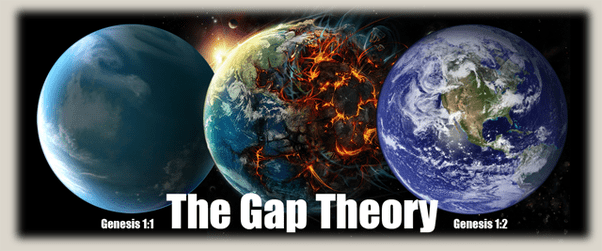
What is the Gap Theory?

Genesis 1:1–2 states, “In the beginning God created the heavens and the earth. Now the earth was formless and empty, darkness was over the surface of the deep, and the Spirit of God was hovering over the waters.” The gap theory is the view that God created a fully functional earth with all animals, including the dinosaurs and other creatures we know only from the fossil record. Then, the theory goes, something happened to destroy the earth completely—most likely the fall of Satan to earth—so that the planet became without form and void. At this point, God started all over again, recreating the earth in its paradise form as further described in Genesis. The gap theory, which is distinct from theistic evolution and the day-age theory, is also called old-earth creationism, gap creationism, and the ruin-reconstruction theory.

In young-earth creationism, Genesis 1:1 is seen as a summary of the complete chapter 1 in the Hebrew storytelling form. God created the heavens and the earth. Then verse 2 begins a detailed breakdown of the step-by-step process that verse 1 summarizes. However, the statement that “the earth was formless and empty, [and] darkness was over the surface of the deep” (Genesis 1:2) can be puzzling. The idea that God created a useless and shapeless earth is an uncomfortable position for some conservative theologians, and this leads them to the gap theory, or an old-earth perspective.

According to conservative proponents of the gap theory, Genesis 1:1 describes the original creation of God—perfect in every way. Then, between verses 1 and 2, Satan rebelled in heaven and was cast out. Satan’s sin “ruined” the original creation; that is, his rebellion brought about its destruction and eventual death, and the earth was reduced to its “formless and empty” state, ready for the “re-construction.” The length of time involved—the size of the “gap”—is not specified but could have lasted millions of years.

Of course, Satan must have fallen before Adam did; otherwise, there would have been no temptation in the garden. Young-earth creationists say that Satan fell sometime after Genesis 1:31. Gap creationists say that Satan fell between Genesis 1:1 and 2.

One difficulty of the gap theory is that it requires that creation suffer death and destruction before Adam’s fall. Romans 5:12 says, “Sin entered the world through one man, and death through sin, and in this way death came to all people, because all sinned.” The gap theory counters by positing two worlds. Satan’s sin brought death to the original creation, whatever that was like; and Adam’s sin brought death to the re-creation, the realm of mankind. Through Adam’s sin, evil entered our world and the realm of man was cursed. But rebellion already existed outside the realm of mankind (in the spiritual realm), since Satan and his angels had already fallen (Isaiah 14:12–14; Ezekiel 28:12–18). Sin could not enter the realm of man until man chose it. And Satan, via the serpent, successfully tempted man to make that choice.

Objections to the gap theory include the idea that, if something important had occurred between Genesis 1:1 and 2, God would have told us so, rather than leave us to speculate in ignorance. Also, Genesis 1:31 says God declared His creation to be “very good”—a statement difficult to square with the theory that evil already existed because of Satan’s fall in the “gap.”

It is possible to hold to a literal, six-day creation week and still hold to the gap theory—the gap theory does not require evolution to be true, since the gap falls before the events of Day One in Genesis 1:3. And that’s why some conservative scholars do believe the gap theory, although its acceptance has waned since the days of proponents C. I. Scofield and J. Vernon McGee.

However, many of those who hold to the gap theory do so in order to reconcile old-earth, evolutionary theories with the book of Genesis. But it seems to be a strained reconciliation. The plain reading of Genesis 1 does not at all intimate a length of time between the first two verses. Genesis 1:1 tells us that God created the heavens and the earth. Genesis 1:2 informs us that, when He first created the earth, it was formless, empty, and dark; it was unfinished and uninhabited. The rest of Genesis 1 relates how God completed the formless, empty, and dark earth by filling it with life, beauty, and goodness.

Stephen Boyd Blog

Belfast-born Hollywood and International Star from 1950-1970's Fan Tribute Page

Abundant Joy

Digging Deep Into The Word

Not My Life

The Bible as clear as possible

Seek Grow Love

Growing Throughout the Year

Smoodock's Blog

Question Authority

PleaseGrace

A bit on daily needs and provisions

Three Strands Lutheran Parish

"A cord of three strands is not easily broken." Ecclesiastes 4:12

1love1god.com

Romans 5:8

The Rev. Jimmy Abbott

read, watch, listen

BEARING CHRIST CRUCIFIED AND RISEN

To know Christ and Him crucified

Considering the Bible

Scripture Musings

rolliwrites.wordpress.com/

The Official Home of Rolli - Author, Cartoonist and Songwriter

Pure Glory

The heavens are telling the glory of God; and the firmament proclaims His handiwork. Psalms 19:1

The daily addict

The daily life of an addict in recovery

The Christian Tech-Nerd

-Reviews, Advice & News For All Things Tech and Gadget Related-

Thinking Through Scripture

to help you walk with Jesus in faith, hope, and love.

A disciple's study

This is my personal collection of thoughts and writings, mainly from much smarter people than I, which challenge me in my discipleship walk. Don't rush by these thoughts, but ponder them.

Author Scott Austin Tirrell

Maker of fine handcrafted novels!

In Pursuit of My First Love

Returning to the First Love