“I have prayed that your own faith may not fail.” (Luke 22:32.)
CHRISTIAN, take good care of thy faith, for recollect that faith is the only means whereby thou canst obtain blessings. Prayer cannot draw down answers from God’s throne except it be the earnest prayer of the man who believes. Faith is the telegraphic wire which links earth to Heaven, on which God’s messages of love fly so fast that before we call He answers, and while we are yet speaking He hears us. But if that telegraphic wire of faith be snapped, how can we obtain the promise? Am I in trouble? I can obtain help for trouble by faith. Am I beaten about by the enemy? My soul on her dear Refuge leans by faith. But take faith away, then in vain I call to God. There is no other road betwixt my soul and Heaven. Blockade the road, and how can I communicate with the Great King? Faith links me with Divinity. Faith clothes me with the power of Jehovah. Faith insures every attribute of God in my defense. It helps me to defy the hosts of hell. It makes me march triumphant over the necks of my enemies. But without faith how can I receive anything from the Lord? Oh, then, Christian, watch well thy faith. “If thou canst believe, all things are possible to him that believeth.” —C. H. Spurgeon. We boast of being so practical a people that we want to have a surer thing than faith. But did not Paul say that the promise was by FAITH that it might be SURE? (Romans 4:16.)—Dan Crawford.
‘It is good that a man should both hope and quietly wait for the salvation of the LORD.’ Lamentations 3:26 SUGGESTED FURTHER READING: Isaiah 54:1–7
The truth of it is good. The word good may be understood in several senses. First, it is reasonable, considering: (i) the greatness of this salvation, which is such that you must allow, if the Lord was to suffer you to go on beset with tears and temptations to the last hour of life, if he showed you mercy at last you would have the utmost reason to praise him. You will say, ‘Oh, if I knew this’; but it is reasonable to wait, though you know it not at present, that you may know it hereafter. (ii) that as a sinner you have no right to make terms. What an inconsistence is it, at one time to confess the Lord might justly send you to hell, and yet perhaps the next hour repine because he makes you wait a while for the blessing. (iii) that this is, as I have observed, the Lord’s usual way. Search the Scripture: you will find it so. Ask his people who set about before you: they will tell you the same. Why should you expect he will change his methods for you? You want to be sure you are right and yet you are discouraged because you are led in that very path in which you see the footsteps of the flock before. Secondly, it is profitable. (i) It makes our waiting more pleasant to wait quietly and to maintain a hope upon the general promise, whereas to give way to another spirit lets in a storm upon the soul and opens a door to the worst temptations. (ii) It is profitable to others, for they have the same exercises—if by your complaints you bring up an evil report of the good land, you lay a snare in the way of seekers and tempt the world to speak evil of your profession. Thirdly, it is safe. It is good because those who thus hope and wait shall never be disappointed or ashamed. See such promises as Isaiah 54:7–8.
FOR MEDITATION: ‘I waited patiently for the LORD; and he inclined unto me, and heard my cry’ (Psalm 40:1).
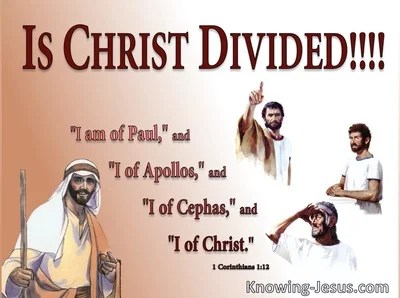
Context Unity in the Church …My brothers, some from Chloe’s household have informed me that there are quarrels among you. What I mean is this: Individuals among you are saying, “I follow Paul,” “I follow Apollos,” “I follow Cephas,” or “I follow Christ.” Is Christ divided? Was Paul crucified for you? Were you baptized into the name of Paul?… 1 Corinthians 1:12
Barnes’ Notes on the Bible Now this I say – This is what I mean; or, I give this as an instance of the contentions to which Irefer. That every one of you saith – That you are divided into different factions, and ranged under different leaders. The word translated “that” ὅτι hoti might be translated here, “because,” or “since,” as giving a reason for his affirming 1 Corinthians 1:11 that there were contentions there. “Now I say that there are contentions, because you are ranged under different leaders,” etc. – Calvin.
I am of Paul – It has been doubted whether Paul meant to affirm that the parties had actually taken the names which he here specifies, or whether he uses these names as illustrations, or suppositions, to show the absurdity of their ranging themselves under different leaders. Many of the ancient interpreters supposed that Paul was unwilling to specify the real names of the false teachers and leaders of the parties, and that he used these names simply by way of illustration. This opinion was grounded chiefly on what he says in 1 Corinthians 4:6, “And these things, brethren, I have ‘in a figure’ transferred to myself and to Apollos for your sakes,” etc. But in this place Paul is not referring so particularly to the factions or parties existing in the church, as he is to the necessity of modesty and humility; and in order to enforce this, he refers to himself and Apollos to show that even those most highly favored should have a low estimate of their importance, since all their success depends on God; see 1 Corinthians 3:4-6.
It can scarcely be doubted that Paul here meant to say that there were parties existing in the church at Corinth, who were called by the names of himself, of Apollos, of Cephas, and of Christ. This is the natural construction; and this was evidently the information which he had received by those who were of the family of Chloe. Why the parties were ranged under these leaders, however, can be only a matter of conjecture. Lightfoot suggests that the church at Corinth was composed partly of Jews and partly of Gentiles; see Acts 18. The Gentile converts, he supposes, would range themselves under Paul and Apollos as their leaders; and the Jewish under Peter and Christ. Paul was the apostle to the Gentiles, and Peter particularly the apostle to the Jews Galatians 2:7; and this circumstance might give rise to the division. Apollos succeeded Paul in Achaia, and labored successfully there; see Acts 18:27-28. These two original parties might be again sub-divided. A part of those who adhered to Paul and Apollos might regard Saul with chief veneration, as being the founder of the church as the instrument of their conversion, as the chief apostle, as signally pure in his doctrine and manner; and a part might regard Apollos as the instrument of their conversion, and as being distinguished for eloquence. It is evident that the main reason why Apollos was regarded as the head of a faction was on account of his extraordinary eloquence, and it is probable that his followers might seek particularly to imitate him in the graces of popular elocution.
And I of Cephas, Peter; – compare John 1:42. He was regarded particularly as the apostle to the Jews; Galatians 2:7. He had his own speciality of views in teaching, and it is probable that his teaching was not regarded as entirely harmonious with that of Paul; see Galatians 2:11-17. Paul had everywhere among the Gentiles taught that it was not necessary to observe the ceremonial laws of Moses; and, it is probable, that Peter was regarded by the Jews as the advocate of the contrary doctrine. Whether Peter had been at Corinth is unknown. If not, they had heard of his name, and character; and those who had come from Judea had probably reported him as teaching a doctrine on the subject of the observance of Jewish ceremonies unlike that of Paul.
And I of Christ – Why this sect professed to be the followers of Christ, is not certainly known. It probably arose from one of the two following causes:
(1) Either that they had been in Judea and had seen the Lord Jesus, and thus regarded themselves as particularly favored and distinguished: or,
(2) More probably because they refused to call themselves by any inferior leader, and wished to regard Christ alone as their head, and possibly prided themselves on the belief that they were more conformed to him than the other sects.
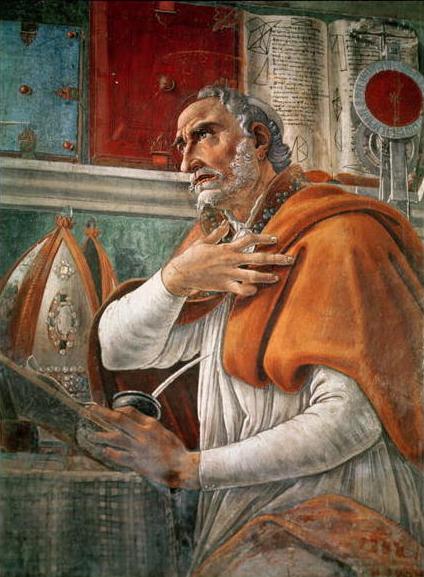
Augustinianism is the system of theology based on the teachings of Augustine (AD 354–430), also known as St. Augustine or Augustine of Hippo (in northern Africa), one of the Nicene church fathers. He is revered as the “Doctor of the Church” according to Roman Catholicism. Augustine is also considered by evangelical Protestants to have correctly understood and taught the biblical doctrines of the depravity of man and the sovereignty of God’s grace in salvation. It is those two doctrines—total depravity and divine sovereignty—that people usually have in mind when they refer to “Augustinianism.” Sometimes, the term Augustinianism is used as a synonym for Calvinism.
Protestant Reformers such as Martin Luther, Ulrich Zwingli, and John Calvin found much to their liking in Augustinianism, because they found it to be biblical. Like Calvinism, Augustinianism holds that, due to the Fall, mankind is unable to avoid sinning. His nature has been overrun by sin to the extent that man does not truly have freedom of the will; rather, he is in bondage to sin. Only an act of God can release him. This corresponds to the Calvinist doctrine of total depravity and accords with Jesus’ words in John 6:44, “No one can come to Me unless the Father who sent Me draws him; and I will raise him up at the last day.”
Augustinianism also teaches that no one can be saved apart from God’s grace. In fact, grace is necessary for the performance of any righteous act, including the exercise of faith. Without that saving grace, no sinner can ever make a decision for Christ. In agreement with the I of Calvinism’s TULIP, Augustinianism teaches that grace is irresistible and effectual. That is, every recipient of God’s grace will come to faith in Christ. As Jesus said, “This is the will of him who sent me, that I shall lose none of all those he has given me” (John 6:39).
Furthermore, according to Augustinianism, saving grace is given to those whom God has predestined before “the foundation of the world” (Ephesians 1:4–5). This predestination, again in sync with Calvinism, is not rooted in God’s foreknowledge or omniscience. In other words, God did not “look down through history” to see the choice a sinner will make and elect him based on that knowledge. In Augustinianism, the choice is completely God’s.
Augustinianism was at odds with Pelagianism, which denied original sin and taught that man was completely free to choose either good or evil for himself, apart from grace. Pelagius was a British monk who lived at the same time as Augustine, and his doctrines were condemned as heretical at the Councils of Carthage in AD 407 and 416 and by the Third Ecumenical Council of Ephesus in AD 431. Augustinianism was then recognized as an expression of Christian orthodoxy in the Western church and much later became a major influence in the doctrine of the Reformers.
The differences between Arminian theology and Reformed theology are well-known and oft-discussed. One “middle ground” system of doctrine that’s been proposed is Amyraldism, also called four-point Calvinism. Another compromise between Arminianism and Calvinism is Reformed Arminianism.
Reformed Arminianism seems like a contradiction in terms, given the historic dispute between Reformed theology and Arminianism. The “contradiction” is actually a compromise that traces its roots to the General Baptist movement of the seventeenth century in England. More recently, Reformed Arminianism has been promoted by the Free Will Baptists. Reformed Arminianism modifies current forms of Wesleyanism to take an approach that some consider to be closer to what Jacobus Arminius actually taught.
Reformed Arminians disagree with the teaching of perfectionism or entire sanctification found in some Arminian circles. In addition, Reformed Arminianism accepts the Reformed teachings of original sin and total depravity, believing it is only the grace of God and the power of the Holy Spirit that can overcome human depravity. At the same time, Reformed Arminianism retains the Arminian view of predestination (God elected those He knew would believe) and the freedom of the will (one is able to resist the grace of God needed to save him).
Akin to Amyraldism, Reformed Arminianism teaches an unlimited atonement, as opposed to Calvinism’s limited atonement. But Reformed Arminianism agrees with Calvinism that Christ’s atonement was a penal satisfaction that satisfied God’s requirement for justice and that Christ’s righteousness is imputed to the believer in justification.
Reformed Arminianism also holds to the perseverance of the saints through faith alone—another tenet of Calvinism—with a caveat. Reformed Arminians believe that Christians can lose their salvation, but only by renouncing their faith. Reformed Arminians reject the idea, found in traditional Wesleyanism, that falling into sin will cause one to fall from grace until repentance restores the sinner back to a state of grace. In other words, according to Reformed Arminianism, a believer cannot fall out of salvation, but he can willingly forfeit it, and once he apostatizes, he is lost forever.
Reformed Arminianism could be seen as “moderate Arminianism,” just as Amyraldism could be seen as “moderate Calvinism.” Those who disagree with some but not all of the teachings of Arminianism, and those seeking a compromise between Calvinism and Arminianism, may find Reformed Arminianism an agreeable option.
This is my personal collection of thoughts and writings, mainly from much smarter people than I, which challenge me in my discipleship walk. Don't rush by these thoughts, but ponder them.