
What is Arminianism, and is it biblical?

Arminianism is a system of belief that attempts to explain the relationship between God’s sovereignty and mankind’s free will, especially in relation to salvation. Arminianism is named after Jacobus Arminius (1560—1609), a Dutch theologian. While Calvinism emphasizes the sovereignty of God, Arminianism emphasizes the responsibility of man. If Arminianism is broken down into five points, similar to the five points of Calvinism, these would be the five points:

(1) Partial Depravity – humanity is depraved but still able to seek God. We are fallen and tainted by sin but not to the extent that we cannot chose to come to God and accept salvation, with the help of prevenient grace from God. Given such grace, human will is free and has the power to yield to the influence of the Spirit. Note: many Arminians reject partial depravity and hold a view very close to Calvinistic total depravity. (2) Conditional Election – God only “chooses” those whom He knows will choose to believe. No one is predetermined for either heaven or hell. (3) Unlimited Atonement – Jesus died for everyone, even those who are not chosen and will not believe. Jesus’ death was for all of humanity, and anyone can be saved by belief in Him. (4) Resistible Grace – God’s call to be saved can be resisted and/or rejected. We can resist God’s pull toward salvation if we choose to. (5) Conditional Salvation – Christians can lose their salvation if they actively reject the Holy Spirit’s influence in their lives. The maintenance of salvation is required for a Christian to retain it. Note: many Arminians deny “conditional salvation” and instead hold to “eternal security.”

The only point of Arminianism that four-point Calvinists believe to be biblical is point #3—Unlimited Atonement. First John 2:2 says, “He is the atoning sacrifice for our sins, and not only for ours but also for the sins of the whole world.” Second Peter 2:1 tells us that Jesus even bought the false prophets who are doomed: “But there were also false prophets among the people, just as there will be false teachers among you. They will secretly introduce destructive heresies, even denying the sovereign Lord who bought them—bringing swift destruction on themselves.” Jesus’ salvation is available to anyone and everyone who will believe in Him. Jesus did not just die for those who will be saved.

Four-point Calvinism (the official position of Got Questions Ministries) finds the other four points of Arminianism to be unbiblical, to varying degrees. Romans 3:10–18 strongly argues for total depravity. Conditional election, or election based on God’s foreknowledge of human action, underemphasizes God’s sovereignty (Romans 8:28–30). Resistible grace underestimates the power and determination of God. Conditional salvation makes salvation a reward for work rather than a gift of grace (Ephesians 2:8–10). There are problems with both systems, but we see Calvinism as more biblically based than Arminianism. However, both systems fail to adequately explain the relationship between God’s sovereignty and mankind’s free will—due to the fact that it is impossible for a finite human mind to discern a concept only God can fully understand.

Calvinism vs. Arminianism – which view is correct?

Calvinism and Arminianism are two systems of theology that attempt to explain the relationship between God’s sovereignty and man’s responsibility in the matter of salvation. Calvinism is named for John Calvin, a French theologian who lived from 1509-1564. Arminianism is named for Jacobus Arminius, a Dutch theologian who lived from 1560-1609.

Both systems can be summarized with five points. Calvinism holds to the total depravity of man while Arminianism holds to partial depravity. Calvinism’s doctrine of total depravity states that every aspect of humanity is corrupted by sin; therefore, human beings are unable to come to God on their own accord. Partial depravity states that every aspect of humanity is tainted by sin, but not to the extent that human beings are unable to place faith in God of their own accord. Note: classical Arminianism rejects “partial depravity” and holds a view very close to Calvinistic “total depravity” (although the extent and meaning of that depravity are debated in Arminian circles). In general, Arminians believe there is an “intermediate” state between total depravity and salvation. In this state, made possible by prevenient grace, the sinner is being drawn to Christ and has the God-given ability to choose salvation.

Calvinism includes the belief that election is unconditional, while Arminianism believes in conditional election. Unconditional election is the view that God elects individuals to salvation based entirely on His will, not on anything inherently worthy in the individual. Conditional election states that God elects individuals to salvation based on His foreknowledge of who will believe in Christ unto salvation, thereby on the condition that the individual chooses God.

Calvinism sees the atonement as limited, while Arminianism sees it as unlimited. This is the most controversial of the five points. Limited atonement is the belief that Jesus only died for the elect. Unlimited atonement is the belief that Jesus died for all, but that His death is not effectual until a person receives Him by faith.

Calvinism includes the belief that God’s grace is irresistible, while Arminianism says that an individual can resist the grace of God. Irresistible grace argues that when God calls a person to salvation, that person will inevitably come to salvation. Resistible grace states that God calls all to salvation, but that many people resist and reject this call.

Calvinism holds to perseverance of the saints while Arminianism holds to conditional salvation. Perseverance of the saints refers to the concept that a person who is elected by God will persevere in faith and will not permanently deny Christ or turn away from Him. Conditional salvation is the view that a believer in Christ can, of his/her own free will, turn away from Christ and thereby lose salvation. Note – many Arminians deny “conditional salvation” and instead hold to “eternal security.”

So, in the Calvinism vs. Arminianism debate, who is correct? It is interesting to note that in the diversity of the body of Christ, there are all sorts of mixtures of Calvinism and Arminianism. There are five-point Calvinists and five-point Arminians, and at the same time three-point Calvinists and two-point Arminians. Many believers arrive at some sort of mixture of the two views. Ultimately, it is our view that both systems fail in that they attempt to explain the unexplainable. Human beings are incapable of fully grasping a concept such as this. Yes, God is absolutely sovereign and knows all. Yes, human beings are called to make a genuine decision to place faith in Christ unto salvation. These two facts seem contradictory to us, but in the mind of God they make perfect sense.

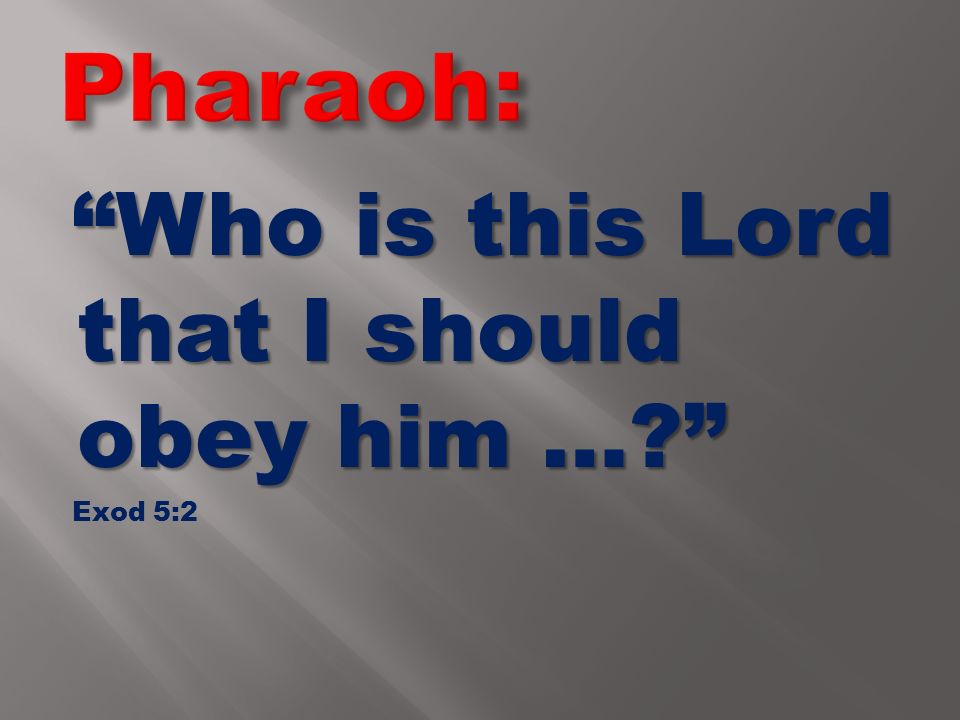
Who is the LORD, that I should obey him and let Israel go?

I do not know the LORD, and moreover, I will not let Israel go. Exodus 5:2

Context
Pharaoh’s First Refusal
After that, Moses and Aaron went to Pharaoh and said, “This is what the LORD, the God of Israel, says: ‘Let My people go, so that they may hold a feast to Me in the wilderness.’ ” But Pharaoh replied, “Who is the LORD that I should obey His voice and let Israel go? I do not know the LORD, and I will not let Israel go.” “The God of the Hebrews has met with us,” they answered. “Please let us go on a three-day journey into the wilderness to sacrifice to the LORD our God, or He may strike us with plagues or with the sword.”…

—The king means to say, that, whoever Jehovah is, He can have no authority over him, as He is not one of his gods. The Egyptians were accustomed to the idea of local gods, and quite expected every nation to have a deity or several deities of its own; but they regarded the power of each as circumscribed, certainly not extending beyond the race or nation to which the god belonged.

Benson Commentary
Exodus 5:2. Who is the Lord, that I should obey his voice? — I am the sovereign lord of Egypt, and I own no superior here. The Hebrew name Jehovah ought to have been retained in this and the preceding verse, and not to have been translated Lord. Thus saith Jehovah — who is Jehovah — I know not Jehovah. The Egyptians, it must be observed, and other nations were at this time sunk in idolatry, and knowing nothing of the true God, the possessor of heaven and earth, each nation had a god or gods of its own. Pharaoh, therefore, did not speak as an atheist, or mean that he knew nothing of any god whom he ought to obey; but he knew nothing of the God of the Hebrews, whom they termed Jehovah, imagining him to be like one of the gods of Egypt, or of some other country, a mere local deity, whom therefore it neither concerned him to know nor to obey. Now the train of miracles which followed were intended to teach Pharaoh and his people, that Jehovah was not only the God of the Hebrews, but of all the world, having an uncontrolled and sovereign power over universal nature.

Self Fashioned Not God Fashioned

What if God, desiring to show his wrath and to make known his power, has endured with much patience vessels of wrath prepared for destruction, Romans 9:22

Context
The Calling of the Gentiles
…Does not the potter have the right to make from the same lump of clay one vessel for special occasions and another for common use? What if God, intending to show His wrath and make His power known, bore with great patience the vessels of His wrath, prepared for destruction? What if He did this to make the riches of His glory known to the vessels of His mercy, whom He prepared in advance for glory—…

Benson Commentary
Romans 9:22-23. What if God, willing, &c. — Referring to Romans 9:18-19. That is, Although it were now his will, because of their obstinate unbelief; to show his wrath — Which necessarily presupposes sin; and to make his power known — This is repeated from Romans 9:17; yet endured — As he did Pharaoh — With much long-suffering — Which should have led them to repentance; the vessels of wrath — Those who had moved his wrath, by still rejecting his mercy; fitted for destruction — By their own wilful and final impenitence: is there any injustice in this? And that he might make known — What if, by showing such long-suffering even to the vessels of his wrath, he did the more abundantly show the greatness of his glorious goodness, wisdom, and power; on the vessels of mercy — On those whom he had himself, by his grace; prepared for glory — Is this injustice? By vessels of mercy he means such persons as were formerly miserable by being dead in trespasses and sins, but had afterward, through believing the gospel, obtained mercy, even the great mercy of the forgiveness of sins, with the fruits and consequences of it; and by the term προητοιμασεν, he means, God’s fitting them for glory, by working in them true repentance and living faith, by justifying and sanctifying them, and giving them all those qualifications necessary for the attainment of it.

Matthew Henry’s Concise Commentary
9:14-24 Whatever God does, must be just. Wherein the holy, happy people of God differ from others, God’s grace alone makes them differ. In this preventing, effectual, distinguishing grace, he acts as a benefactor, whose grace is his own. None have deserved it; so that those who are saved, must thank God only; and those who perish, must blame themselves only, Hos 13:9. God is bound no further than he has been pleased to bind himself by his own covenant and promise, which is his revealed will. And this is, that he will receive, and not cast out, those that come to Christ; but the drawing of souls in order to that coming, is an anticipating, distinguishing favour to whom he will. Why does he yet find fault? This is not an objection to be made by the creature against his Creator, by man against God. The truth, as it is in Jesus, abases man as nothing, as less than nothing, and advances God as sovereign Lord of all. Who art thou that art so foolish, so feeble, so unable to judge the Divine counsels? It becomes us to submit to him, not to reply against him. Would not men allow the infinite God the same sovereign right to manage the affairs of the creation, as the potter exercises in disposing of his clay, when of the same lump he makes one vessel to a more honourable, and one to a meaner use? God could do no wrong, however it might appear to men. God will make it appear that he hates sin. Also, he formed vessels filled with mercy. Sanctification is the preparation of the soul for glory. This is God’s work. Sinners fit themselves for hell, but it is God who prepares saints for heaven; and all whom God designs for heaven hereafter, he fits for heaven now. Would we know who these vessels of mercy are? Those whom God has called; and these not of the Jews only, but of the Gentiles. Surely there can be no unrighteousness in any of these Divine dispensations. Nor in God’s exercising long-suffering, patience, and forbearance towards sinners under increasing guilt, before he brings utter destruction upon them. The fault is in the hardened sinner himself. As to all who love and fear God, however such truths appear beyond their reason to fathom, yet they should keep silence before him. It is the Lord alone who made us to differ; we should adore his pardoning mercy and new-creating grace, and give diligence to make our calling and election sure.

My Utmost for His Highest

June 13th

Getting there

Where the selective affinity dies and the sanctified abandon lives. Come ye after Me. Mark 1:17.

One of the greatest hindrances in coming to Jesus is the excuse of temperament. We make our temperament and our natural affinities barriers to coming to Jesus. The first thing we realize when we come to Jesus is that He pays no attention whatever to our natural affinities. We have the notion that we can consecrate our gifts to God. You cannot consecrate what is not yours; there is only one thing you can consecrate to God, and that is your right to yourself (Romans 12:1). If you will give God your right to yourself, He will make a holy experiment out of you. God’s experiments always succeed. The one mark of a saint is the moral originality which springs from abandonment to Jesus Christ. In the life of a saint there is this amazing wellspring of original life all the time; the Spirit of God is a well of water springing up, perennially fresh. The saint realizes that it is God Who engineers circumstances, consequently there is no whine, but a reckless abandon to Jesus. Never make a principle out of your experience; let God be as original with other people as He is with you.
If you abandon to Jesus, and come when He says ‘Come,’ He will continue to say ‘Come’ through you; you will go out into life reproducing the echo of Christ’s ‘Come.’ That is the result in every soul who has abandoned and come to Jesus.
Have I come to Jesus? Will I come now?

Stephen Boyd Blog

Belfast-born Hollywood and International Star from 1950-1970's Fan Tribute Page

Abundant Joy

Digging Deep Into The Word

Not My Life

The Bible as clear as possible

Seek Grow Love

Growing Throughout the Year

Smoodock's Blog

Question Authority

PleaseGrace

A bit on daily needs and provisions

Three Strands Lutheran Parish

"A cord of three strands is not easily broken." Ecclesiastes 4:12

1love1god.com

Romans 5:8

The Rev. Jimmy Abbott

read, watch, listen

BEARING CHRIST CRUCIFIED AND RISEN

To know Christ and Him crucified

Considering the Bible

Scripture Musings

rolliwrites.wordpress.com/

The Official Home of Rolli - Author, Cartoonist and Songwriter

Pure Glory

The heavens are telling the glory of God; and the firmament proclaims His handiwork. Psalms 19:1

The daily addict

The daily life of an addict in recovery

The Christian Tech-Nerd

-Reviews, Advice & News For All Things Tech and Gadget Related-

Thinking Through Scripture

to help you walk with Jesus in faith, hope, and love.

A disciple's study

This is my personal collection of thoughts and writings, mainly from much smarter people than I, which challenge me in my discipleship walk. Don't rush by these thoughts, but ponder them.

Author Scott Austin Tirrell

Maker of fine handcrafted novels!

In Pursuit of My First Love

Returning to the First Love