“My own peace I give to you.” (John 14:27.) (Weymouth.)
TWO painters each painted a picture to illustrate his conception of rest. The first chose for his scene a still, lone lake among the far-off mountains. The second threw on his canvas a thundering waterfall, with a fragile birch tree bending over the foam; and at the fork of the branch, almost wet with the cataract’s spray, sat a robin on its nest. The first was only stagnation; the last was rest. Christ’s life outwardly was one of the most troubled lives that ever lived: tempest and tumult, tumult and tempest, the waves breaking over it all the time until the worn body was laid in the grave. But the inner life was a sea of glass. The great calm was always there. At any moment you might have gone to Him and found rest. And even when the human bloodhounds were dogging Him in the streets of Jerusalem, He turned to His disciples and offered them, as a last legacy, “My peace.” Rest is not a hallowed feeling that comes over us in church; it is the repose of a heart set deep in God.—Drummond.
My peace I give in times of deepest grief,
Imparting calm and trust and My relief.

My peace I give when prayer seems lost, unheard;
Know that My promises are ever in My Word.

My peace I give when thou art left alone—
The nightingale at night has sweetest tone.

My peace I give in time of utter loss,
The way of glory leads right to the cross.

My peace I give when enemies will blame,
Thy fellowship is sweet through cruel shame.

My peace I give in agony and sweat,
For mine own brow with bloody drops was wet.

My peace I give when nearest friend betrays—
Peace that is merged in love, and for them prays.

My peace I give when there’s but death for thee—
The gateway is the cross to get to Me.
‘It is good that a man should both hope and quietly wait for the salvation of the LORD.’ Lamentations 3:26 SUGGESTED FURTHER READING: Nehemiah 4:1–23
Observe the need of such a word as this. It is much like the design of the parable which our Lord delivered to encourage us to pray earnestly and not to faint. The reasons arise: (i) partly from the manner of his dispensation—he has promised to hear and answer—but it is likewise his pleasure to exercise our faith and patience. He seldom carries on his work any other way. When he promised Israel deliverance, he permitted Pharaoh to double his opposition. When he set them upon rebuilding the temple, he permitted their enemies to interrupt them. So when he stirs up a soul to seek his salvation, he seems at times to hide his face; their fears prevail, and their ease seems to grow worse. Yet his purpose stands good, and he tells them it is good for them both to hope and quietly wait. (ii) partly from the tendency of our spirits to impatience and unbelief. A convinced sinner seeks mercy, but he must have it immediately; he can brook no delay, and is often brought to say or think, Wherefore should I wait any longer? FOR MEDITATION: The lion that on Sampson roared, The world and Satan join their strength, And thirsted for his blood; To fill their souls with fears; With honey afterwards was stored, But crops of joy they reap at length, And furnished him with food. From what they sow in tears.
Believers, as they pass along, Afflictions make them love the Word, With many lions meet; Stir up their hearts to prayer; But gather sweetness from the strong, And many precious proofs afford, And from the eater, meat. Of their Redeemer’s care.
The lions rage and roar in vain, The lions roar but cannot kill, For JESUS is their shield; Then fear them not, my friends, Their losses prove a certain gain, They bring us, though against their will, Their troubles comfort yield. The honey JESUS sends.
Context A Gentle Answer Turns Away Wrath …Plans fail for lack of counsel, but with many advisers they succeed. A man takes joy in a fitting reply — and how good is a timely word! The path of life leads upward for the wise, that he may avoid going down to Sheol.… Proverbs 15:23
I tell you, on the day of judgment people will give account for every careless word they speak, Matthew 12:36
Context Good and Bad Fruit …The good man brings good things out of his good store of treasure, and the evil man brings evil things out of his evil store of treasure. But I tell you that men will give an account on the day of judgment for every careless word they have spoken. For by your words you will be acquitted, and by your words you will be condemned.”…
Benson Commentary Matthew 12:36-37. But I say unto you — You may perhaps think God does not much regard your words, but I assure you, that not only for blasphemous and profane, malicious, false, slanderous, and reviling words, but for every idle word which men shall speak: for all light, vain, trifling expressions; for all useless, unprofitable conversation, and all discourse uttered without seriousness and caution, and which does not conduce to the glory of God and the good of mankind; that men shall speak — At any time, or on any occasion, they shall give an account in the day of judgment — “I cannot think,” says Dr. Doddridge, “that our Lord here uses αργον, idle, merely to signify mischievous. We are certainly accountable for useless as well as wicked discourses, and they will be taken into that last survey which is to determine our character and state: which they whose life is one continued scene of whim, or sneering raillery, would do well seriously to consider. And it was to our Lord’s purpose to observe it here, as it inferred, by the strongest consequence, the danger of such vile and criminal discourses as those of the Pharisees in this case. But discourse tending to exhilarate the spirits is not idle discourse; as the time spent in necessary recreation is not idle time; nor does a wise and gracious God expect from men the life of angels. If any are dissatisfied with the account of things here given, I would beg leave to ask them whether unprofitable talk be not a sinful wasting of time? and whether that must not render a man in some degree criminal before God?” For by thy words — That is, by the evidence of thy words, as well as of thy tempers and works, thou shall be justified, &c. — Shalt be either acquitted or condemned; since by the tenor of these the disposition of thy heart is shown, and thy true character discovered. Therefore these shall be produced in evidence for or against thee at the great day, and by this evidence thou shalt then stand or fall.
Matthew Henry’s Concise Commentary 12:33-37 Men’s language discovers what country they are of, likewise what manner of spirit they are of. The heart is the fountain, words are the streams. A troubled fountain, and a corrupt spring, must send forth muddy and unpleasant streams. Nothing but the salt of grace, cast into the spring, will heal the waters, season the speech, and purify the corrupt communication. An evil man has an evil treasure in his heart, and out of it brings forth evil things. Lusts and corruptions, dwelling and reigning in the heart, are an evil treasure, out of which the sinner brings forth bad words and actions, to dishonour God, and hurt others. Let us keep constant watch over ourselves, that we may speak words agreeable to the Christian character. Barnes’ Notes on the Bible But I say unto you … – Christ closes this address to his malignant and wicked hearers by a solemn declaration that for these things God would bring them into judgment. Therefore. They who had spoken so malignantly against him, could not escape. Idle word – This literally means a vain, thoughtless, useless word; a word that accomplishes no good. Here it means, evidently, “wicked, injurious, false, malicious, for such” were the words which they had spoken.
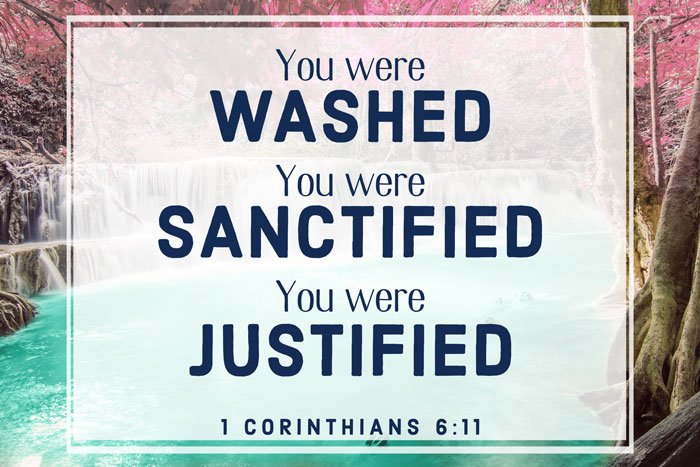
And such were some of you. But you were washed, you were sanctified, you were justified in the name of the Lord Jesus Christ and by the Spirit of our God. 1 Corinthians 6:11
Context Members of Christ …nor thieves, nor the greedy, nor drunkards, nor verbal abusers, nor swindlers, will inherit the kingdom of God. And that is what some of you were. But you were washed, you were sanctified, you were justified, in the name of the Lord Jesus Christ and by the Spirit of our God. “Everything is permissible for me,” but not everything is beneficial. “Everything is permissible for me,” but I will not be mastered by anything.…
Matthew Henry’s Concise Commentary 6:9-11 The Corinthians are warned against many great evils, of which they had formerly been guilty. There is much force in these inquiries, when we consider that they were addressed to a people puffed up with a fancy of their being above others in wisdom and knowledge. All unrighteousness is sin; all reigning sin, nay, every actual sin, committed with design, and not repented of, shuts out of the kingdom of heaven. Be not deceived. Men are very much inclined to flatter themselves that they may live in sin, yet die in Christ, and go to heaven. But we cannot hope to sow to the flesh, and reap everlasting life. They are reminded what a change the gospel and grace of God had made in them. The blood of Christ, and the washing of regeneration, can take away all guilt. Our justification is owing to the suffering and merit of Christ; our sanctification to the working of the Holy Spirit; but both go together. All who are made righteous in the sight of God, are made holy by the grace of God.
Barnes’ Notes on the Bible And such – Such drunkards, lascivious, and covetous persons. This shows: (1) The exceeding grace of God that could recover even such persons from sins so debasing and degrading.
(2) it shows that we are not to despair of reclaiming the most abandoned and wretched people.
(3) it is well for Christians to look back on what they once were. It will produce:
(a) humility,
(b) gratitude,
(c) a deep sense of the sovereign mercy of God,
(d) an earnest desire that others may be recovered and saved in like manner; compare Ephesians 2:1, Ephesians 2:2; Ephesians 5:8; Colossians 3:7; Titus 3:3, Titus 3:6 – The design of this is to remind them of what they were, and to show them that they were now under obligation to lead better lives – by all the mercy which God had shown in recovering them from sins so degrading, and from a condition so dreadful.
But ye are washed – Hebrews 10:22. Washing is an emblem of purifying. They had been made pure by the Spirit of God. They had been, indeed, baptized, and their baptism was an emblem of purifying, but the thing here particularly referred to is not baptism, but it is something that had been done by the Spirit of God, and must refer to his agency on the heart in cleansing them from these pollutions. Paul here uses three words, “washed, sanctified, justified,” to denote the various agencies of the Holy Spirit by which they had been recovered from sin. The first, that of washing, I understand of that work of the Spirit by which the process of purifying was commenced in the soul, and which was especially signified in baptism – the work of regeneration or conversion to God. By the agency of the Spirit the defilement of these pollutions had been washed away or removed – as filth is removed by ablution – The agency of the Holy Spirit in regeneration is elsewhere represented by washing, Titus 3:5,” The washing of regeneration.” compare Hebrews 10:22.
Ye are sanctified – This denotes the progressive and advancing process of purifying which succeeds regeneration in the Christian. Regeneration is the commencement of it – its close is the perfect purity of the Christian in heaven; see the note at John 17:17. It does not mean that they were perfect – for the reasoning of the apostle shows that this was far from being the case with the Corinthians; but that the work was advancing, and that they were in fact under a process of sanctification.
But ye are justified – Your sins are pardoned, and you are accepted as righteous, and will be treated as such on account of the merits of the Lord Jesus Christ; see the note at Romans 1:17; note at Romans 3:25-26; note at Romans 4:3. The apostle does not say that this was last in the order of time, but simply says that this was done to them. People are justified when they believe, and when the work of sanctification commences in the soul.
In the name of the Lord Jesus – That is, by the Lord Jesus; by his authority, appointment, influence; see the note at Acts 3:6. All this had been accomplished through the Lord Jesus; that is, in his name forgiveness of sins had been proclaimed to them Luke 24:47; and by his merits all these favors had been conferred on them.
And by the Spirit of our God – The Holy Spirit. All this had been accomplished by his agency on the heart – This verse brings in the whole subject of redemption, and states in a most emphatic manner the various stages by which a sinner is saved, and by this single passage, a man may obtain all the essential knowledge of the plan of salvation. All is condensed here in few words:
(1) He is by nature a miserable and polluted sinner – without merit, and without hope.
This is my personal collection of thoughts and writings, mainly from much smarter people than I, which challenge me in my discipleship walk. Don't rush by these thoughts, but ponder them.