‘And Abram went up out of Egypt, he, and his wife, and all that he had, and Lot with him, into the south. And Abram was very rich in cattle, in silver, and in gold. And Lot also, which went with Abram, had flocks, and herds, and tents. And the land was not able to bear them, that they might dwell together: for their substance was great, so that they could not dwell together. And there was a strife between the herdmen of Abram’s cattle and the herdmen of Lot’s cattle: and the Canaanite and the Perizzite dwelled then in the land.’ Genesis 13:1–2, 5–7 SUGGESTED FURTHER READING: Genesis 13:1–18
Notice the riches of Abraham and Lot. They forsook their own country and went into a strange land at the Lord’s command, and he provided well for them. It is true the promises of the gospel chiefly respect better and spiritual blessings, yet they include the things of this life likewise. I would observe from it that the best way to prosper as to worldly concerns is to observe the Lord’s commandments. I am afraid some of you, yea some believers, think otherwise. To this is owing the profanation of the Lord’s Day, which so sadly prevails amongst us. I know some allow themselves in what their consciences condemn, because they cannot trust the Lord with their substance or character. They seem desirous to serve him if they could do it without offending the world. This is for a lamentation. Note the inconvenience attending their riches: strife—not immediately between themselves, but their herdsmen strove, and Abraham and Lot were in danger of taking part with their respective servants as to have some difference. We may see from hence that though the Lord will give his people every needful good, yet for the most part he withholds riches from them. It is in mercy. Great possessions are usually accompanied with great cares, troubles and snares. Our life and comfort does not depend upon them; rather, they endanger peace and safety. Abraham and Lot wished to live in peace, but their servants had strife, and strife is like the kindling of a fire, which spreads far and wide from small beginnings.
FOR MEDITATION: ‘They that will be rich fall into temptation and a snare, and into many foolish and hurtful lusts, which drown men in destruction and perdition’ (1 Timothy 6:9).
It drives me crazy how inconsistent many Christians are with their worldview. Many Christians claim to believe in God and to trust the Bible as being God’s Word, yet, as soon as the Christian worldview stands in the way of something they want to do, it gets thrown out the window, only to be recovered the next time it becomes convenient. This is the lukewarm faith Jesus spoke of in Revelation 3:16. I, too, would rather have people be hot or cold. If they are hot, I am ready to partner with them in declaring and living the truth. If they are cold, I am ready to attempt to reach them by speaking the truth in love (Ephesians 4:15). If they are lukewarm…? [Insert vomiting sound here.]
A worldview is, simply, how we view the world. Our worldview impacts every area of our lives, sometimes purposefully in that we intentionally base our decisions on it, and sometimes ignorantly in that it impacts us even when we are not consciously thinking about it. Our worldview is a core set of beliefs/values that determines how we view everything else in life. The core of a worldview is made up of the answers to the following questions: (1) Why are we here? (2) What is wrong with the world? (3) Can it be fixed? A Christian worldview would answer the questions: (1) God created us. (2) Sin. (3) Yes, through Jesus Christ.
God created us for a purpose. God created us in His image so that He could have a meaningful relationship with us. God designed us so that we would be ideal stewards over His creation. This aspect of a Christian worldview impacts how we view and treat other people. Does human life have any value? Should human life be treated different from other forms of life? Why should I be loving, kind, and compassionate towards other people? We were created in order to have a relationship with God. Life has no true meaning or value without that relationship. Yet, so many treat God as an afterthought, something you talk about one day a week.
Sin is what is wrong with the world. This world, as wonderful and amazing as it still is, is completely screwed up. It is not completely what God intended it to be. While it still contains beauty, and still provides what we need for life, it is a warped and faded image of what God created. We brought sin and evil into the world. We are responsible for all that is wrong in the world. We are completely messed up and infected with a deadly plague (Romans 3:10-23). We are the problem, not the solution. This aspect of a Christian worldview should humble us and keep us from pride and arrogance. The world does not revolve around us. If it did, it would be upside-down, spinning backwards, and shaped like a rotten potato with all those weird-looking sprouts coming out of it.
God is the solution. God became a human being (John 1:1,14), lived a perfect life, taught us the truth, and died to pay the penalty for our sins (2 Corinthians 5:21). Jesus’ resurrection proved that His mission was successful. Through Jesus Christ, our lives can be redeemed and restored. Through Jesus Christ, one day, the universe and everything in it will be restored to glory and perfection. Through faith in Jesus Christ, all of our sins can be forgiven and we can have our heavenly eternal destiny secured. Do you see the pattern? It is all about Jesus! We are the problem, Jesus is the solution. Jesus accomplished it all and offers it to us as a gift, if we will just receive it in faith. How could such a tremendous sacrifice not completely shape our worldview? How could such an amazing gift not be the basis for how and why we live our lives?
Whether it is your marriage, your job, your politics, your hobbies, your morals, or your desires, your worldview should be the foundation. Nothing in your life should be separated from the fact that you are a Christian, a dedicated follower of Jesus Christ. If the Christian worldview is true, it demands our all. We should be on fire for God. If the Christian worldview is false, it should be completely ignored. We should be as cold as the south pole. What should be done with lukewarmness? The same thing the whale did with Jonah.
Several years ago, my wife and I experienced a wonderful vacation in New Zealand. New Zealand is a beautiful country with many natural wonders which, for us, undeniably point to a Creator God. Only God could design and create scenery so amazing.
During the trip, we went on a whale-watching adventure. Prior to departing on the boat, we were asked to watch an informative video on whales. In this video was a lengthy section discussing how whales evolved. According to the video, what was essentially a large wolf learned to catch fish on the coastlines, began to venture further and further into the water, and over millions of year, eventually evolved into a whale. The absurdity of the idea would have been hilarious were it not for the fact that millions of people actually believe what the video presented.
Christians are not, or at least should not be, opposed to microevolution. Microevolution, which is changes within a species, is an uncontroversial, well-documented, naturally occurring biological phenomenon. Macroevolution, which is one species developing into an entirely new species, is what many Christians are opposed to. Why? For one, it is not scientific. It is not observable, testable, or repeatable. We see species adapting all the time. But, we do not see dogs becoming horses, or lizards becoming birds. When Darwin observed finches on the Galapagos islands, he observed certain types of finches surviving better due to a slightly different beak design (microevolution). He did not observe finches becoming anteaters (macroevolution).
Theistic evolution is probably the predominant view in the world today. While I believe theistic evolution to be decidedly unbiblical, I do not view it as contradictory to the core message of the Christian faith. One can be a true follower of Jesus Christ while holding to theistic evolution. I can see how theistic evolution “makes sense,” as it would take an all-powerful Creator God to turn a wolf into a whale. But, for me, theistic macroevolution is completely unnecessary. If God wanted a whale to exist, why not just create a whale? Why take a wolf and over millions of years transform it into a whale?
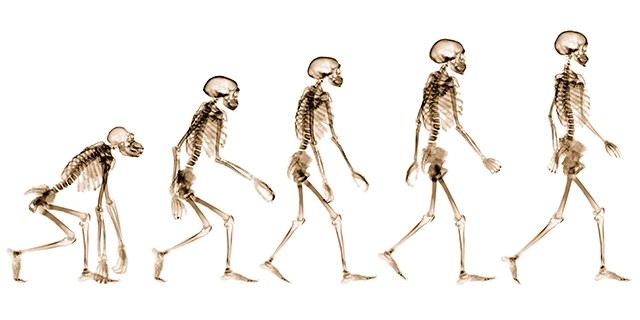
Christians reject macroevolution because: (1) it is unbiblical, and (2) it is the “Creation account” for atheism. Now, I am not saying that everyone who accepts macroevolution is an atheist. What I am saying is that for atheism to be true, macroevolution must also be true. If there is no God, then everything we see has to have evolved. Protein molecules became amoebas; amoebas became fish; fish became lizards; lizards became dogs; dogs became monkeys; and monkeys became humans. Despite the absurdity of it, despite the virtually impossible odds of a single protein molecule forming by chance even if given billions of years, this is what many people believe. Why do they believe this evolutionary mythology? Atheists believe it because they have no other choice. Others believe it because they have been taught that it is true and have been told that anyone who believes otherwise is an ignorant and backwards caveman.
The consequences of believing in evolution can be readily seen in the world today. If we teach children they are nothing but highly evolved animals, why are we surprised when they act like animals? If we are told that survival of the fittest is how the world works, why are we surprised when those who think they are the fittest are willing to do anything, no matter how immoral and evil, to make sure they survive? If we are nothing but the most highly evolved creature on this planet, “Let us eat, drink, do drugs, sleep around, you know, do whatever we want, for tomorrow we die” (loose paraphrase of 1 Corinthians 15:32).
In contrast, if there is a Creator God, there is meaning and purpose to our existence. There is a reason for choosing good instead of evil, love instead of hate, and mercy instead of revenge. With God, we can recognize places like New Zealand as beautiful examples of God’s creative power instead of understanding them to be random piles of rock and dirt that just happen to cause our neural synapses to fire in a certain way.
Being a young earth creationist can be difficult. If you are a young earth creationist, the vast majority of scientifically-minded people in the world think you are an ignorant buffoon (or worse). Naturalistic evolutionists believe in an old earth. Theistic evolutionists believe in an old earth. Old earth creationists believe in an old earth. Progressive creationists believe in an old earth. A lot of the scientific data seems to point to an old earth. So, why do young earth creationists still believe in a young earth?
I can’t speak for all young earth creationists, but for me, there are several reasons. First, young earth creationism seems to be what the Bible teaches. Genesis 1 seems to be referring to literal, 24-hour days. The passage does not seem poetic, symbolic, or metaphorical to me. A normal reading of the text is that God created the universe, the earth, and everything in it in six 24-hour days.
Then, Genesis 5 and 11 give us a timeline we can use to trace history back to the beginning. One can roughly estimate the time Abraham lived, and from there, calculate the numbers all the way back to the creation of Adam. While I do not deny the possibility of gaps, even significant gaps, in the genealogies recorded in Genesis chapters 5 and/or 11, why would those passages give the ages of the individuals if it was not intended to provide some sort of a timeframe? Why not just say, “And Seth lived a really long time…”?
Further, a literal and specially created Adam and Eve are crucial to Christian theology (see Romans 5). If you deny a literal understanding of Genesis 1—3, it causes all kinds of problems in other areas of biblical interpretation.
With all of that in mind, the ultimate answer for why I am a young earth creationist is that the Bible seems to teach that the earth was created thousands, not billions, of years ago.
How does that square with the claimed overwhelming evidence for a universe that is approximately 14.6 billion years old? I don’t know. Did God instantly create a fully formed universe and stable, life-supporting earth, resulting in them having an appearance of age? Perhaps. Is the current scientific consensus on the age of the universe wrong? Maybe. Could there be another possible explanation for the apparent multi-billion-year discrepancy that no one has thought of? Yep.
But, again, I am a young earth creationist because that is what the Bible appears to teach. And I am not willing to abandon what the Bible appears to teach unless there is absolutely no possible explanation that would harmonize with the biblical account.
I have several friends whom I admire and respect who are old earth creationists. Each of them has repeatedly told me that I should abandon young earth creationism because it is driving scientifically-minded people away from the Christian faith. While they don’t explicitly say it, the implication of their argument is that if all Christians agreed with the scientific consensus on the age of the earth, scientists would begin flocking to the Christian faith. I don’t buy it.
People reject belief in God because their hearts are hard and their eyes are blinded to the truth. Ultimately, their problem is not with creationism. Their problem is with God.
Romans 1:18-22 declares, “The wrath of God is being revealed from heaven against all the godlessness and wickedness of people, who suppress the truth by their wickedness, since what may be known about God is plain to them, because God has made it plain to them. For since the creation of the world God’s invisible qualities—his eternal power and divine nature—have been clearly seen, being understood from what has been made, so that people are without excuse. For although they knew God, they neither glorified him as God nor gave thanks to him, but their thinking became futile and their foolish hearts were darkened. Although they claimed to be wise, they became fools and exchanged the glory of the immortal God for images made to look like a mortal human being and birds and animals and reptiles.”
People are without excuse. Even if it turns out that the universe is indeed billions of years old, a scientifically-minded person who stands before God and says, “I would have accepted Christ as my Savior, but some of your followers believed the earth was young…” is not going to receive a positive response. It is not a valid excuse. There is no valid excuse.
As can be easily seen in the scientific community’s rejection of the intelligent design theory (which entirely accepts an exceedingly old earth), agreeing with them on an old earth does not get us anywhere. Atheists and the scientific community intelligentsia are ardently opposed to intelligent design, and all the various forms of old earth and progressive creationism. They are not satisfied with anything other than pure, atheistic, naturalistic evolution—and they never will be.
We must have billions of years or else evolution is not true, and if evolution is not true, then creationism is true, and if creationism is true, God exists, and if God exists, I am accountable to Him for my actions—therefore the earth must be billions of years old! Ultimately, the issue is their hatred of God, not the age of the earth.
I understand why some old earth creationists believe the way they do. Again, there is scientific data which seems to point to an exceedingly old universe. I do not believe, as some young earth creationists do, that old earth creationists are rejecting the Bible. I do not doubt the validity of their faith. I do not doubt their motives. I do not question their love of and commitment to God’s Word.
Perhaps the earth really is billions of years old. Should God one day correct me on this, I will gladly and humbly accept His enlightenment and ask for His forgiveness for teaching falsehood. But, until that day, I am going to believe what the Bible seems to teach even if that makes me look like a fool to the scientific intelligentsia.
Atheists have been accusing Christians and theists of believing in fairy tales — using condescension — often in place of reason — for decades (centuries?). Watching the stream of rocks fly from the glass house, one wonders, how does the atheist fairy tale read?
Once upon a super-super long time ago, there was nothing. Not no-thing-nothing, but we’ll say “nothing” as if it changes what that word has meant for millennia. Whatever it was, or wasn’t, it was definitely not God. Certainly not God. This something-nothing huffed and puffed and blew the universe into existence! Out of not-nothing-but-not-God poofed an entire…something…from a not-nothing nothing. Or was that a something-not…Never mind.
Anyway…
So, the not-God-not-nothing-nothing exploded a universe that was super-perfect for life — like us — to exist. Even the teeniest, tiniest little change would mean no planets, no elements, no us! We’re hoping…we mean, guessing…this was just good luck on the part of the nothing-something-blowing-in-ago-ness, but definitely not on purpose. Certainly not on purpose. Certainly not God. Life is possible only by luck!
And then, another amazing thing happened. This universe “evolved” which, like “nothing” is a word we’ll use to mean pretty much anything whether it makes any sense or not. Even more amazingly, this change had nothing controlling or guiding it! By, “nothing,” this time, we mean a complex series of consistent, independent, inexplicable and finely tuned rules. So, not nothing-nothing, but more of that something-nothing. You know, I mean, rules-from-nowhere-for-no-reason. Except the rule about things getting less ordered over time…forget that one for now. It all came together to make galaxies and stars and planets. We don’t know why or how, but we know it was definitely not designed. Certainly not designed. Certainly not on purpose. Certainly not God. The not-guided-except-by-something-not-God-stuff self-made itself. Or was not-self-made…not into anything. Something? Never mind.
Anyway…
One little planet was not too far from a star, not too close to a star, but juuuust right so that complicated molecules could jiggle around and become even more complicated molecules and become reproducing organisms. We have no clue how this actually happened, but that doesn’t stop us from being definitely, totally sure it involved absolutely no intelligence or design at all. We have fai— (ahem), confidence…confidence this moment or process or whatever was definitely not creation. Certainly not creation. Certainly not designed. Certainly not on purpose. Certainly not God.
Eventually, those organisms travelled through a magical journey of change and self-discovery to become…us! All without any meaning, purpose, reason, or guidance of any kind whatsoever! Which means you are…or, well…actually, it means you’re just mindless matter reacting to physics, and everything you are or will be is going to come crashing down in obscurity and futility when the universe collapses. We know for sure, for sure that there is definitely no meaning to the universe. Certainly not meaning. Certainly not creation. Certainly not designed. Certainly not on purpose. Certainly not God. But we can make our own meaning, whatever that means.
And that’s the moral of the story! This magical tale, about which we actually know almost nothing, and can prove exactly nothing, explains everything — everything — I SAID EVERYTHING! about life and our universe. Except for anything that actually matters or conflicts with what I want to do; those we can make up however we want! Unless it bothers me, then you can’t make things up that way.
So, finally, after a very, very long time, the matter-machines finally learned how stupid, ignorant, backwards, dumb, stinky, and cootie-brained they had been for looking for actual answers to real questions and somehow concluding there is a God. And, how silly it is to believe fairy tales like an intelligent God making a universe that looks designed on purpose, in order to create people and minds and stuff. They turned away from their childlike foolishness, which had only led to intolerance and superstition, and physics and chemistry, and medicine, and philosophy, and music, and human rights, basically everything civilization is built on…well…wait.
Never mind. The point is, religious people are stupid, even when they’re not. Okay?
And so, we know for sure, for sure, that all of this had nothing to do with God. There is no doubt, no question, that this is a really truthy story, and what we believe…I mean, know for sure without any hard evidence or absolute proof, but won’t call faith because that’s something only dummies and babies use…is definitely not a religion. Certainly not religion. Certainly not meaning. Certainly not creation. Certainly not designed. Certainly not on purpose. Certainly not God.
And they all continued to experience meaningless biochemical reactions until they didn’t! And remember, question everything…except atheism.
A silly, slightly cynical take on atheism. But it mirrors the same “just so story” and self-contradiction atheists claim Christianity is based on. In actuality, we at GotQuestions.org strive to give people the benefit of the doubt, assuming they’ve actually got reasons and evidence for what they do or don’t believe. Obviously, we think the weight of reason, evidence, and experience supports the biblical worldview. It’s the reason we make an effort to “give a reason for the hope that we have” (1 Peter 3:15).
There’s plenty to question and criticize about the atheistic worldview. Even plenty to mock, especially if you’re inclined to oversimplifications, like the above sarcasm or silly comments about religious “fairy tales.” But we wish atheists would see that open derision isn’t a good way to support — or convert — others. But, perhaps sneering at religious believers is the only sales pitch modern atheism has left.
This is my personal collection of thoughts and writings, mainly from much smarter people than I, which challenge me in my discipleship walk. Don't rush by these thoughts, but ponder them.




 Milo
Milo 