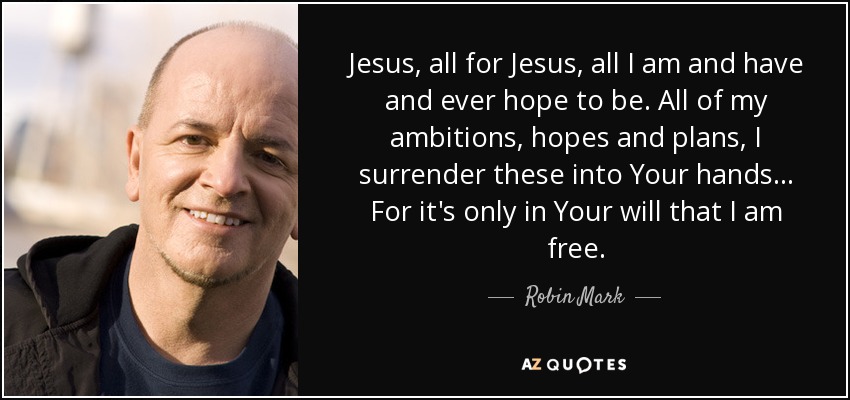
Robin Mark (born 1957) is a Northern Irish Christian singer, songwriter, worship leader, and recording artist based in Belfast, Northern Ireland. Mark may be known best for “Days of Elijah”, “Revival”, “All for Jesus”, “The Wonder of The Cross”, and “Not by Might” amongst the many songs he has written and which are sung throughout the world. He has released thirteen albums in total, with sales of over two million worldwide, and has won the GMA’s international award.
Though known within the United Kingdom and throughout Canada and Europe from the early 1990s, it was not until his 1999 live album Revival in Belfast that Mark became known well in the United States, Australia, and the rest of the world. His signature song, “Days of Elijah”, has proven popular since 1996.
Mark’s album Revival in Belfast, released in 1999, remained high in both the Christian retail charts and Billboard charts for many years. It was still at No. 39 on the Billboard Top Christian Albums chart in 2004. When the follow up album, Come Heal This Land, was released in 2001, it went straight to No. 1 in the Christian Retail Charts in the United States. Robin became the first artist from the UK to accomplish this feat.[2]
Robin Mark is also the worship leader in his home church, Christian Fellowship Church (CFC) in East Belfast.
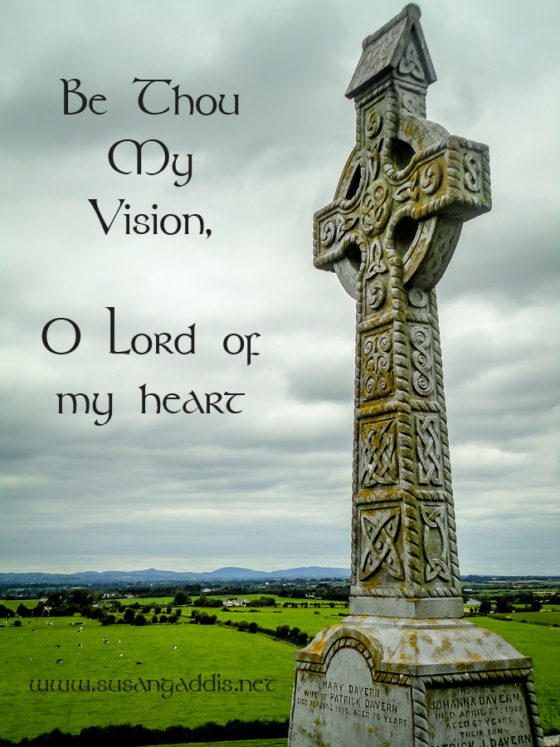
Translator: Mary E. Byrne Mary Elizabeth Byrne, M.A. (July 2, 1880 – January 19, 1931) was born in Ireland. She translated the Old Irish Hymn, “Bí Thusa ‘mo Shúile,” into English as “Be Thou My Vision” in Ériu (the journal of the School of Irish Learning), in 1905.
1 Be thou my vision, O Lord of my heart; naught be all else to me, save that thou art. Thou my best thought, by day or by night, waking or sleeping, thy presence my light. 2 Be thou my wisdom, be thou my true word; I ever with thee, and thou with me, Lord. Born of thy love, thy child may I be, thou in me dwelling and I one with thee. 3 Be thou my buckler, my sword for the fight. Be thou my dignity, thou my delight, thou my soul’s shelter, thou my high tow’r. Raise thou me heav’nward, O Pow’r of my pow’r. 4 Riches I heed not, nor vain empty praise; thou mine inheritance, now and always. Thou and thou only, first in my heart, Ruler of heaven, my treasure thou art. 5 “*True Light of heaven, when vict’ry is won may I reach heaven’s joys, O bright heav’n’s Sun! Heart of my heart, whatever befall, still be my vision, O Ruler of all. *Alternate phrase: “High King”
He is the radiance of the glory of God and the exact imprint of his nature, and he upholds the universe by the word of his power. After making purification for sins, he sat down at the right hand of the Majesty on high,
Who being the brightness . . .–Who being the effulgence of His glory and the exact image of His substance. The first figure is familiar to us in the words of the Nicene Creed (themselves derived from this verse and a commentary upon it), “God of God, Light of Light, Very God of Very God.” Again striking parallels to the language present themselves in Philo, who speaks of the spirit breathed into man at his creation as an “effulgence of the Blessed and Thrice-blessed Nature”; and in the well-known passage of the Book of Wisdom, “She (Wisdom) is the effulgence of the everlasting light, the unspotted mirror of the power of God, and the image of His goodness” (Wisdom Of Solomon 7:26). In the Old Testament the token of the divine presence is the Shechinah, the “cloud of glory” (called “the glory” in Romans 9:4; comp. Hebrews 9:5 in this Epistle); here it is the divine nature itself that is denoted by the “glory.” Of the relation between this word and that which follows (“substance”) it is difficult to speak, as the conceptions necessarily transcend human language; but we may perhaps say (remembering that all such terms are but figurative) that the latter word is internal and the former external,–the latter the essence in itself, the former its manifestation. Thus the “Son” in His relation to “God” is represented here by light beaming forth from light, and by exact impress–the perfect image produced by stamp or seal. These designations, relating to the essential nature of the Son, have no limitation to time; the participle “being” must be understood (comp. Philippians 2:6; John 1:1) of eternal, continuous existence. The word “person” is an unfortunate mistranslation in this place. Most of the earlier English versions have “substance,” person being first introduced in the Genevan Testament in deference to Beza. By the word.–The thought seems suggested by Genesis 1. (Psalm 33:9); the spoken word was the expression of His power. What is said above of “being” applies to “upholding,” except that the latter implies a previous creative act. . . .
but in these last days he has spoken to us by his Son, whom he appointed the heir of all things, through whom also he created the world.
Hath in these last days . . .–Better, at the end of these days spake unto us in a Son. The thought common to the two verses is “God hath spoken to man”; in all other respects the past and the present stand contrasted. The manifold successive partial disclosures of God’s will have given place to one revelation, complete and final; for He who spake in the prophets hath now spoken “in a Son.” The whole stress lies on these last words. The rendering “a Son” may at first cause surprise, but it is absolutely needed; not, “Who is the Revealer?” but, “What is He?” is the question answered in these words. The writer does not speak of a Son in the sense of one out of many; the very contrast with the prophets (who in the lower sense were amongst God’s sons) would be sufficient to prove this, but the words which follow, and the whole contents of this chapter, are designed to show the supreme dignity of Him who is God’s latest Representative on earth. The prophet’s commission extended no farther than the special message of his words and life; “a Son” spoke with His Father’s authority, with complete knowledge of His will and purpose. It is impossible to read these first lines (in which the whole argument of the Epistle is enfolded) without recalling the prologue of the fourth Gospel. The name “Word” is not mentioned here, and the highest level of St. John’s teaching is not reached; but the idea which “the Word” expresses, and the thought of the Only Begotten as declaring and interpreting the Father (John 1:18; also John 14:10; John 14:24) are present throughout. There is something unusual in the words, “at the end of these days.” St. Peter speaks of the manifestation of Christ “at the end of the times” (1Peter 1:20); and both in the Old Testament and in the New we not unfrequently read “at the end (or, in the last) of the days.” (See 2Peter 3:3; Jude 1:18; Numbers 24:14; Daniel 10:14, &c.) The peculiarity of the expression here lies in “these days.” The ages preceding and following the appearance of Messiah are in Jewish writers known as “this world” (or, age) and the “coming world” (or, age); the “days of Messiah” seem to have been classed sometimes with the former, sometimes with the latter period; but “the end of these days” would be understood by every Jewish reader to denote the time of His appearing. . . .
Pulpit Commentary Verse 2. – In these last days. The true reading being ἐπ ἐσχάτον τῶν ἡμερῶν τούτων, not ἐπ ἐσχάτων, as in the Textus Receptus, translate, at the end of these days’, The Received Text would, indeed, give the same meaning, the position of the article denoting’ “the last of these days,” not “these last days.” The reference appears to be to the common rabbinical division of time into αἰὼν οϋτος, and αἰὼν μέλλων, or ἐρχόμενος: the former denoting the pro-Messianic, the latter the Messianic period. Thus “these days” is equivalent to αἰὼν ου{τος, “the present age,” and the whole expression to ἐπὶ συντέλειᾳ τῶν αἰώνων, “at the end of the ages” (infra, Hebrews 9:26); cf. 1 Corinthians 10:11,” for our admonition, upon whom the ends of the ages are come.” The term, αἰὼν μέλλων, is also used in this Epistle (Hebrews 6:5); cf. Hebrews 2:5, τὴν οἰκουμένην τὴν μέλλουσαν. For allusions elsewhere to the two periods, cf. Matthew 12:32; Mark 10:30; Luke 18:30; Luke 20:35; Ephesians 1:21; Titus 2:12. Cf. also in Old Testament, Isaiah 9:6, where, for “Everlasting Father,” Cod. Alex. has πατὴρ τοῦ μελλόντος αἰῶνος. A subject of discussion has been the point of division between the two ages – whether the commencement of the Christian dispensation, ushered in by the exaltation of Christ, or his second advent. The conception in the Jewish mind, founded on Messianic prophecy, would, of course, be undefined. It would only be that the coming of the Messiah would inaugurate a new order of things. But how did the New Testament writers after Christ’s ascension conceive the two ages? Did they regard themselves as living at the end of the former age or at the beginning of the new one? The passage before us does not help to settle the question, nor does Hebrews 9:26; for the reference in both cases is to the historical manifestation of Christ before his ascension. But others of the passages cited above seem certainly to imply that “the coming age” was regarded as still future. It has been said, indeed, with regard to this apparent inference from some of them, that the writers were regarding their own age from the old Jewish standing-point when they spoke of it as future, or only used well-known phrases to denote the two ages, though they were no longer strictly applicable (see Alford’s note on Hebrews 2:5). But this explanation cannot well be made to apply to such passages as 1 Corinthians 10:11 and Ephesians 1:21, or to those in the Gospels. It would appear from them that it was not till the παρούσια (or, as it is designated in the pastoral Epistles, the ἐπιφάνεια) of Christ that “the coming age” of prophecy was regarded as destined to begin, ushering in “new heavens and a new earth, wherein dwelleth righteousness” (2 Peter 3:13). Still, though “that day” was in the future, the first coming of Christ had been, as it were, its dawn, signifying its approach and preparing believers for meeting it. “The darkness was passing away; the true light was already shining” (1 John 2:8). Hence the apostolic writers sometimes speak as if already in the “coming age;” as being already citizens of heaven (Philippians 3:20); as already “made to sit with Christ in the heavenly places” (Ephesians 2:6); having already “tasted the powers of the age to come” (Hebrews 6:5). In a certain sense they felt themselves in the new order of things, though, strictly speaking, they still regarded their own age as but the end of the old one, irradiated by the light of the new. To understand fully their language on the subject, we should remember that they supposed the second advent to be more imminent than it was. St. Paul, at one time certainly, thought that it might be before his own death (2 Corinthians 5:4; 1 Thessalonians 4:15). Thus they might naturally speak of their own time as the conclusion of the former age, though regarding the second advent as the commencement of the new one. But the prolongation of “the end of these days,” unforeseen by them, does not affect the essence of their teaching on the subject. In the Divine counsels “one day is as a thousand years, and a thousand years as one day.” Hath spoken unto us (more properly, spake to us) in his Son. “His” is here properly supplied to give the meaning of ἐν υἱῷ. The rendering, a SON, which seems to have the advantage of literalism, would be misleading if it suggested the idea of one among many sons, or a son in the same sense in which others are sons. For though the designation, “son of God,” is undoubtedly used in subordinate senses – applied e.g. to Adam, to angels, to good men, to Christians – yet what follows in the Epistle fixes its peculiar meaning here. The entire drift of the earlier part of the Epistle is to show that the idea involved in the word “Son,” as applied to the Messiah in prophecy, is that of a relation to God far above that of the angels or of Moses, and altogether unique in its character. This idea must have been in the writer’s mind when he selected the phrases of his exordium. Nor is the article required for the sense intended. Its omission, in fact, brings it out. Ἐν τῷ υἱῷ would have drawn especial attention to “the personage in whom God spake; ἐν υἱῷ does so rather to the mode of the speaking – it is equivalent to “in one who was SON.” Son-revelation (as afterwards explained), is contrasted with previous prophetic revelations (cf. for omission of the article before υἱὸς, Hebrews 3:6; Hebrews 5:8; Hebrews 7:28). Whom he appointed (or, constituted) heir of all things; not, as in the A.V., “hath appointed.” The verb is in the aorist, and here the indefinite sense of the aorist should be preserved. “Convenienter statim sub Filii nomen memoratur haereditas” (Bengel). Two questions arise. (1) Was it in respect of his eternal Divinity, or of his manifestation in time, that the Son was appointed “Heir of all things?”
(2) When is God to be conceived as so appointing him? i.e. What is the time, if any, to be assigned to the indefinite aorist? In answer to question
(1) the second alternative is to be preferred. For
(a) his eternal pre-existence has not yet been touched upon: it is introduced, as it were parenthetically, in the next and following clauses.
(b) Though the term Son is legitimately used in theology to denote the eternal relation to the Father expressed by the Λόγος of St. John, yet its application in this Epistle and in the New Testament generally (excepting, perhaps, the μονογενὴς υἱὸς peculiar to St. John, on which see Bull, ‘Jud. Eccl. Cath.,’ 5:4, etc.), is to the Word made flesh, to the Son as manifested in the Christ. And hence it is to him as such that we may conclude the heirship to be here assigned.
(c) This is the view carried out in the sequel of the Epistle, where the SON is represented as attaining the universal dominion assigned to him after, and in consequence of, his human obedience. The conclusion of the exordium in itself expresses this; for it is not till after he had made purification of sins that he is said to have “sat down,” etc.; i.e. entered on his inheritance; having become (γένομενος not ω}ν) “so much better,” etc. This is the view of Chrysostom, Theodoret, and the Fathers generally (cf. the cognate passage, Philippians 2:9).
(2) It seems best to refer the aorist ἔθηκε, not to any definite time, as that of the prophetic utterances afterwards cited, or that of the actual exaltation of Christ, but indefinitely to the eternal counsels, which were indeed declared and fulfilled in time, but were themselves ἐνἀρχῇ. A similar use of the aorist, coupled with other aorists pointing to events in time, is found in Romans 8:29, 30. What this heirship of all things implies will appear in the sequel, By whom also he made the worlds. Interposed clause to complete the true conception of the SON; showing who and what he was originally and essentially through whom God “spake” in time, and who, as SON, inherited. Here certainly, and in the expressions which follow, we have the same doctrine as that of the Λόγος of St. John. And the testimony of the New Testament to the pre-existence and deity of Christ is the more striking from our finding the same essential idea under different forms of expression, and in writings differing so much from each other in character and style. He who appeared in the world as Christ is, in the first place, here said (as by St. John 1:3) to have been the Agent of creation; cf. Colossians 1:15-17, where the original creative agency of “the Son of his love” is emphatically set forth, as well as his being “the Head of the body, the Church.” This cognate passage is of weight against the view of interpreters who would take the one before us as referring to the initiation of the gospel ages; with respect to which view see also the quotation from Bull given below under ver. 3. Here τοὺς αἰῶνας is equivalent to “the worlds,” as in the A.V. For though the primary meaning of αἰών has reference to time – limited in periods, or unlimited in eternity – it is used to denote also the whole system of things called into being by the Creator in time and through which alone we are able to conceive time. “Οἱ αἰῶνες, saecula, pro rerum creatarum universitate est Hebraismus” (Bull); cf. Hebrews 11:3, καταρτίσθαι τοὺς αἰῶνας ῤήματι Θεοῦ: also 1 Corinthians 2:7, πρὸ τῶν αἰώνων: and 2 Timothy 1:9; Titus 1:2, πρὸ χρόνων αἰωνίων.
“God told me to tell you…” “I have a word from the Lord for you.” “I am a prophet of God.” “I know what the Bible says, but God spoke to me and…”
Claims like the above are increasingly common these days. Sadly, most people who say them do not understand how dangerous they are. Claiming direct revelation from God is essentially putting yourself in a place of equal authority with the Word of God. If God speaks, it is always going to be 100% inerrant, authoritative, true, holy, and perfect. If God truly told you to tell me something, I better listen or I am in direct rebellion against God.
The problem with this idea that God is directly speaking to people, and through people, today, is the fact that the messages attributed to Him are everything but inerrant, authoritative, and true. They are almost always a jumbled mess of confusion, inconsistencies, and outright contradictions of the Word of God. Far too often, “God told me…” is in reality, “I think…and I think God would agree with me…therefore, I am going to tell you that God told me…”
In response to this, many argue that God no longer speaks outside of His Word. Period. Never. The Bible is the complete and sufficient Word of God that gives us everything we need to be saved and walk with God (2 Timothy 3:16-17; Hebrews 4:12). Therefore, there is no need for any further revelation from God. God does not speak. Rather, God has spoken.
This is the viewpoint I was taught in Bible College and Seminary. This is still the viewpoint that I strongly lean towards. Admittedly, it is a very comforting position. It means I can ignore all the claimed messages from God. It frees me from having to use biblically informed discernment in separating truth from error in supposed messages from God. The problem for me is … I do not see solid biblical evidence on which to claim God NEVER speaks today.
Interestingly, even those who hold the “God never speaks” position seem to allow for exceptions to the rule. For example, stories of people in closed countries having dreams/visions that result in them coming to faith in Christ seem to be accepted, even rejoiced over. Accounts of people in third world countries being told to go to such and such a place at such and such a time to speak with God’s messenger, only to bump into a missionary at the exact place and time, are accepted as amazing miracles of God. The justification for the exception is usually something along the lines of, “Well, God only does stuff like that in places where they don’t have access to the Bible.”
Hmm. Where does the Bible say that God works differently based on whether a person has access to the Bible? And, the fact that the United States has tens of millions more Bibles than Yemen does not mean the average American is significantly more biblically literate than the average Yemeni. One could argue that with the massive amount of false doctrine being propagated in the United States that the United States is more in need of corrective direct revelation from God than most third world countries. I just don’t see a solid biblical or reasonable basis for the “God only does stuff like that over there” argument.
So, where does that leave us? To be honest, I am not completely sure.
I firmly believe that the Bible is the perfect and complete Word of God. It contains everything we need to know to follow God’s will for our lives. While it does not give specific instructions related to the personal situations and decisions we face, it does provide all the wisdom we need to be able to make right judgments in those situations and decisions.
With that in mind, I do not see any reason for God to “supplement” His Word with additional revelation. But, at the same time, there is nothing in the Bible that indicates God NEVER speaks today. I do not know the mind of God, and therefore I do not claim to know every reason why God might say something to someone (Isaiah 55:8-9; Romans 11:34).
What I do know is this: if God were to speak today, what He said would be in perfect agreement with His Word. God does not contradict Himself. God does not change His mind. Compare any supposed message from God with God’s Word, and if the message in any way is in contradiction or disharmony with God’s Word, reject the message. If you think God has spoken to you, but are unsure about it, ask Him for confirmation (Judges 6:36-40; 1 Samuel 3:1-10). Seek wise counsel from men and women of God whom you respect and trust (Proverbs 11:14; 15:22).
Above all, understand that God speaking is a miracle, not a normal. Even in the Bible, God speaking directly to people, whether through an audible voice or a “still small voice,” is rare. We would all benefit from spending far more time on what God has said instead of on what God might be saying.
This is my personal collection of thoughts and writings, mainly from much smarter people than I, which challenge me in my discipleship walk. Don't rush by these thoughts, but ponder them.


 Milo
Milo 