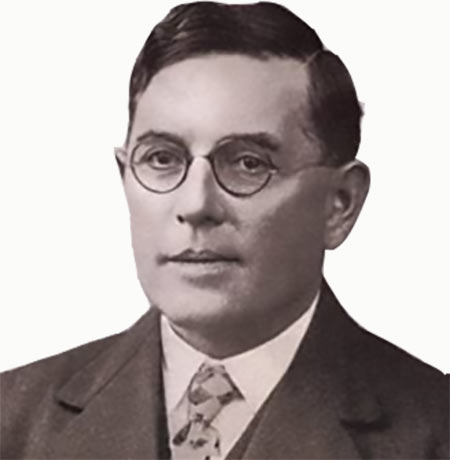
J. Edwin Orr

James Edwin Orr was born January 15, 1912, in Belfast, Ireland, to William Stewart and Rose (Wright) Orr. William Orr, who was a jeweler, had United States and British citizenship, so his children did as well. There were eventually to be five children born to William and Rose Orr, with one child dying in infancy (Louise at 3 years of age) and another as a young man (Alan at 25 years of age). The day January 15 would become even more meaningful than simply a birthday in the life of J. Edwin Orr; on that day he was born, converted, married, ordained, and became a chaplain in the U.S. Air Force.

At the age of nine, J. Edwin Orr became a Christian through his mother’s influence but his faith was not very active as yet. In 1922, his father and baby sister died and the family began to suffer from difficult economic circumstances. Orr enrolled in the College of Technology, Belfast, and eventually passed University of London Matriculation exams in five subjects. But the illness and then death of older brother Alan made him the family breadwinner. He worked as a clerk in a bakery for the next few years.

Orr and a friend began to feel a strong call to evangelize in 1930 or 1931 and began to hold open air meetings in the streets of Belfast. In 1932, he was involved with a city-wide evangelistic effort organized by Christian Endeavor. This increased his desire to preach and lead people to Christ. By late 1933 he felt God wanted him to be an itinerant evangelist. Despite skepticism and discouragement from family and friends, he set out from Belfast in September to follow this call. He went to London and gradually began making contacts with Christian leaders as he spoke in various churches. With London as his base, he preached throughout the British isles for the next two years. Then he began to travel farther to preach. In the first part of 1935 he traveled to Norway, Sweden, Denmark, Finland, the Soviet Union, Estonia, Poland, Lithuania, Germany, Switzerland, France, Holland, and Belgium. Then a few weeks later, after a return to London, he traveled through Hungary, Turkey, Greece, Palestine, Italy, Spain, France, and Portugal.

In September of the same year he sailed for Canada. He began preaching when he arrived in Newfoundland and continued in Ontario at the Peoples Church in Toronto and then in Winnipeg. He went on to Saskatoon and British Columbia. Then he began an evangelistic tour of the United States that involved visiting all forty eight states in the next three months, including preaching at Moody Church at the invitation of H. A. Ironside. In February of 1936, he held meetings at Wheaton College in Illinois.

He continued his whirlwind progress in 1936 by going to New Zealand and Australia and then on to South Africa and Rhodesia. In October, he returned to London and planned take a rest. He traveled with Stanley Donnan and Evan John to Norway. After speaking in Oslo, he left his friends and went north to Narvik, seeking quiet. But Christian leaders in that city asked Orr to lead meetings there as well. Eventually he did manage to get some time to himself and decided to ask Ivy Muriel Carol Carlson, a young woman he had met very briefly in South Africa, to marry him. He telegraphed her and set out for South Africa. After a quick courtship, they were married on January 15, 1937. At his wedding reception, Orr gave an evangelistic invitation and counseled inquirers. The couple then returned to London, where Orr spoke at meetings commemorating the centennial of evangelist Dwight L. Moody’s meetings in that city. The couple eventually had four children: Eileen Muriel, who lived three months and died in 1938; Carolyn Astrid born in Toronto in 1939 (later Mrs. Larry D. Booth); Alan Bertran born in Chicago in 1942; and David Arundel born in Oxford in 1946.

Besides his travels, Orr had been busy turning out autobiographical volumes relating his experiences around the world and describing the Christian life. Among some of these early titles were Can God-? (1934), This Promise Is to You (1935), Times of Refreshing (1936), Prove Me Now (1936), This is the Victory (1936), All Your Need (1936), If Ye Abide (1936), Such Things Happen (1937), and The Church Must First Repent (1937). He also edited some books by Andrew Gih in the late 1930’s.

In 1938 Orr formed the Revival Fellowship Team of young preachers such as Stanley Donnan, Brinley Evans, and Andrew Gih and led them in a series of mass evangelistic campaigns in Ulster and Australia. Then he and Gih made an evangelistic tour of the portions of China not occupied by the Japanese. They also made a film of the tour. Most of 1939 was spent raising funds for war relief for Chinese orphans. He continued to write, publishing Telling Australia and Through Blood and Fire in China, both in 1939.

In late 1939 Orr and his wife traveled to Canada, where he served briefly as associate pastor of the Peoples Church. He decided that he needed further education and began studying at Northwestern University in Chicago. On January 15, 1940, he was ordained in the Emmanuel Baptist Church in Newark, New Jersey. He continued to preach and write, making a tour of the West Indies and Central America in 1940 and publishing Always Abounding. He got his M.A. from Northwestern in 1942, the same year his mother died in Ulster. Toward the end of the year, he enlisted in United States armed forces and went to attend chaplain’s school on the campus of Harvard University. The following year, he got his Th.D. from Northern Baptist Seminary in Chicago and began his service as an air force chaplain.

He saw extensive service during the war, serving with the 13th Air Force in Bismark Archipelago, New Guinea, and being involved in campaigns in Borneo, the south Philippines, Luzon, and China. He earned seven battle stars and finished with the rank of major. He wrote about his military experience in I Saw No Tears (1948).

When he was discharged in 1946, he hitchhiked across Korea, China, and India to Cairo and then to Durban, South Africa, where he rested two months with his family. He then sent his family to England by troopship and traveled through the Congo to West Africa. From Dakar he crossed the Sahara and traveled on to England. He picked up his education again and was at Oxford from 1946 to 1948, doing resident study for his doctorate, which he received in the latter year. His dissertation was published in 1949 under the title The Second Evangelical Awakening in Britain. The year 1952 saw the publication of The Second Great Awakening in America. Later he received a D.D. in African History from the University of South Africa (1969), a Th.D. from Serampore University (1970), and a Ed.D. from Th.D. from the University of California, Los Angeles (1971).

In 1949 he established a permanent residence in southern California and began a series of speaking tours and evangelistic meetings on college and university campuses. First he preached across the United States and then, from 1949-1951, in Australia, Great Britain, Canada, New Zealand, and South Africa. He made a brief visit to Brazil in 1951. The response caused him to be invited back for a full scale campaign in cities throughout the country. There followed meetings in South Africa (1953) and India (1954). He and Mrs. Orr led a team evangelistic effort in Australia and New Zealand from 1956 to 1957. Other members of the team included Mr. and Mrs. Robert B. Doing, Mr. and Mrs. Max H. Bushby, Rev. and Mrs. William Dunlap, and Corrie ten Boom. The following year, Orr again held meetings in India. Other countries where major meetings were held in the next few years included Great Britain in 1961, where he spoke with young theological students about spiritual renewal; Norway, Sweden and Denmark in 1962; university meetings in the United States in 1962 and 1963.

In 1966, Orr became a professor at Fuller Seminary’s School of World Mission, a position he held until 1981. Besides his teaching and writing, he greatly stimulated the study and understanding of revivals and evangelism through his founding in 1974 and continuing leadership of the Oxford Reading and Research Conference on Evangelical Awakenings. This conference of scholars met every summer to hear and present papers on revivals. His own writing continued unabated.

Besides his writing, teaching, and preaching, Dr. Orr had great impact on evangelicals around the world through his friendship with other leading Christians. He was an advisor of Billy Graham’s from the start of that evangelist’s career, a friend of Abraham Vereide and helped shape the prayer breakfast movement that grew out of Vereide’s International Christian Leadership, and he was a important leader in Andrew Gih’s Evangelize China Fellowship.

Dr. Orr suffered from heart trouble in his later years, and died the morning after presenting a lecture at a conference in 1987.

https://jedwinorr.com/

Nicholson, William Patteson

True passionate preaching is the flower and fruit of passionate praying. The fiery preaching that transforms the Church and the market place is first kindled in the secret place. This truth is powerfully illustrated through the life of W. P. Nicholson. In the early 1920’s, Northern Ireland passed through a period of great strife and bloodshed. These were times of great despair and apprehension. Fear gripped the heart of many and even spread to the churches and religious community. “In the mercy of God, an intervention came from an unexpected source. There began a series of evangelistic campaigns, which in the course of the following years had a profound effect upon the religious and communal life of the Province.” The evangelist used of God during these meetings was W. P. Nicholson. He was a fearless individual, peculiar to some and offensive to others. Nicholson didn’t care what others thought of his manner of speech or methods. He had been taught by God Himself in the secret place and as a result was quite unique in his preaching and dealings with men. To be all-out for the Kingdom of God and it’s interests was his passion. Burning zeal was the chief characteristic of Nicholson’s whole life and ministry.

He wielded the Sword of the Spirit
Nicholson used to say that when a mission was begun it was not long before they had either a riot or revival. Sometimes we had more riot than revival, but never a revival without a riot.
“Nicholson used to say that when a mission was begun it was not long before they had either a riot or revival. Sometimes we had more riot than revival, but never a revival without a riot.” Nicholson wielded the Sword of the Spirit with a fury. His hearers were always affected one way or another. Some through his preaching were brought to humble repentance, while others resisted God’s Word with indignation.

Two favorite themes of Nicholson were “God’s love” and “God’s hell.” W. P. Nicholson always preached the love of God with all the warmth and tenderness he could muster; but for those who rejected this Good News, he offered the only alternative, GOD’S HELL. He preached on every aspect of hell with such zeal and passion that his hearers claimed to be able to almost smell the burning sulphur. Still others, under deep conviction and anxiety, dripped with sweat and unconsciously shredded the hymn books they held in their laps.

Through this kind of fervent preaching, God brought entire communities face to face with the question, “What shall I do with Jesus?” One elderly man who had recollections of the Ulster Revival of 1859 said that some of the effects of Nicholson’s meetings even exceeded what happened in ‘59. Another commentator on Nicholson’s work said that he had seen nothing like it since the days of D. L. Moody.

He was a man of deep prayer
Apart from prayer such revival power is unattainable. Mr. Nicholson was always a man of deep prayer. “Prayer might be called his habit, for he loved to pray. His campaigns had nights and half nights of prayer. Praying in the Spirit kept him in the spirit of prayer. From the prayer closet he mounted the pulpit – endued.” Mr. Lindsay Glegg wrote of W. P. Nicholson, “The secret of his power was no doubt in his prayer life. He stayed at our home . . . and he was up in the morning at six o’clock but he never appeared until twelve noon; he spent the hours wrestling with God in prayer. By his own special request he was not disturbed by telephone or visitor, however urgent.” On another occasion the sheets of his bed were found to be torn to shreds. Mr. Glegg again commented; “What had happened was that he unconsciously, agonizing in prayer had ripped the sheets into strips . . .” Yes, prayer was surely the secret of his powerful life and ministry.

Perhaps the sweetest fruit of Nicholson’s prayer life was the deep

I do not know anyone in the world that I know better than the Lord. I do not know my wife or my mother the way I know the Lord. I do not know the best friends I ever had the way I know the Lord. We walk together, my Lord and I, because we are in fellowship, and there is nothing that I have but is Hisfamiliarity that was produced between himself and the person of Christ. In Nicholson’s book, On Towards the Goal, he writes, “I do not know anyone in the world that I know better than the Lord. I do not know my wife or my mother the way I know the Lord. I do not know the best friends I ever had the way I know the Lord. We walk together, my Lord and I, because we are in fellowship, and there is nothing that I have but is His.” Truly this is the essence and heart of revival, an intimate visitation and fellowship with Jesus Christ. Lord, will You not revive us again, that Your people may rejoice and delight in You? (Psa. 85:6).
References Used: All for Jesus – The Life of W. P. Nicholson by Stanley Barnes, W. P. Nicholson Flame for God in Ulster by S. W. Murray, God’s Hell by W. P. Nicholson

© David Smithers

William P. Nicholson

Nicholson, William Patteson (1876–1959), evangelist, was born on 3 April 1876 in Cottown near Bangor, Co. Down, one among seven children of Capt. John G. Nicholson, merchant seaman, and his wife Ellen (née Campbell). The family was devoutly presbyterian; two sisters and a brother became missionaries. Nicholson was brought up in Belfast and educated at Fisherwick presbyterian school and the Model School on the Falls Road. He went to sea aged sixteen, spending four years on the barque Galgorm Castle. He reacted against his upbringing and lived a life of drunkenness and debauchery, but remained haunted by fears for his salvation. His unease intensified when he left ship at Cape Town and worked as a miner and railway builder in the Kalahari Desert, seeing associates die of blackwater fever.

Nicholson returned to Bangor in May 1899. On 22 May he was ‘born again’. For seven months Nicholson remained haunted by timidity and spiritual emptiness. Then he came under the influence of the Rev. J. Stuart Holden, who taught ‘holiness doctrine’ (that after conversion believers should experience a second spiritual transformation, ‘receiving the Holy Ghost’). Nicholson felt God wanted him to proclaim faith; he joined the weekly Salvation Army procession, an object of widespread ridicule. He always thanked God this cured him of respectability.

Nicholson became a railway clerk and lay evangelist. In December 1901 he entered the Bible Training Institute, Glasgow (inspired by the revivalist missions of Dwight W. Moody). After graduation in 1903 Nicholson became an evangelist with the Lanarkshire Christian Union, preaching to working-class audiences. Here he perfected his brash, uncompromising, humorous oratory and his techniques of self-advertisement. In 1907 Nicholson married Ellison D. Marshall of Bellshill, Lanarkshire, a gospel worker. They had two daughters and a son. In 1907 he preached in London, subsequently travelling to Australia and America with the Chapman/Alexander mission.

On 14 April Nicholson was ordained by the Carlisle (USA) presbytery of the United Presbyterian Church. This was undertaken to bolster his credentials as a travelling evangelist rather than from strong denominational attachment. His missions were interdenominational, linked to all the principal protestant churches. Nicholson believed those dissatisfied with their church should derive extracurricular sustenance from orthodox evangelists rather than seceding. He later acted as pastor in a Christian and Missionary Alliance Church without formally abandoning presbyterianism. In 1918 he was recruited by the fundamentalist Los Angeles Bible Mission as an evangelist for its extension programme. Thereafter Nicholson’s principal residence was in California, although he resigned from the Institute in 1924; as in unregenerate days, he felt he was born to wander and could not settle in one place. (His son later worked with the Mission, retiring in 1967.) In October 1920 Nicholson revisited Bangor during a mission in Scotland. His preaching aroused mass enthusiasm reminiscent of the 1859 revival. He returned in January 1921; a series of missions across Northern Ireland produced thousands of converts. Nicholson preached a hellfire gospel, denouncing alcohol, tobacco, cinema, cosmetics, ‘long-haired men and short-haired women’. His provocative language and showmanship resembled a particularly outrageous stand-up comedian.

Nicholson was unusually effective in appealing to working-class men (he also addressed women who ‘manicure your nails on the washboard’). Churches filled to twice their capacity, apparently irrecoverable debts were paid, crowds of shipyard workers went across Belfast (even outside it) to hear him. Responses were intensified by contemporary political instability, bloodshed, and turmoil. Nicholson’s 1920 Shankill Road mission was conducted to the sound of gunfire; his early 1923 missions in east Belfast allegedly reduced sectarian violence. He returned to California in June 1923. Even critics noted a sustained rise in communicants. ‘He is filled with vulgarity and with Holy Spirit’, commented one clergyman, ‘and how a man can be filled with both at the same time I do not know.’

In 1924–6 Nicholson gave another series of missions in Ulster (he also spoke in Dublin). These proved extremely divisive. Nicholson provoked criticism in some church circles by his vulgar humour and uncompromising language. He retorted that the mission did well when publicans and Pharisees attacked it; T. C. Hammond (qv) commented that if Nicholson was vulgar, so were Isaiah and Elijah. Nicholson attacked theological modernism as believable only by ‘fools and theological professors . . . calling Mary a Jewish prostitute and Jesus a bastard’. This provoked fundamentalist–modernist controversy within the Irish presbyterian church; several Nicholson associates accused Professor J. E. Davey (qv) of heresy. Davey’s acquittal led to the secession of the Irish Evangelical (later Evangelical Presbyterian) Church, while the fundamentalist Bible Standards League campaigned within the church throughout the interwar period.

Ellison Nicholson died in 1926 during a mission in Australia. In 1927 Nicholson married Fanny Elizabeth Collett, a nursing matron. He continued to travel the English-speaking world as a preacher. He gave further missions in Northern Ireland in 1928, 1936, 1937, and 1946. His last series of Northern Ireland missions (1958) was a self-conscious farewell tour. He had developed a heart condition in the 1920s; by 1958 his health was so weak he was warned against preaching. In autumn 1959, while the Nicholsons were returning from America to retirement in Bangor, he suffered a heart attack and was put ashore at Cork. W. P. Nicholson died 29 October 1959 in the Victoria Hospital, Cork, and is buried in Clandeboye cemetery, Bangor.

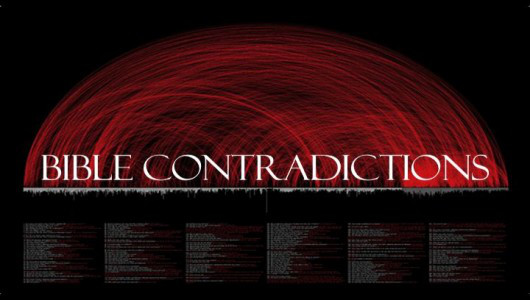
Contradictions ?

Who incited David to count the fighting men of Israel?

a) God did (2 Samuel 24:1)
b) Satan did (1 Chronicles 21:1)

We learn in other places in the Bible that God intends to work good things in the same situation where Satan (or man) is working to produce something bad.

Joseph told his brothers:

“You intended to harm me, but God intended it for good to accomplish what is now being done, the saving of many lives.”

Genesis 50:20
Likewise, when Jesus was crucified, Satan meant it for the destruction of the Son of God, (John 13:2, 1 Cor 2:8) but God ordained it to redeem mankind by the death of his son.(Acts 2:14-39)

Solution: Both God and Satan incited David to count the fighting men of Israel.

God did it to humble David and make him better. Satan did it to destroy David

How old was Ahaziah when he began to rule over Jerusalem?

a) Twenty two (2 Kings 8:26)

b) Forty two (2 Chronicles 22:2)

This is clearly a copyist error. If Ahaziah were 42, he would have been older than his own father.

A copyist error is not a contradiction. And we have lots of handwritten copies of Old Testament books and New Testament books.

How long did he (Jehoiachin) rule over Jerusalem?

a) Three months (2 Kings 24:8)

b) Three months and 10 days (2 Chronicles 36:9)

Three months and 10 days is approximately three months.

Note: the author of 2 Kings didn’t say “exactly” three months.

If you just turned 21 four months ago, do you say “I’m 21 years, four months?” You probably just say “I’m 21.”

One author decided to be more precise than the other. That’s all.

You have two slightly different viewpoints from two different authors.

Bible critics -when two books of the Bible agree completely- like to claim one author copied the other.

Here the two authors have a slightly different viewpoint and they claim a contradiction.

Some people are determined to disagree no matter what.

The chief of the mighty men of David lifted up his spear and killed how many men at one time?

a) Eight hundred (2 Samuel 23:8)

b) Three hundred (1 Chronicles 11:11)

Both are correct. Yes. Both 800 and 300 are correct.
But how?

A careful reading shows that there is approximately a 30-year difference between the two claims.

These are two different chiefs at two different times. The chief in 1 Chronicles 11:11 is Jashobeam -a Hacmonite.

He raised his spear against 300 men at the beginning of David’s reign.

The other chief was Josheb-Basshebeth, a Tahkemonite.

He raised his spear against 800 men and his exploits are recorded after the Last Words of David just a few verses earlier in the same chapter.

One is near the beginning of David’s reign. The other is near the end of David’s reign.

And these men have two different names and come from two different families.

At the end of David’s reign he was an old man -and in no shape to fight. So his chief from 30 years prior would -by that time- have been replaced by a younger warrior.

When I say “a careful reading” all I mean is any reasonable person can simply read the passages and immediately come to the conclusion it is two different people.

This doesn’t require an advanced degree. No special Biblical knowledge needed.

You don’t have to have a degree in Biblical Hebrew.

An elementary school-aged child can read the passage and easily come to the correct conclusion.

The contradictionists embarrass themselves again and again.

When did David bring the Ark of the Covenant to Jerusalem? Before defeating the Philistines or after?

a) After (2 Samuel 5 and 6)

b) Before (1 Chronicles 13 and 14)

This is one of those places where it’s really awkward to be a contradictionist.

It’s one of those “contradictions” that makes you wonder if these guys even bothered to read the Bible before they came up with this stuff.

It’s downright painful to watch them do this to themselves.

Let’s take a look at these passages and see if they really contradict.

When reading 2 Samuel 5 and 6, it’s completely clear and straightforward that David brings the Ark of the Covenant to Jerusalem AFTER defeating the Philistines.

Now let’s look at 1 Chronicles 13 and 14.

David begins bringing the Ark to Jerusalem, but only gets as far as the threshing floor of Kidon after the tragic death of Uzzah.

David leaves the Ark there, and AFTER he defeats the Philistines, he then brings the ark to Jerusalem.

The contradictionists are sloppy and factually wrong. You wonder if they even read the whole passage.

How many pairs of clean animals did God tell Noah to take into the Ark?

a) Two. (Genesis 6:19, 20)

b) Seven (Genesis 7:2) But despite this last instruction only two pairs went into the ark.

Once again, contradictionist sloppiness abounds.

Genesis 6:19-20 refers to 2 of every animal. It never mentions the clean animals, so it’s obviously just about the unclean animals.

When we turn over to Genesis 7:2, we see God’s instruction to Noah to bring in 7 pairs of clean animals:

“Take with you seven pairs of all clean animals, the male and his mate, and a pair of the animals that are not clean, the male and his mate.” Genesis 7:2, ESV

How much clearer can it get than this? The passage clearly says 7 pairs of clean animals and “a pair” (one pair) of unclean animals.

Contradictionists commit another awkward blunder.

The Bible clearly tells them, but they can’t even tell the difference between clean and not clean when it’s right under their nose.

Is this an innocent error? Or something else?

When it’s this easy to see through it, you’ve just got to wonder.

Answering Biblical Contradictions

I was looking to answer some questions on another site where people were asking about religion and stuff. This person supplied a list of so-called “contradictions” in the Bible that someone listed. I told them not to take things out of context but Id like details. Can you help answer them?

Thanks!

Exodus 32:14 says “the Lord repented of the evil which he thought to do” VS. Numbers 23:19 says God does not repent. >>
Matthew 7:21 Jesus says not everyone that calls the name of the Lord shall be saved VS. Acts 2:21 Paul says whosoever shall call on the name of the Lord shall be saved.>>
Matthew 15:4 Jesus says, “Honour thy father and mother…” VS. Luke 14:26 Jesus says, “If any man come to me, and hate not his father and mother…he cannot be my disciple.”>>
Matthew 26:27-28 – “…Drink ye all of it, For this is my blood…” vs. Deuteronomy 12:16 – “Ye shall not eat the blood.” Symbolically disobeying god. Jesus being the sacrifice and thou shalt not drink the blood of the sacrifice.>>
Mark 15:25 Jesus was crucified at the third hour VS. John 19:14-15 says the sixth hour.>>
Mark 15:40 says Mary was afar off beholding the crucifixion VS. John 19:25 says she stood at the cross.>>
John 13:38 “the rooster shall not crow till thou hast denied me three times.” VS. Mark 14:68 Says the rooster crowed after the first denial.>>
Acts 9:7 VS. Acts 22:9 VS. Acts 26:14
Paul of Tarsus lies each time he tells the story of meeting Jesus on the road to Damascus. Paul, a liar, wrote over half of the New Testament. The Apostles considered his preachings falsehood.>>
Cicely.

Hi Cicely,

Thank you for writing. Many times you will see some detractor bring out a list of so-called contradictions such as these. There are many online and some are quite long. All go to great lengths to try and prove that the Bible is filled with errors. However, if one is looking at these passages objectively, you will find it is the list maker who is being dishonest in his approach. That’s because they have chosen to ignore the context in which the statement.

You see, context is really the thing that determines what the speaker is trying to convey for any passage. If I were to say “I missed my family today” you may assume that I meant I felt a longing to be with my family when I couldn’t. However, if I put the sentence in this context: “I missed my family. It looks like they left five minutes before I arrived.” then the meaning of the statement changes dramatically. Finally, if the context is “We had a great time at the picnic. I hit all my friends with water balloons. I missed my family.” then we have another meaning.

Let’s extend this idea to two statements. If I were to tell a co-worker on Monday “I had some good family time at the picnic”, then later tell someone else “I missed my family” you might think this is a contradiction, but since the context for the second sentence may be understood in a different manner, you can quickly see that the contradiction doesn’t exist.

Most of the contrasting verses you have listed fall into this type of an error. The critic has taken only a simplistic approach to the statements made and ignored the larger context in which they are given. They therefore seem like a contradiction but this is really not so. With this in mind, let’s take a look at each of the statements below:

Exodus 32:14 vs. Numbers 23:19 – Does God Repent?
Exodus 32:14 says “the Lord repented of the evil which he thought to do” VS. Numbers 23:19 says God does not repent.

God is supposed to be all good and all knowing, so why would such a God change His mind or repent of something He has decided to do? This is the challenge offered above. Actually, Numbers 23:19 is describing this very aspect of God. God, speaking through Balaam, explains His nature to the pagan king Balak and says, “God is not a man, that he should lie, Neither the son of man, that he should repent: Hath he said, and will he not do it? Or hath he spoken, and will he not make it good?”

However, Exodus 32:14 is a completely different context. God is speaking with Moses and telling him that the children of Israel are sinning and their sins are putting them in danger of being judged. God then says “Let Me alone, that My anger may burn against them and that I may destroy them; and I will make of you a great nation.” Now, God had previously promised that He would deliver the nation of Israel out of the bondage of Egypt and into the Promised Land. Notice how He says “Let me alone.” This was a test for Moses. God wanted to see if Moses would intercede for the people and provide a way of escape for them. Moses did as he should have and God didn’t destroy Israel.

In writing this incident, Moses chose to use dramatic language to reflect the seriousness of the situation. By saying “God changed His mind” or “God repented”, Moses employs what is known as an anthropomorphism – ascribing human qualities to God – to make his point. God promised that He would deliver Israel and He did. The “changing of mind” wasn’t a change at all – God made good on his promise.

Matthew 7:21 vs. Acts 2:21 – Calling on the Name of the Lord
Matthew 7:21 Jesus says not everyone that calls the name of the Lord shall be saved VS. Acts 2:21 Paul says whosoever shall call on the name of the Lord shall be saved.

Again in these passages, context means a lot. In the book of Acts, Peter is speaking before a crowd in Jerusalem, challenging them to believe in Jesus since they have been witness to the events of His crucifixion and resurrection. He quotes a passage from the prophet Joel, and tells the crowd that all they need to do is truly believe in Jesus as Messiah and they will be saved.

The context of Matthew 7 is dramatically different, though. Jesus starts off that passage by saying “Beware of false prophets, who come to you in sheep’s clothing, but inwardly are ravenous wolves.” He then goes on to talk about how to discern a true believer from a pretender by examining their fruit. That’s what leads up to the statement saying ‘Not everyone who says to me ‘Lord, Lord’ will enter the kingdom of heaven.” The difference is simply one of true belief versus pretense. I think we can safely assume that Peter meant you must call on the name of the Lord sincerely to be saved.

Matthew 15:4 vs. Luke 14:26 – Honoring Your Parents
Matthew 15:4 Jesus says, “Honour thy father and mother…” VS. Luke 14:26 Jesus says, “If any man come to me, and hate not his father and mother…he cannot be my disciple.”

One must remember when reading the Scriptures that to take passages in an ultimate, wooden way is detrimental. One must surely honor his mother and father; however, what should you do if your father ort mother asked you to kill? Would you be disobeying God if you disobeyed them?

The general admonition to honor your mother and father is a good one. In Luke 14:26, Jesus is laying out the marks of a true follower. He uses a common bond, the love for your parents as a point of comparison. He says that to be a true disciple it requires total devotion. You cannot be more devoted to you parents than to God. Indeed, in my example above, one should obey the laws of God that say “do not murder” above the commands of your parents. Jesus is saying that those who follow Him should love Him so much, the love for their parents seems trivial in comparison.

Matthew 26:27-28 vs. Deuteronomy 12:16 – Disobeying God through Communion
Matthew 26:27-28 – “…Drink ye all of it, For this is my blood…” vs. Deuteronomy 12:16 – “Ye shall not eat the blood.”

This one is a bit of a stretch, since one passage is dealing with actual behavior, but the other is symbolic. One is an admonition for the nation of Israel under the old covenant against the real drinking of blood. Many times, drinking of blood was tied to pagan worship and the nation of Israel was to be separate people. Blood also held contaminants and you could get diseases from such an action. However, the symbolic drinking of the Lord’s blood holds a different idea – it is not to consume the spirit of the animal and therefore absorb that animal’s strength, but to rely wholly on Jesus’ sacrifice for us.

To assume that the injunction to not drink actual blood is somehow violated by taking of communion wine that symbolizes the blood of Jesus is stretching things a bit far. Even in the early Christian church, there was a strong debate about whether people should be forbidden to drink real blood and it was held as the standard for Christians at the same time as they celebrated communion (see Acts 15:20, 29; Acts 21:25).

The silliness of this objection is apparent when we look at other symbolic references. For example, Jesus taught that if your right eye offends you, you should cut it out. Now, it is widely understood that actually losing an eye won’t keep you from sinning at all, since you still have another to look at things. In these days, the right-hand side would be symbolic of the bet or the most powerful you had. So, when Jesus says “if your right eye offends you, cut it out”, His audience would have understood that He meant if the best things you have cause you to fall into sin, it’s better to forego them than to continue disobeying God. Similarly, the communion cup is a symbolic gesture that isn’t meant to be taken literally.

Mark 15:25 vs. John 19:14-15 – The Time of the Crucifixion
Mark 15:25 Jesus was crucified at the third hour VS. John 19:14-15 says the sixth hour.

Mark figures the time by Jewish reckoning, where the day would start at sundown and be broken into segments. We still see this today as observant Jews start their observance of the Sabbath at sundown. This would make the third hour to be about noon.

The Romans reckoned their time differently and their segments were longer. Ancient Roman sundials show that the daylight hours were divided into twelve equal segments, or hours. However, there were only two major segments, daytime and nighttime, with the hours beginning at sunrise and counted until sunset. Therefore, this makes the sixth hour in Roman time also about noon. John’s audience was the Gentile church, so John uses Roman time throughout His Gospel.

Mark 15:40 vs. John 19:25 – Mary’s position at the cross
Mark 15:40 says Mary was afar off beholding the crucifixion VS. John 19:25 says she stood at the cross.

Since the entire time of Jesus’ hanging on the cross was three hours, it’s highly likely that both statements are true. This discrepancy can be easily understood by thinking about the vantage point of the witnesses. The women and John could have stood farther away as the Romans actually performed the crucifixion, then drew closer to Jesus after He had been hanging on the cross a while. When the soldiers returned to break the legs of each, they would have withdrawn again. This is not only plausible, but reads quite naturally and would be what you would expect given the fear the Jews would have of the Romans at the time.

John 13:38 vs.. Mark 14:68 – The timing of Peter’s Denial
John 13:38 “the rooster shall not crow till thou hast denied me three times.” VS. Mark 14:68 Says the rooster crowed after the first denial.

Tradition holds that Mark received much of his gospel accounts from Peter, so it’s no surprise that Mark would have a detail about this incident that the others miss. In Mark’s gospel Jesus tells Peter “Before a rooster crows twice, you will deny me three times.” Peter’s first denial came before the first crow and his third denial came after the second.

However, to think that this is a mistake is still not accurate. Eric Lyons at Apologetics Press gives a good analogy of a family attending a football game. The parents make plans to meet their son outside the gate “after the buzzer sounds”. Now, in football, there are four buzzers, one for each quarter. However we would understand intuitively that the parents meant after the “last buzzer” sounds. The passage above is similar. In the ancient world, many held that a rooster would crow first at about midnight or one AM, but this was an insignificant action. The crowing that everyone focused on was the crowing near daybreak – which would be the second crowing. So, Mark simply gives us more detail than Matthew, but the end result is the same.

Acts 9:7 vs. Acts 22:9 vs. Acts 26:14 – Paul’s legitimacy as a witness
Paul of Tarsus lies each time he tells the story of meeting Jesus on the road to Damascus. Paul, a liar, wrote over half of the New Testament. The Apostles considered his preachings falsehood.

I would challenge this claim made outright. To call Paul a liar and to say “The Apostles considered his preachings (sic) falsehood” flies in the face of everything we know about the early church. In fact, Peter calls Paul’s New Testament writings Scripture and puts them on par with the Old Testament scriptures (see 2 Peter 3:15-16). Where does the accuser get the idea that Paul was rejected? This type of objection requires proof before it can be taken seriously. Since Paul’s letters are the earliest manuscripts we have of New Testament documents, since we know that the early church copies and circulated them along with other Scriptures, and since we have the writings of the early church fathers quoting from Paul as authoritative there is no evidence that the apostles or the early church felt his teaching was false.

I have said that context is a very good way of determining the meaning of the passages written. I believe the last statement made by this person who put forth these so-called contradictions is telling. He seems to have an axe to grind against the Bible and simply asserts certain passages to be contradictory without even a fair reading of the passages in question. He offers no historical context for any of them and he ends his list with a vitriolic assertion against Paul. That tells me much. It seems this is a very childish way to treat any text and is inherently unfair, whether the text is Christian, Muslim, or another faith.

I pray that this discussion has helped you to read the Bible in a more mature fashion. If you diligently seek Him, He will be found.

Stephen Boyd Blog

Belfast-born Hollywood and International Star from 1950-1970's Fan Tribute Page

Abundant Joy

Digging Deep Into The Word

Not My Life

The Bible as clear as possible

Seek Grow Love

Growing Throughout the Year

Smoodock's Blog

Question Authority

PleaseGrace

A bit on daily needs and provisions

Three Strands Lutheran Parish

"A cord of three strands is not easily broken." Ecclesiastes 4:12

1love1god.com

Romans 5:8

The Rev. Jimmy Abbott

read, watch, listen

BEARING CHRIST CRUCIFIED AND RISEN

To know Christ and Him crucified

Considering the Bible

Scripture Musings

rolliwrites.wordpress.com/

The Official Home of Rolli - Author, Cartoonist and Songwriter

Pure Glory

The heavens are telling the glory of God; and the firmament proclaims His handiwork. Psalms 19:1

The daily addict

The daily life of an addict in recovery

The Christian Tech-Nerd

-Reviews, Advice & News For All Things Tech and Gadget Related-

Thinking Through Scripture

to help you walk with Jesus in faith, hope, and love.

A disciple's study

This is my personal collection of thoughts and writings, mainly from much smarter people than I, which challenge me in my discipleship walk. Don't rush by these thoughts, but ponder them.

Author Scott Austin Tirrell

Maker of fine handcrafted novels!

In Pursuit of My First Love

Returning to the First Love