
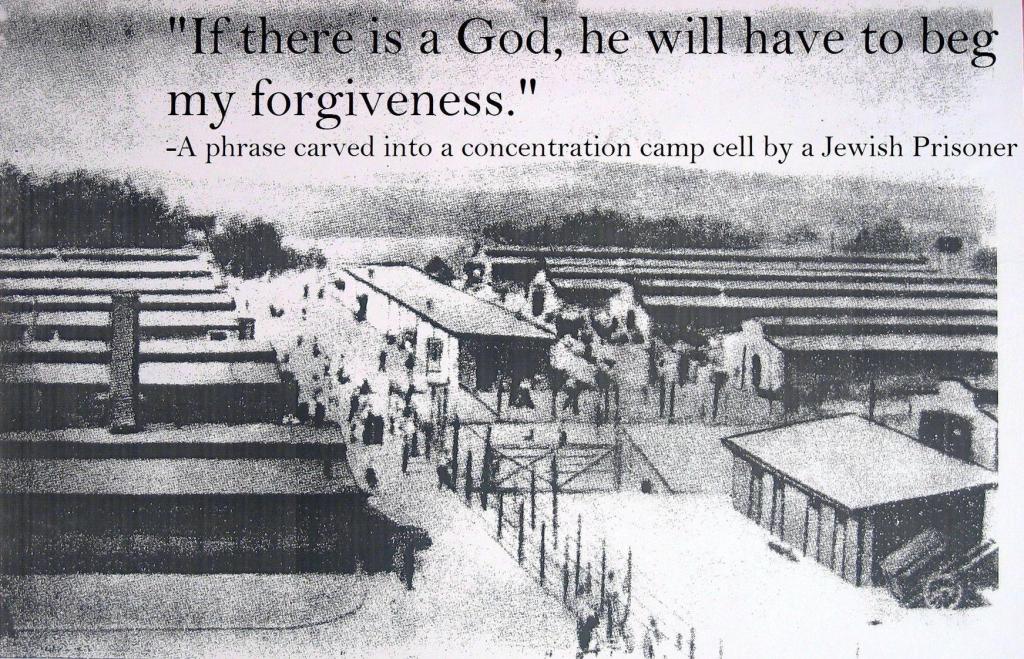
What was God’s role in Auschwitz?

A question often prohibited, but always asked

Otto Dov Kulka’s writing considers how religious belief can exist in a world with no future. His answer comes in the form of a dream

‘Implicit in Otto Dov Kulka’s writing is the very disturbing question of whether he could have felt the safety he did in this sky without the yearning to escape from the horror that surrounded him below.’

One part of the immense distance that separates Gentiles from the Jewish experience of Auschwitz is the role of God there. Of course many atheists and many Christians died there, along with people who had believed in humanity and in the future. But there is a peculiar quality of claustrophobic horror in Jewish reflections on the matter, for they are the chosen people whose whole history is of wrangling with God; yet an omnipotent God singled them out for this dreadful fate. If we disregard the frankly disgusting suggestion that they deserved it, there is no explanation possible and certainly not one that does not sound glib. Yet that does not stop the conversation.

Otto Dov Kulka approaches this in two ways. The first is so indirect as to leave almost no traces. He talks about beauty: the most beautiful and innocent experience of his childhood, he says, was watching the skies of southern Poland where “silver-coloured toy aeroplanes carrying greetings from distant worlds pass slowly across the azure skies while around them explode what look like white bubbles. The aeroplanes pass by and the skies remain blue and lovely, and far off, far off on that clear summer day, distant blue hills as though not of this world make their presence felt.”

Yet these were seen from inside the camp. “I took in nothing but that beauty and those colours, and so they have remained imprinted in my memory. This contrast is an integral element of the black columns that are swallowed up in the crematoria, the barbed-wire fences that are stretched tight all around by the concrete pillars. But in that experience all this seemingly did not exist, only in the background and not consciously.”

Implicit in this is the very disturbing question of whether he could have felt the safety he did in this sky without the yearning to escape from the horror that surrounded him below.

This sense of almost entering something just out of reach seems a central religious experience. It is connected with George Santayana‘s claim that “another world to live in – whether we expect ever to pass wholly over into it or no – is what we mean by having a religion.”

Against that, Kulka stresses over and over again the inescapable, totalitarian quality of Auschwitz. It was a world in which the future was completely absent, where any other world became impossible. That is one of the things that he means by “the immutable law of the Great Death”.

So religious belief, or even religious experience, becomes impossible in a way that is more profound than even the obvious and overwhelming fact of the suffering of innocents in the extermination camps. Where was God there? Because the question is unanswerable, some religious authorities pronounce it is forbidden to ask it: Kulka quotes two people saying that, one of them who was actually in the camp as a Sonderkommando, whose reply was: “It is forbidden to ask that question, those questions, there, and unto eternity.” It will be seen that this isn’t an answer.

The answer Kulka offers is a dream he had more than 50 years after the event, when Israel was braced for a chemical attack in the Gulf war. He dreamed then he was inside crematorium number 2, and there was God, also: “At first I felt Him (only) as a kind of mysterious radiation of pain, flowing at me from the dark void in the unlit part of the cremation ovens. A radiation of insupportably intense pain, sharp and dull alike. Afterwards He began to take the shape of a kind of huge embryo, shrunk with pain … He was alive, shrunken, hunched forward with searing pain … a figure on the scale of His creatures, in the form of a human being who came and was there … as a response to ‘the question they were forbidden to ask there’, but was asked and floated in that dark air.”

Even more than most dreams, this cannot have its meaning pinned down. It works like the Gate of the Law in the Kafka story: it is open for everyone but individual to each of us. The atheist might see in it that God is no more than the quintessence of humanity. It is not one answer but many, none of them sufficient. All it unarguably shows is that the question of God keeps being asked, no matter how often it is prohibited.

Amazing Grace: 366 Hymn Stories

February 6
THE LOVE OF GOD
Words and Music by Frederick M. Lehman, 1868–1953
The Lord your God is with you, He is mighty to save. He will take great delight in you, He will quiet you with His love, He will rejoice over you with singing. (Zephaniah 3:17)
Never has God’s eternal love been described more vividly than in the words of this greatly loved hymn: “measureless,” “strong,” “evermore endure … ”
The unusual third stanza of the hymn was a small part of an ancient lengthy poem composed in 1096 by a Jewish songwriter, Rabbi Mayer, in Worms, Germany. The poem, entitled “Hadamut,” was written in the Arabic language. The lines were found one day in revised form on the walls of a patient’s room in an insane asylum after the patient’s death. The opinion has since been that the unknown patient, during times of sanity, adapted from the Jewish poem what is now the third verse of “The Love of God.”
The words of this third stanza were quoted one day at a Nazarene campmeeting. In the meeting was Frederick M. Lehman, a Nazarene pastor, who described his reaction:
The profound depths of the lines moved us to preserve the words for future generations. Not until we had come to California did this urge find fulfillment, and that at a time when circumstances forced us to hard manual labor. One day, during short intervals of inattention to our work, we picked up a scrap of paper and added the first two stanzas and chorus to the existing third verse lines.
Pastor Lehman completed the hymn in 1917. His daughter Claudia (Mrs. W. W. Mays) assisted him with the music.
The love of God is greater far than tongue or pen can ever tell,
It goes beyond the highest star and reaches to the lowest hell,
The guilty pair, bowed down with care, God gave His Son to win:
His erring child He reconciled and pardoned from his sin.
When years of time shall pass away and earthly thrones and kingdoms fall,
When men, who here refuse to pray, on rocks and hills and mountains call,
God’s love so sure shall still endure, all measureless and strong:
Redeeming grace to Adam’s race—the saints’ and angels’ song.
Could we with ink the ocean fill and were the skies of parchment made,
Were ev’ry stalk on earth a quill and ev’ry man a scribe by trade
To write the love of God above would drain the ocean dry,
Nor could the scroll contain the whole tho stretched from sky to sky.
Chorus: O love of God, how rich and pure! How measureless and strong! It shall forevermore endure—the saints’ and angels’ song.


For Today:

John 15:9; Ephesians 3:1, 19; 1 John 3:1; Revelation 1:5, 6


Consciously try to personalize and experience the truth of this hymn in every situation that comes your way. Carry this musical message with you realizing that—

Amazing Grace: 366 Hymn Stories

February 5
IMMORTAL LOVE–FOREVER FULL
John Greenleaf Whittier, 1807–1892
To know this love that surpasses knowledge—that you may be filled to the measure of all the fullness of God. (Ephesians 3:19)
Love is Silence—when your words would hurt.
Love is Patience—when your neighbor’s curt.
Love is Deafness—when a scandal flows.
Love is Thoughtfulness—for others’ woes.
Love is Promptness—when stern duty calls.
Love is Courage—when misfortune falls.
—Unknown
The Bible teaches that the three cardinal virtues of the Christian life are faith, hope, love, with love as the greatest (1 Corinthians 13:13). These virtues in a person’s life are the most convincing evidences of a personal relationship with Christ. True faith must always lead to a life of love for God and others. It also gives purpose for this life and the glorious hope of spending eternity with our King of Love. Our love relationship with others should be characterized as sacrificial, sensitive, and sharing. We should relate to people even as Jesus did. He loved individuals simply for themselves and met and accepted them at the place of their personal need.
In 1867 John Greenleaf Whittier, a Quaker and recognized as one of America’s finest poets, wrote a 38 stanza poem titled “Our Master.” This hymn text with its emphasis upon the constancy of God’s immortal love was taken from that poem. It was Whittier who once stated “a good hymn is the best use to which poetry can be directed.” The musical setting by William V. Wallace, a Scottish violinist and composer, was adapted from a longer love song, “Waft, Ye Winds,” written by Wallace in 1856.
Immortal Love—forever full, forever flowing free, forever shared, forever whole, a never ebbing sea!
We may not climb the heav’nly steeps to bring the Lord Christ down; in vain we search the lowest deeps, for Him no depths can drown.
But warm, sweet, tender, even yet a present help is He; and faith has still its Olivet, and love its Galilee.
The healing of His seamless dress is by our beads of pain; we touch Him in life’s throng and press, and we are whole again.
Thru Him the first fond prayers are said our lips of childhood frame; the last low whispers of our dead are burdened with His name.
O Lord and Master of us all, whate’er our name or sign, we own Thy sway, we hear Thy call, we test our lives by Thine!


For Today:

Psalm 139; Jeremiah 31:3; Romans 8:38, 39; 1 John 4:19


Reflect on the constancy of our Lord’s immortal love as you meditate on this thoughtful hymn text.

Amazing Grace: 366 Hymn Stories

February 4
LOVE DIVINE, ALL LOVES EXCELLING
Charles Wesley, 1707–1788
This is how God showed His love among us: He sent His one and only Son into the world that we might live through Him. (1 John 4:9)
We must never underestimate the power of love in our human relationships—whether marriages, family, business associations, or friendships. The divine love of God for man far excels all other forms of love.
“Love Divine … ” is another of the more than 6500 hymns by Charles Wesley, the “sweet bard of Methodism.” This fine text —written in 1747—touches various elements of Christian doctrine. It extols the love of God as expressed in the incarnation of Christ. Then it refers to the Wesleyan concept of entire sanctification—that any believer might live without consciously sinning and thereby find the promised “rest” mentioned in Hebrews 4:9. The “Alpha and Omega” of verse two (first and last letters of the Greek alphabet) also reflect this Wesleyan teaching, that the experiences of conversion and sanctification are thought of as the “beginning of faith” and the “end or object of faith.” The third stanza emphasizes the truth that the Spirit of God indwells the temple or body of each believer, while the fourth stanza anticipates the glorious culmination of our faith when “we cast our crowns before Thee, lost in wonder, love and praise.”
Although Christians may have differences of interpretation regarding the doctrine of sanctification, we can agree on this basic truth: It ought to be a normal desire for each believer to grow in the grace of our Lord.
Love divine, all loves excelling, joy of heav’n, to earth come down; fix in us Thy humble dwelling; all Thy faithful mercies crown. Jesus, Thou art all compassion; pure, unbounded love Thou art; visit us with Thy salvation; enter ev’ry trembling heart.
Breathe, O breathe Thy loving Spirit into ev’ry troubled breast! Let us all in Thee inherit; let us find that second rest. Take away our bent to sinning, Alpha and Omega be; end of faith, as its beginning, set our hearts at liberty.
Come, almighty to deliver, let us all Thy life receive; suddenly return, and never, nevermore Thy temples leave. Thee we would be always blessing, serve Thee as Thy hosts above, pray and praise Thee without ceasing, glory in Thy perfect love.
Finish then Thy new creation; pure and spotless let us be; let us see Thy great salvation perfectly restored in Thee. Changed from glory into glory, till in heav’n we take our place, till we cast our crowns before Thee, lost in wonder, love and praise.


For Today:

John 3:14–21; Philippians 1:6; Colossians 1:28; 1 John 3:11–24


God’s love must dominate our hearts, minds, and wills. Pray that this will become increasingly true in your life. Carry this portion of the hymn with you—

Amazing Grace: 366 Hymn Stories

February 3
O THE DEEP, DEEP LOVE OF JESUS
S. Trevor Francis, 1834–1925
I pray that you, being rooted and established in love, may have power, with all the saints, to grasp how wide and long and high and deep is the love of Christ. (Ephesians 3:17, 18)
Who can fully grasp the dimensions of God’s great love for us? Yet the Scriptures teach that we are to have a growing awareness of divine love. Love is the very heart and essence of God, not only for the lovely but for the vilest of sinners. Christ did not die merely to display God’s love—He died because God is love (1 John 4:8). If the New Testament teaches us anything, it teaches us about God’s love in searching for lost men. Becoming a Christian in a very real sense is simply putting ourselves in the way of being found by God—to stop running from His loving pursuit.
As we mature in the Christian faith, we begin to realize that every situation that comes our way is an opportunity for God’s love to be made more evident in our lives. Once we realize this, our attitude changes dramatically toward suffering people as well as toward ourselves when we are called to suffer. Then even during those times when our spiritual fervor declines and our devotion to God subsides, despite these shortcomings, God’s love remains unfailing—continually working for our eternal good.
The author of this text, S. Trevor Francis, was a prominent lay leader with the Plymouth Brethren in England and was known as an effective devotional speaker throughout Great Britain and around the world.
O the deep, deep love of Jesus—vast, unmeasured, boundless free! Rolling as a mighty ocean in its fullness over me, underneath me, all around me, is the current of Thy love—leading onward, leading homeward, to my glorious rest above.
O the deep, deep love of Jesus—spread His praise from shore to shore! How He loveth, ever loveth, changeth never, nevermore. How He watches o’er His loved ones, died to call them all His own; how for them He intercedeth, watcheth o’er them from the throne.
O the deep, deep love of Jesus, love of ev’ry love the best! ’Tis an ocean vast of blessing; ’tis a haven sweet of rest. O the deep, deep love of Jesus—’tis a heav’n of heav’ns to me; and it lifts me up to glory, for it lifts me up to Thee.


For Today:

Romans 5:8; 8:35–39; Ephesians 3:14–20; 1 John 4:8; Revelation 1:5, 6


Ask God to enlarge your understanding of His great love and the ability to share it with others. Reflect on this musical truth—

Stephen Boyd Blog

Belfast-born Hollywood and International Star from 1950-1970's Fan Tribute Page

Abundant Joy

Digging Deep Into The Word

Not My Life

The Bible as clear as possible

Seek Grow Love

Growing Throughout the Year

Smoodock's Blog

Question Authority

PleaseGrace

A bit on daily needs and provisions

Three Strands Lutheran Parish

"A cord of three strands is not easily broken." Ecclesiastes 4:12

1love1god.com

Romans 5:8

The Rev. Jimmy Abbott

read, watch, listen

BEARING CHRIST CRUCIFIED AND RISEN

To know Christ and Him crucified

Considering the Bible

Scripture Musings

rolliwrites.wordpress.com/

The Official Home of Rolli - Author, Cartoonist and Songwriter

Pure Glory

The heavens are telling the glory of God; and the firmament proclaims His handiwork. Psalms 19:1

The daily addict

The daily life of an addict in recovery

The Christian Tech-Nerd

-Reviews, Advice & News For All Things Tech and Gadget Related-

Thinking Through Scripture

to help you walk with Jesus in faith, hope, and love.

A disciple's study

This is my personal collection of thoughts and writings, mainly from much smarter people than I, which challenge me in my discipleship walk. Don't rush by these thoughts, but ponder them.

Author Scott Austin Tirrell

Maker of fine handcrafted novels!

In Pursuit of My First Love

Returning to the First Love