‘And the Spirit and the bride say, Come. And let him that heareth say, Come. And let him that is athirst come. And whosoever will, let him take the water of life freely.’ Revelation 22:17 SUGGESTED FURTHER READING: 1 Chronicles 29:10–20
The church militant: the church on earth. Though they have not yet fully attained, yet they have known enough of the Lord to invite others to taste and see. And this is the desire of every gracious heart, that many may partake of the same grace. The world unjustly calls them uncharitable. None are or can be truly charitable but they. Their eyes are spared to see sin and its consequences and when they get a little hope for themselves, they soon look round and think, O that my parents, children, friends and neighbours might know it too. How do they pity sinners. And when the Lord comforts them they long to tell. Nay, they cannot wholly keep silence, though they often get little thanks for their pains. And indeed this is their duty, for so it is said. Let him that heareth say, Come. This, however, means the understanding ear—so the word signifies, as in John 6:60 [This is an hard saying; who can hear it?]. Those who know not for themselves, cannot recommend it to others. We are sure, however, they will not. Perhaps there are some now hearing, who, instead of joining with the Spirit and bride, fight against them and say, ‘Keep away.’ You come perhaps to listen if you can find something amiss, or to misrepresent, that you may confirm others in their prejudices against the truth. You may jest at what you hear now, but you will not jest in the day when God shall require your soul.
FOR MEDITATION: But you that hear and understand, remember you are bid to repeat the invitation and say, Come. Has the Lord opened eyes and cast out the evil spirits? Go then, and upon every fair occasion be ready to commend him to others—and especially seek out and comfort afflicted souls.
Where are wars, and where are fightings among you? As James says from within us our fallen human natures. The fruit of the flesh as opposite the fruit of the Holy Spirit
Demons are fallen angels, as Revelation 12:9 indicates: “The great dragon was hurled down—that ancient serpent called the devil, or Satan, who leads the whole world astray. He was hurled to the earth, and his angels with him.” Satan’s fall from heaven is symbolically described in Isaiah 14:12–15 and Ezekiel 28:12–15. When he fell, Satan took some of the angels with him—one third of them, according to Revelation 12:4. Jude 6 also mentions angels who sinned. So, biblically, demons are fallen angels who, along with Satan, chose to rebel against God.
Some of the demons are already locked “in darkness, bound with everlasting chains” (Jude 1:6) for their sin. Others are free to roam and are referred to as “the powers of this dark world and . . . the spiritual forces of evil in the heavenly realms” in Ephesians 6:12 (cf. Colossians 2:15). The demons still follow Satan as their leader and do battle with the holy angels in an attempt to thwart God’s plan and hinder God’s people (Daniel 10:13).
Demons, as spirit beings, have the ability to take possession of a physical body. Demonic possession occurs when a person’s body is completely controlled by a demon. This cannot happen to a child of God, since the Holy Spirit resides in the heart of the believer in Christ (1 John 4:4).
Jesus, during His earthly ministry, encountered many demons. Of course, none of them were a match for the power of Christ: “Many who were demon-possessed were brought to him, and he drove out the spirits with a word” (Matthew 8:16). Jesus’ authority over the demons was one of the proofs that He was indeed the Son of God (Luke 11:20). The demons who encountered Jesus knew who He was, and they feared Him: “‘What do you want with us, Son of God?’ [the demons] shouted. ‘Have you come here to torture us before the appointed time?’” (Matthew 8:29). The demons know their end will be one of torment.
Satan and his demons now look to destroy the work of God and deceive anyone they can (1 Peter 5:8; 2 Corinthians 11:14–15). The demons are described as evil spirits (Matthew 10:1), unclean spirits (Mark 1:27), lying spirits (1 Kings 22:23), and angels of Satan (Revelation 12:9). Satan and his demons deceive the world (2 Corinthians 4:4), promulgate false doctrine (1 Timothy 4:1), attack Christians (2 Corinthians 12:7; 1 Peter 5:8), and combat the holy angels (Revelation 12:4–9).
The demons/fallen angels are enemies of God, but they are defeated enemies. Christ has “disarmed the powers and authorities,” and He has “made a public spectacle of them, triumphing over them by the cross” (Colossians 2:15). As we submit to God and resist the devil, we have nothing to fear. “The one who is in you is greater than the one who is in the world” (1 John 4:4).
That there is a struggle, a “battle of life,” must be assumed at once by all who look at the world as it is; the question is whether it is against flesh and blood, or against a more unearthly power of evil.
Against the rulers . . .—“Principalities” and “powers” describe simply angelic powers, whether of good or evil. But in the following clauses St. Paul defines them as powers of evil, and appears to indicate two different aspects of this evil power. The original phrase is striking and powerful, “against the world-rulers of this darkness, against the spiritual powers of wickedness in the heavenly places.”
“spiritual hosts” of wickedness; and the phrase “in the heavenly places,” corresponding to “the power of the air” in Ephesians 2:2
The spiritual hosts of evil are described as fighting in the region above the earth.
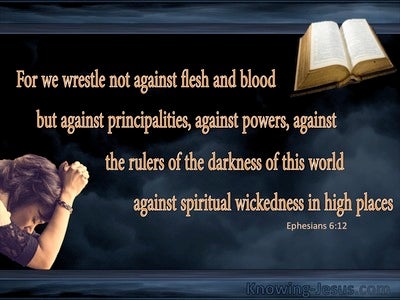
Ephesians 6:12. For we wrestle not — Greek, ουκ εστιν ημιν η παλη, our struggle is not; against flesh and blood — Not merely against human adversaries, however powerful, subtle, and cruel, nor against fleshly appetites; but against principalities, against powers — The mighty princes of all the infernal legions: and great is their power, and that likewise of the legions which they command. Against the rulers of the darkness of this world — Greek, προς τους κοσμοκρατορας του σκοτους, του αιωνος τουτου, against the rulers of the world, of the darkness of this age. Dr. Whitby explains this of “those evil spirits that ruled in the heathen nations which were yet in darkness,” and of “those that had their stations in the region of the air.” “Perhaps,” says Mr. Wesley, “these principalities and powers” (spoken of in the former clause) “remain mostly in the citadel of the kingdom of darkness; but there are other evil spirits who range abroad, to whom the provinces of the world are committed.” By the darkness of this age, that spiritual darkness is intended, which prevails during the present state of things. “Evil spirits,” Macknight thinks, “are called rulers of this world, because the dominion which, by the permission of God, they exercise, is limited to the darkness of this world; that is, this world darkened by ignorance, wickedness, and misery, and which is the habitation or prison assigned them, until the judgment of the great day, Jude, Ephesians 6:6.” Against spiritual wickedness — Or rather, wicked spirits, as the Syriac translates the expression. The word πονηρια, rendered wickedness, properly signifies malice joined with cunning, and is fitly mentioned as the characteristic of those wicked spirits with whom we are at war; and it is a quality so much the more dangerous, in that it exists in beings whose natural faculties are very great. And it must be observed, that they continually oppose faith, love, holiness, either by force or fraud, and labour to infuse unbelief, pride, idolatry, malice, envy, anger, hatred. In high places — Greek, εν τοις επουρανιοις, in, or about, heavenly places. Those who translate it in the former way, think the expression refers to those places where they rebelled against the God of heaven, and drew in multitudes who were before holy and happy spirits, to take part with them in their impious revolt. But it seems more probable the sense is, about heavenly places; namely, the places which were once the abodes of those spirits, and which they still aspire to, as far as they are permitted; labouring at the same time to prevent our obtaining them.
But against principalities – There can be no doubt whatever that the apostle alludes here to evil spirits. Like good angels, they were regarded as divided into ranks and orders, and were supposed to be under the control of one mighty leader; see the notes on Ephesians 1:21. It is probable that the allusion here is to the ranks and orders which they sustained before their fall, something like which they may still retain. The word “principalities” refers to principal rulers, or chieftains.
“Against the world rulers of this (present) darkness”
On Satan and his demons being “world rulers
Though they be “world rulers,” they are not the ruler of the universe; and their usurped rule of the world is soon to cease, when He shall “come whose right it is” (Eze 21:27).
for we have not the wrestling with feeble men, but we have to contend with the diabolic powers.
The word familiar is from the Latin familiaris, meaning a “household servant,” and is intended to express the idea that sorcerers had spirits as their servants ready to obey their commands. Those attempting to contact the dead, even to this day, usually have some sort of spirit guide who communicates with them. These are familiar spirits.
Leviticus 19:31; 20:6, 27; and Deuteronomy 18:9-14 refer to “mediums and familiar spirits” and forbids being involved with them, as they are an abomination to the Lord. A medium is one who acts as a liaison to supposedly contact or communicate with the dead on behalf of the living. In reality mediums are contacting demons who convince the mediums that they are “familiar” and can be trusted and believed. The practices associated with mediums and familiar spirits were banned in Israel, and the punishment for practicing such things was death.
Familiar spirits and spirit guides are under the control of their master, Satan. They influence people to spread lies and deceit in order to thwart the kingdom of God. To knowingly open oneself to the work of demons is an evil thing: “Let no one be found among you who sacrifices his son or daughter in [a] fire, who practices divination or sorcery, interprets omens, engages in witchcraft, or casts spells, or who is a medium or spiritist or who consults the dead. Anyone who does these things is detestable to the LORD” (Deuteronomy 18:10-12a).
Some avenues through which demons or “familiar spirits” can gain entrance into a person’s life are divination, transcendental meditation, visualization, necromancy, witchcraft, drugs, and alcohol. These are all activities that believers are exhorted to avoid, or in the case of alcohol, limit. Instead, we are to be filled with the Holy Spirit, with love, with joy, and with the fullness of life that comes from Jesus Christ. We are also to be on guard, “for our struggle is not against flesh and blood, but against the rulers, against the authorities, against the powers of this dark world and against the spiritual forces of evil in the heavenly realms” (Ephesians 6:12).
This is my personal collection of thoughts and writings, mainly from much smarter people than I, which challenge me in my discipleship walk. Don't rush by these thoughts, but ponder them.